







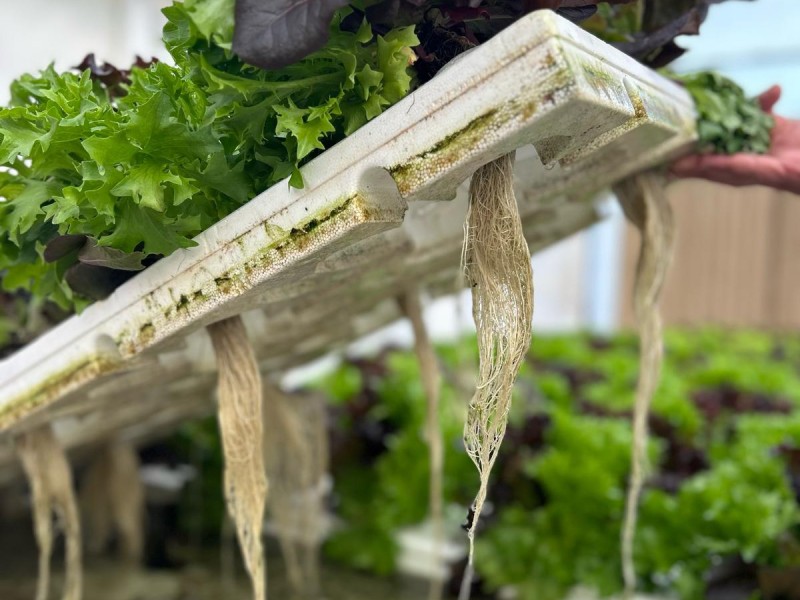
Can you imagine a greenhouse capable of producing year-round, on the same footprint, achieving up to 13 harvest cycles while significantly reducing reliance on external climate conditions?
That model exists — and it is called hydroponics.
Today, hydroponics is a dominant system in countries such as Malaysia, where virtually 100% of lettuce is grown hydroponically, and South Africa, where it accounts for around 80% of production. The United States is one of the fastest-growing markets for hydroponic cultivation. In contrast, Spain still has a relatively limited share.
“There is increasing interest, especially for producing specialties — differentiated products that allow growers to move away from low-priced commodity markets,” explains José Luis Saiz, Global Key Account Manager for lettuce at Rijk Zwaan.
Attracting investment funds
The expansion of hydroponic production is attracting investors from sectors unrelated to traditional agriculture. Many of these business profiles analyse the profitability of the model and conclude that conventional soil-based farming — with high investments in machinery, large land areas and greater labour needs — is less attractive compared to intensive greenhouse systems.
The main competitive advantage of hydroponics lies in productivity efficiency. On a limited surface, production can be multiplied twelve, thirteen or even fourteen times compared to conventional open-field farming. This intensification reduces the need to acquire large land areas — one of the primary barriers to entry in traditional agriculture.
The model also facilitates proximity to consumption centres. In the United States, where lettuce has traditionally been produced in California due to favourable climate conditions, greenhouses are now emerging within one hour of major cities such as New York, Atlanta and Chicago. The goal is to shorten logistics chains and produce closer to end markets.
Following an initial wave of investment led by funds and entrepreneurs without prior ties to agriculture, major agri-food companies are now also positioning themselves in the hydroponic segment, responding to the model’s growth.
In Spain, examples such as the brand Gota Viva illustrate this trend. Its founder, originally from the industrial sector, invested in a greenhouse in Santander to produce living lettuce under this system, confirming hydroponics as an attractive and innovative investment alternative within horticulture.
Living lettuce and specialties for fresh cut
During its Winter Open Field Days, Rijk Zwaan showcased a hydroponic greenhouse featuring a wide range of varieties adapted to Mediterranean conditions and specifically developed for hydroponic systems. These included living lettuce varieties such as Salanova® and Salatrio, Crystal-type lettuces and new applications of the Teenleaf™ concept for fresh-cut production.
One of the most successful concepts is Salatrio — a mix of three lettuces sown together and bred to grow uniformly, giving the appearance of a single plant.
“They are very popular in Central European countries, especially Germany, and also in the Netherlands, Belgium and Austria. They are sold in supermarkets with roots attached, in bags containing water,” explains Saiz.
Consumers take them home with the feeling of participating in the ‘harvest’ and enjoying maximum freshness when preparing their salad. “It fits into the convenience segment because it’s easy to prepare, but at the same time it offers an experiential component — the idea that I finish harvesting it myself. It has experienced enormous growth largely for this reason.”
RELATED NEWS: Rijk Zwaan secures lettuce production
At the demonstration greenhouse, this concept was presented both in a Floating Root System — a structure similar to a ‘pool’ where plants grow under controlled conditions — and in a channel-based system.
As Saiz explained, hydroponic systems can be classified into three categories: low-, mid- and high-tech. The Rijk Zwaan demonstration greenhouse represents mid-tech. “High-tech systems include artificial lighting, which is not economically viable in Spain due to high natural light levels.”
Water efficiency and climate control
Operating in controlled environments, hydroponic systems are characterised by greater efficiency in water, fertiliser and resource use.
Climate uncertainty and pest pressure are among the major vulnerabilities of modern agriculture. Increasingly erratic weather patterns — prolonged storm systems or summers that have virtually erased spring and autumn — extend periods of extreme temperatures and encourage pest proliferation.
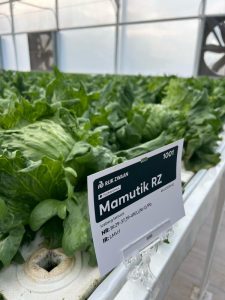 “Often the limiting factor is climate, which forces you to protect lettuce crops. Once protected, and if you want to produce year-round, you need to implement climate control systems. Ultimately, hydroponics is the most efficient system when making that investment. For example, with iceberg lettuce you can achieve seven or eight cycles per year on the same surface. With other types, such as Salatrio, you can reach 12 or 13 harvests.”
Breeding specialised for hydroponics
Depending on location, climatic conditions determine whether artificial lighting is required. This factor directly impacts breeding strategies.
“That already differentiates varieties. Some perform well under artificial lighting; others do not. Even if you can adjust the light spectrum, plants are intelligent enough to detect that it’s not natural sunlight — and they do not respond in exactly the same way.”
In Malaysia, for example, monsoon seasons can last up to six months, with very limited sunlight and continuous rainfall. In such contexts, developing varieties capable of tolerating low light intensity is essential.
Worker optimisation and comfort
Another advantage of hydroponics is ease of harvesting. Crops are grown on elevated supports, and some systems allow for simple mechanisation, such as floating platforms or cable-driven systems.
“Workers sit at one end and pull the modules along while harvesting.”
Working in a closed environment with controlled temperatures also improves labour conditions — an important factor in addressing workforce challenges.
Challenges and opportunities in Spain
Spain is Europe’s largest lettuce producer. Given the scale of the crop and existing infrastructure and logistics (machinery, supply chains), transitioning to hydroponics may initially appear as an additional investment.
However, José Luis Saiz maintains that the model is profitable.
“In open-field production you might achieve two lettuce cycles per year, or one and a half. Here, we’re talking about six or eight cycles without moving from the same location. There is, of course, an upfront investment, but profitability is achieved much sooner than many might expect.”