










Early clementines from Huelva have faced one of their most difficult seasons, oranges have moved at an unprecedentedly slow pace, and competition from South Africa has worsened the situation — a trend that will intensify from next year when entry tariffs disappear.
The company is facing an especially complicated campaign, conditioned by the shortest citrus harvest in the last 16 years, the massive presence of South African fruit in key market weeks and very high farm-gate prices. “We have low consumption, South African oranges and growers demanding high prices. The perfect storm,” summarises the SAT Síntesis director, José Rodríguez, during the interview.
Early clementines
The season began with serious difficulties for early Huelva varieties. The main reason was slow ripening caused by an extremely prolonged summer, which delayed the natural colouring of the fruit. In addition, the market was saturated with South African mandarins, leaving early varieties without their traditional commercial window.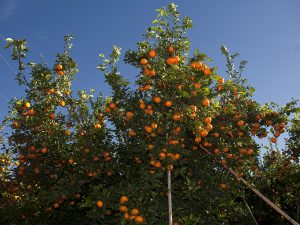
“The only ones that had a chance were those with leaves, and if they don’t colour, the fruit cannot be degreened. Everything has been extremely slow,” explains the manager. The situation is so critical that a large share of early varieties is ending up in the processing industry.
Oranges: internal maturity and poor colouring
The outlook for oranges has been similar. Navelinas show advanced internal maturity, but with skin colour that “was still lagging behind”. The lack of cold throughout most of the autumn in Europe — only reversed in recent weeks with the arrival of the first Arctic cold fronts — kept consumption very low both on the continent and in Spain.
This weak demand coincides with an especially short season: “It is the smallest harvest in the last 16 years,” stresses the executive. “Every week that passes is one less week of sales we have left,” he insists. And in varieties like Navelina, the window is extremely limited.
The South Africa tariff
One of the most critical issues for the immediate future is the elimination of tariffs on South African citrus next year. Until now, South African exporters adjusted their shipments to avoid tariff weeks and concentrated pressure during the most favourable windows. From 2026 onwards, that restriction disappears.
RELATED NEWS: “Fruit quality has been poor”
“South Africa will be present at the start of the Spanish season. They are here to stay,” warns the director of Síntesis.
The sector fears that this permanent presence at the start of the season will become a structural factor, further compromising Spain’s competitiveness during its traditional window.
Markets with no major changes
Despite the difficult context, Síntesis — which markets around 25 million kilos of citrus — maintains its usual focus on markets such as the United Arab Emirates, Brazil, Canada and Europe.
The company avoids China and much of Southeast Asia due to excessively long transit times and the impact of cold treatment, which damages the fruit’s skin after so many days at 0ºC. “It does not align with a logical trade flow for fresh fruit,” notes the executive. In Arab markets, the window varies depending on Egypt’s entry. In Canada, Egyptian competition is also increasing.
Regarding club varieties, the situation is mixed: Nadorcott remains the star performer, Leanri has not yet consolidated productively, and M7 is not delivering the expected results.
Technological innovation
The company plans to incorporate graders with artificial vision and AI to improve sorting and address the growing labour shortage. It is not a cost-saving decision, the director emphasises, but a way to guarantee operational capacity in a context where “there are not enough people to complete the seasons”.