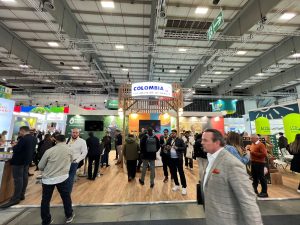








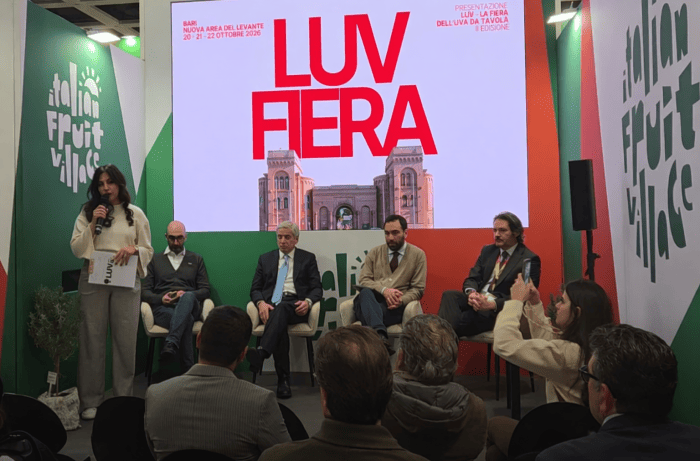
The Table Grape Fair has chosen Berlin to spotlight its second edition, scheduled for 20, 21 and 22 October 2026 at the Nuova Fiera del Levante, with Bari ready to once again become — for three days — the international hub of the value chain.
This was underlined from the outset by Mirko Sgaramella, project manager of LUV Fiera, when opening the presentation: “Knowledge is not enough if we do not work as a network to reach the critical mass that can influence the future of the chain.” Read between the lines, this statement also reflects LUV’s own evolution: following its 2024 debut — which marked the first European format entirely dedicated to the value chain — the 2026 edition points to a more ambitious event, designed to truly expand its reach beyond national borders.
LUV Fiera: partnerships and agreements for the 2026 edition
As announced, the event will take a strategic leap forward thanks to its collaboration with Fruitnet, a global reference in fresh produce information, which will bring a well-established international content format to LUV: the Fruitnet Grape Congress. The stated objective is to turn LUV 2026 into a platform capable of engaging with the global market without losing sight of its roots: Apulia and Sicily, described as “the productive heart of table grapes in Europe”, but also territories now called upon to transform agricultural leadership into value chain leadership, based on standards, vision, content and strategy.
New partnerships, therefore, but also renewed agreements. Starting with SG Marketing, which supports LUV with a very specific goal: bringing the consumer perspective into the fair and, with it, the ability to identify and manage the most insidious risk facing a mature product such as table grapes — commoditisation.
This was highlighted by Salvo Garipoli, Business Director at SG Marketing, during the presentation: “We must be aware that we are working within one of the most relevant value chains, where Italian identity is a real and tangible asset. Italy is a reference point in Europe and, to some extent, worldwide, and this gives us the responsibility to act in a structured and organised way, focusing on this chain: starting from the consumer and ending with the consumer.”
RELATED NEWS: Innovation and varietal development headline the Table Grape Conference
A view echoed by Alessandro Simone, buyer for Lulu Group International in the Middle East, who described LUV as a “compass” for international buyers precisely because it goes beyond the immediate logic of negotiation: “From an operator’s perspective, a value-chain-focused platform like LUV is essential because it brings buyers closer not only to the commercial side — often reduced to a simple supply-demand relationship — but to a deeper analysis that includes both technical and commercial aspects.”
Research and expertise at the core
Within this space — between business, innovation and market — came the contribution of Giacomo Suglia, President of Apeo, who recalled that table grapes are Italy’s second most exported horticultural product, and that this central role calls for a leap in maturity: acting collectively to engage “on equal terms” with major players in breeding, technology and production inputs.
In his remarks, Suglia revisited a debate often framed in binary terms within the sector — seeded versus seedless grapes — proposing a broader perspective: revaluing seeded grapes, starting with the Italia variety, without relegating them to nostalgia or a “residual market”. To support this view, he cited scientific studies conducted by the IRCCS “Saverio De Bellis” hospital in Castellana Grotte on the gastroenterological benefits of chewing the seed: “We must not overlook the scientific and health aspects in favour of marketing alone.”
And if, as the Apeo president pointed out, value cannot be sustained by marketing alone, the issue then becomes one of the value chain: who organises, at territorial level, the system that generates that value. This framed the closing remarks by Gianluca Nardone, Director of the Department of Agriculture of the Apulia Region: “This is the time to debate, to engage in dialogue and to place at the centre of attention a product that is fundamental for agriculture,” he said, “but which also represents an example of best practice, showing how an entire region and a whole production system have been able, over 30 to 40 years, to turn table grapes into the second export product of our agri-food sector.”
The value chain under the spotlight
Conceived to celebrate and showcase one of the Mediterranean’s most outstanding agricultural products, the first value-chain-focused fair dedicated to table grapes is entering a new phase. The dates are now set: 20, 21 and 22 October 2026. The venue will once again be Bari, at the Nuova Fiera del Levante, for a second edition that, while rooted in its national core, adds a genuine international dimension. A boost that confirms a project capable of consolidating its position and looking ambitiously towards the future of the sector.