



In volume terms, consumption of organic products was led by fresh fruit, which accounted for 24.1% of the total, followed by fresh vegetables, according to the Analysis of Characterisation and Projection of Organic Production published by Spain’s Ministry of Agriculture, Fisheries and Food.
Per capita spending stood at €59.44, with 94.2% of consumption taking place in the home. Total spending on organic products reached €2.89 billion in 2024, representing a slight decrease of 0.89% compared to 2023.
Consumption patterns continue to shift towards higher unit-price categories such as organic meat, fresh fruit and fish.
Trade balance at a historic high
Total exports of organic products reached €3.884 billion in 2024, up 27.5% on 2023.
 This positive balance was driven by a sharp reduction in imports, which fell by half to €782 million, allowing the organic trade surplus to rise to €3.102 billion, the highest level on record.
The main destinations for Spanish organic exports were Germany, France and the Netherlands, and outside the European Union, the United States, South Korea, the United Kingdom, Switzerland and Japan. Spain ranks third worldwide in the number of organic exporters (7.4% of the total) and fifth in organic importers (5.7%).
In 2024, Spain’s main organic export products followed the same trend as in 2023: fresh vegetables (cucumber, pepper and tomato), nuts (almonds and pistachios), extra virgin olive oil, wine and berries.
Leader in organic area
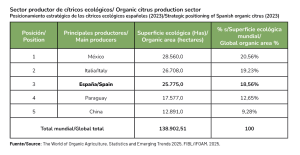
Spain remains Europe’s leader in organic farming area, with 2.95 million hectares, equivalent to 12.31% of utilised agricultural area (UAA). Organic production reached 3.75 million tonnes, down 24.06% year-on-year due to temporary factors, while estimated value at origin stood at €4.796 billion, representing a cumulative increase of nearly 350% since 2012.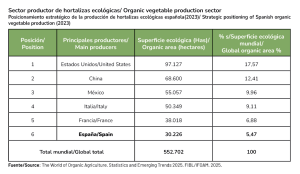
And in Spain, where is organic sold and who consumes it?
Traditional shops accounted for 29.1% of consumption, followed by supermarkets (28.6%), discount stores (11%), hypermarkets (10.1%) and e-commerce (3.3%), while other channels made up the remaining 21.1%. The market share of supermarkets and discount stores continued to rise, hypermarkets declined slightly and e-commerce maintained its growth.
In volume terms, the organic basket in 2024 was heavily concentrated in fresh fruit and vegetables, while value shifted towards higher unit-price categories such as meat and fish. Fresh fruit represented the largest volume share at 24.11%, followed by fresh vegetables at 17.65%.
Boomers, the biggest consumers
Organic spending and consumption are concentrated in upper and upper-middle social groups, which account for 42.3% of spending and 41.6% of volume.
Organic spending is clearly concentrated among consumers aged 50 and over. Households aged 50–64 account for 35.9% of spending and 36.6% of volume, closely followed by those aged 65 and over (35.1% of spending and 34.3% of volume). Together, these groups represent more than 71% of the market.
RELATED NEWS: “Inflation has slowed organic growth”
Consumers aged 35–49 account for 23.7% of spending and 23.9% of volume, while those under 35 represent just 5.3% of spending and 5.1% of volume.
Average organic prices by age group stand at €4.53/kg-l for under-35s, €4.44/kg-l for over-65s, €4.31/kg-l for those aged 35–49 and €4.26/kg-l for the 50–64 age group.
The combination of market shares and prices suggests very different consumption patterns. The 50–64 age group is the main driver of volume, while those aged over 65 maintain a higher unit-price basket, meaning their share in value slightly exceeds their share in volume.
Origin
Andalusia’s leading role is explained by a combination of extensive olive-growing area and strong organic fruit and vegetable processing. The Valencian Community has consolidated itself as a second major hub specialising in citrus, vegetables and processed plant-based products geared towards export. Catalonia maintains a more diversified profile, combining vegetable processing with fifth-range products.
Regional diversity
Large urban markets with high purchasing power—Catalonia, Madrid and the Basque Country—stand out for combining strong value shares with high unit prices.
The average price of organic products consumed in Spain stood at €4.34/kg-l. The Basque Country leads at €5.15/kg-l, followed by the Community of Madrid (€4.65) and Cantabria (€4.63).