







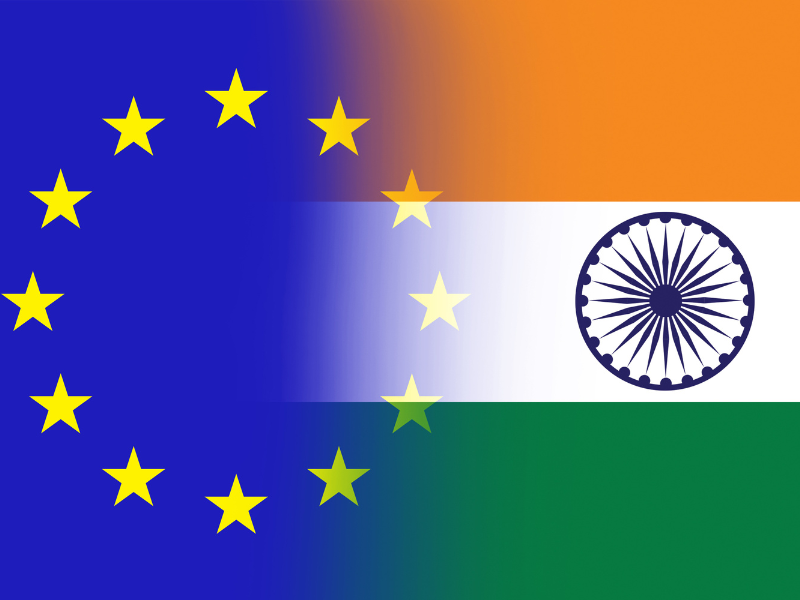
The EU and India concluded the agreement in New Delhi, describing it as historic. Once in force, it will link the world’s second- and fourth-largest economies, creating an unprecedented market of 2 billion consumers after 18 years of negotiations.
Spain’s Ministry of Economy praised the deal in statements released to the media, underlining that it opens new opportunities for the international expansion of Spanish companies, including those in the agri-food sector, within a market of “enormous potential”.
According to the latest figures from Spain’s Ministry of Agriculture, Fisheries and Food (MAPA) for 2024, Spain runs an annual agri-food and fisheries trade deficit of €325 million with India.
Spanish agri-food exports to India amount to €123 million, reflecting year-on-year growth of 34.6%, while imports total €448 million, up 9.5%.
Spain’s main agri-food exports to India include olive oil (€38.1 million), pulses (€14.2 million), vegetable juices and extracts (€7.2 million), and prepared animal feed (€6.5 million). On the import side, Spain mainly purchases molluscs (€156.1 million), coconuts, nuts and cashews (€29.2 million), and coffee (€22.7 million) from India.
India currently ranks 56th among destinations for Spanish food and beverage exports and 26th among Spain’s main suppliers.
What does the agreement mean for agri-food?
Regarding the agri-food sector, the Ministry of Economy stressed that the agreement will eliminate or reduce tariffs on a range of products. Wine tariffs will be cut from 150% to 75% upon entry into force, and progressively reduced to 20% in the long term. Olive oil tariffs will fall from 45% to zero within five years, while tariffs of up to 50% on processed products such as bread and confectionery will also be reduced.
Overall, the agreement will liberalise 96.6% of EU exports, while excluding segments considered red lines by both sides. These include India’s subsistence agriculture sectors (such as rice, wheat and dairy) and sensitive European sectors, including beef and sugar.
The agreement focuses primarily on industrial and high value-added processed products.
Farmers’ organisation Asaja, while expressing caution in a statement, noted that the exclusions are a direct result of pressure from recent European farming protests in Brussels and Strasbourg. Both Asaja and representatives of the wine and olive oil sectors have nonetheless highlighted the opportunities created for these products.
RELATED NEWS: European farmers mobilise against EU–Mercosur trade deal
Spain’s Conference of Wine Regulatory Councils (CECRV), the Spanish Wine Interprofessional Organisation (OIVE) and the Spanish Wine Federation (FEV) described the agreement as positive news. Rafael Pico, director general of the Spanish Association of Olive Oil Exporters (Asoliva), said the opening of the Indian market is “very positive” for increasing olive oil consumption among Indian consumers.
From agri-food policy think tank Farm Europe, expert Luc Vernet noted that the balance of the EU–India agreement differs from that of Mercosur and could prove even more favourable if sensitive products are effectively excluded. He added that India could “create significant opportunities for wines and cheeses, provided the agreement is based on a clear principle of reciprocity”.
However, Vernet also stressed the need for safeguards, pointing out that India is a global leader in dairy, rice and the world’s second-largest sugar producer, with output “twice that of the EU”.