








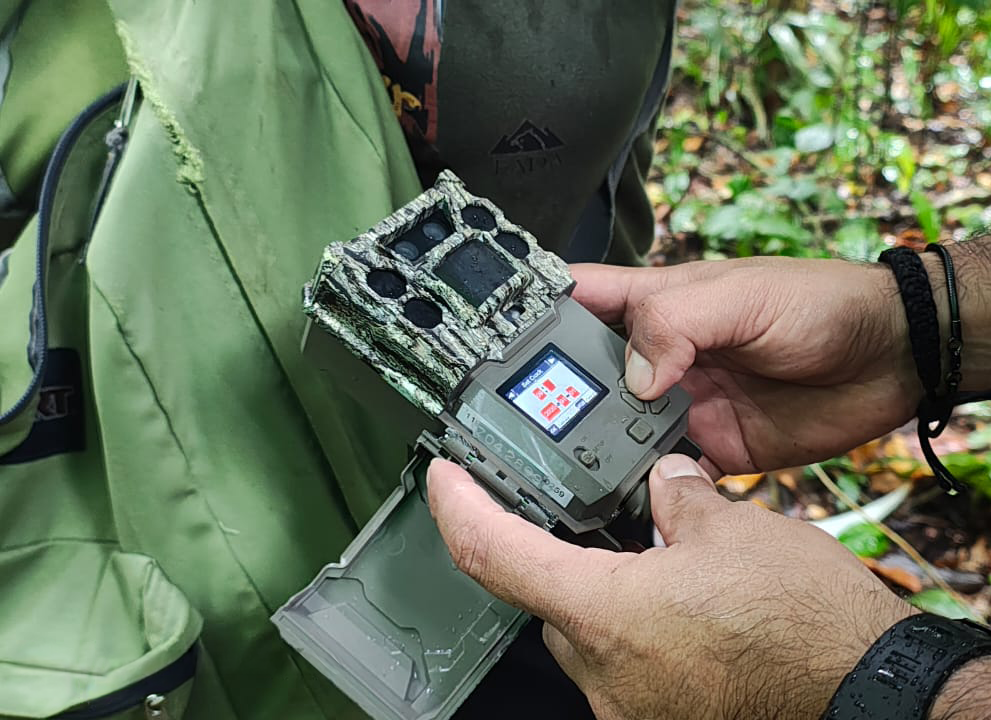
Two camera traps are capturing the wildlife that inhabits the forests of Agroforestales de Sixaola, a protected area safeguarded by the banana industry in Costa Rica’s Southern Caribbean region.
The initiative, led by the National Forestry Financing Fund (FONAFIFO) — specifically through its Directorate for the Development and Commercialisation of Environmental Services and its Proposals Development Department — will enable the collection of fauna data and the creation of a technical record of the biodiversity present in the area.
The devices will remain active for six months and form part of a broader effort to install camera traps on farms across the country, 18 of them located in the Talamanca region. This initiative aims to strengthen decision-making related to conservation and the sustainable management of ecosystems in the Southern Caribbean.
The installation of the cameras is part of the Bosque Vivo project, promoted by FONAFIFO and funded through donations and agreements with private companies. Camera trapping is used as a scientific tool to develop a baseline inventory of the fauna inhabiting areas enrolled in the Payment for Environmental Services Programme (PES). This programme provides financial recognition to landowners and organisations that protect forests and deliver key ecosystem services for the country.
RELATED NEWS: Ecuador’s banana price increases by $0.50
FONAFIFO’s PES programme promotes forest conservation by recognising environmental services such as the mitigation of greenhouse gas emissions, biodiversity protection for conservation and sustainable use, and the safeguarding of water resources for human, rural and hydroelectric consumption. Through this scheme, Costa Rica has consolidated a network of privately protected areas that complement the State’s environmental efforts.
The forested areas of Agroforestales de Sixaola, a subsidiary of the National Banana Corporation (CORBANA), are located between the communities of Mata de Limón and San Miguel. These areas have been part of the PES programme since 2001 and, in 2025, were also formally incorporated into the National REDD+ Strategy, which recognises their contribution to reducing greenhouse gas emissions between 2018 and 2024. According to technical studies by FONAFIFO, the recognised areas range from 43.61 to 836.42 hectares.
“Our commitment goes beyond exporting bananas. For decades, we have worked towards sustainable production that protects farming areas while also conserving forests that are home to a wide diversity of flora and fauna. Taking part in this project allows us to showcase that effort and to understand, through technical evidence, the value of the ecosystems we protect,” said Jhamna Magsig, Sustainability Coordinator at CORBANA.
A biodiversity refuge
Agroforestales de Sixaola covers a total area of 1,250 hectares, including around 400 hectares of primary forest more than 100 years old and approximately 600 hectares of regenerated secondary forest. Decades ago, these lands were used for crops such as bananas and cocoa.
Studies conducted in 2012 by The Nature Conservancy (TNC) recorded the presence of 164 plant species, 158 fern species, 51 mammal species, 141 bird species, 25 reptile species and 20 amphibian species.
The farm borders the Gandoca–Manzanillo Biological Corridor and contributes directly to the Mesoamerican Biological Corridor, as well as to carbon sequestration and oxygen production. It stands as a clear example of how collaboration between the productive sector and environmental institutions can deliver tangible results for the conservation of Costa Rica’s natural heritage.