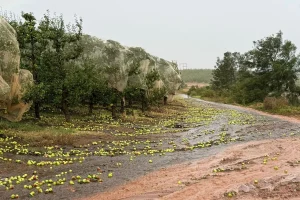











Luis wears many hats. He dances bachata, presents radio shows, runs marathons and takes open-water swims such as the Santa Pola-Tabarca crossing. And on what was the coldest day in decades (7 January), he even led us into the sea at Malvarrosa Beach, in Valencia—wetsuit on, using the same orange buoy he had relied on during the DANA floods.
Despite his tough exterior, he has a heart that barely fits in his chest. He lost any sense of self-consciousness long ago and has no problem posing in a fluorescent green shirt (bought in Johannesburg) with a matching hat. Sharp as a tack — and although he was never a standout student — he has a remarkable photographic memory. In fact, his sister-in-law likes to say he is the family’s Wikipedia.
I have seen him improvise live on air and was genuinely impressed. How long have you been broadcasting?
More than fifteen years. It’s a real hobby for me, and I’ve always been involved with Latin music stations such as Olímpica, Latinos, Zeta and Tropicalísima.
And when did your passion for music begin?
During my military service. I started DJing in a pub and that’s where it all began. I was into early 1990s dance music back then, but when I returned to Valencia, my first wife and I signed up for dance classes — and I’ve never stopped.
I’ve seen you dance many times, and you always become the star of the floor. I envy your sense of rhythm.
Where did you do your military service?
In Melilla, where I was recruited by the Legion. I made up my mind quickly: in the Legion you earned 30,000 pesetas and I learnt values I still live by today… while regular service paid 1,200.
What did you study?
I completed vocational training in electronics, but I always wanted to work in sales, like my father. I can’t even remember when I started clocking up more than 50,000 kilometres a year, always with music playing.
But you’ve studied other things as well
That’s true. I’m naturally restless. I hold a skipper’s licence for recreational boats, with offshore extensions. I’ve also completed lifeguarding courses for beaches and pools, and I hold a UEFA B football coaching licence.
How many lives have you lived?
Quite a few. I’ve lived intensely, both professionally –since I was 18– and personally. I’ve travelled all over the world, been married twice, and now have a stable partner. My two children live with us. Life is there to be lived, whatever the circumstances.
That was evident during the DANA floods. When we spoke, you came across as one of many unsung heroes
No—heroes belong in films. What I did was simply a matter of values. Sadly, my children were living in one of the hardest-hit areas, near the Poyo ravine. That same afternoon I tried to reach them, but it was impossible; cars were floating everywhere. It was utter chaos. I went back home and returned at five the next morning. There was nothing but destruction and bodies. Once I knew my family was safe, I went to the end of the street, where there was a residential care and day centre.
Two elderly people were inside, shaking after spending the entire night clinging to their bed and shouting for help. I got them out as best I could. Later, together with my son, we found others who hadn’t made it. There are no words for what I saw.
You spent two months helping around the clock, didn’t you?
Yes, but I wasn’t alone. Solidarity was everywhere. We set up an NGO to help feed the people, Longanizas sin fronteras.
I call it an NGO because it was privately funded. We couldn’t formalise it legally because the process was too slow and expensive for something temporary, with a single aim: making sure people had something decent to eat. And what could be better than a hot sandwich with pancetta, sausage and aioli? I also launched a crowdfunding campaign to buy shelving for a secondary school, instruments for a music classroom and another school, among other things.
Is swimming a recent passion?
No. Wherever I am, I try to swim every day in a pool. When I started, I couldn’t swim at all, but it was medical advice after four knee surgeries and a few other issues. All the other sports I used to practise —football and running— are no longer part of my life, although I still dream of returning. That was twelve years ago, and to start strong I swam the harbour crossing, two kilometres. Everything I’ve done has been a constant competition with myself. Now, I swim the Tabarca–Santa Pola crossing every year, medium distance, around six kilometres.
So you’re stubborn
In a way. If I set myself a goal, I have to reach it. I’ve also run ultra-marathons, the longest involved 11,000 metres of cumulative elevation gain, from Alfondeguilla to Camarena de la Sierra: around 117 kilometres in 26 hours. The toughest sections are the climbs at Peñagolosa and La Mola de Sarrión, and the 30 times you ask yourself, “What am I doing here?”
I’ve interviewed people who would feel embarrassed to show up in a wetsuit, but you seem completely at ease
At this stage of life, I’ve lost any sense of shame and have nothing to hide. I only care about what truly matters.
Does your shirt have a story?
Life itself is a story, and this shirt is part of it. I should say I have others too—one for each chapter of my story. And none of them goes unnoticed.
In other words, pure discretion