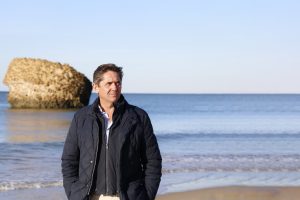
Someone who loves his work and feels passion for his profession and for what he does every day, but who also knows how to enjoy the “small things” in life: moments with family and friends. Deeply aware that this is what truly matters. He has always been closely connected to nature; from a young age, he enjoyed protecting the natural environment. In fact, working in agriculture today is, for him, a way to combine economic development in rural areas with sustainability.And so, I managed to get him to pose in El Rocío wearing traditional attire — and to feel comfortable doing so.Juan Báñez was born in Ulm (Germany) in 1969. His mother is from Ourense (Galicia) and his father from Almonte (Huelva). The family returned to Spain in the 1980s. He spoke better German than Spanish, and the town — which at the time knew nothing about immigration — nicknamed him Juan the German, a name many in Almonte still use today. He was blond, with light-coloured eyes.At 18, he met a young woman from Almonte — now his wife and the mother of his two children. They both studied at the School of Business in Seville and hold degrees in Economics and Business Administration.We met near his home and there we were introduced to Leo, the family dog. We then went to Matalascañas, the family’s summer retreat and his personal place of disconnection. From there, we continued on to El Rocío.
How does a 13-year-old boy feel arriving in Almonte barely knowing any Spanish?
At first it was a bit tough because I had grown up in Germany and my Spanish was the language used only at home. Soon I surrounded myself with a good group of friends, and at that age you adapt to everything. I had many problems with our ‘r’, because in German it isn’t pronounced.Are you the kind of father who takes the dog out every morning?
That’s the arrangement. At 6:15, Leo knows he’s going out with me to walk and do all kinds of exercises. I’ve trained him since he was very young; he’s a very smart dog. I always try to tire him out mentally — it’s very good for him.How did Leo arrive in the family?
He was meant for my younger son, but now we are all very happy with him. Curiously, my wife used to be afraid of dogs, but she has integrated him into the family as if he were one of us. My children take him out for the rest of the day.How many years have you been taking part in El Rocío?
Since the very beginning. I belong to the Brotherhood of Almonte, and with the wagons our journey only lasts one day. My family and I live the pilgrimage to be closer to the Virgin and to share those days with our family and friends. Even though, sometimes, it coincides with the end of the agricultural season, I rarely miss it. I’m already wearing the bracelet for El Rocío 2026.Where do you stay?
We are fortunate to stay at the home of Ángel Blanco and his wife, my sister-in-law Pilar Faraco. Four generations gather there — sometimes more than 40 people, including family, relatives and friends. They are very special days. We’ve been attending the pilgrimage for 30 years.Tell me about the cross on the hermitage bell gable
The cross on the hermitage was made by my father-in-law, Genaro Faraco, who was a blacksmith. It is a replica of the cross in the Santa Cruz neighbourhood of Seville, originally made by another blacksmith from Almonte — hence the similarity. My father-in-law would travel to Seville and sketch the cross by eye with paper and pencil. The result was spectacular.In front of the marshland beside the hermitage, Juan begins naming birds one after another: cattle egrets, glossy ibises, mallards, flamingos, grebes…Why do you know so many bird species?
Because when I was 18, during the design of the First Sustainable Development Plan for the Doñana Area, I started an environmental education company with some friends called Doñana Educa. We welcomed school groups and did important educational work, helping students learn about the park. I balanced it with my studies in Seville until I could no longer manage both and had to leave it.Does Matalascañas hold a special meaning for you?
I spent many teenage years working in hospitality in Matalascañas because I was practically the only person who spoke German at the time. I also worked as a lifeguard. My father worked in the tourism office and a few years ago he was honoured there. Today there is a small spot called Alfonso Báñez’s Corner.Nowadays, we spend around three months a year there — it is our second home. For me, reaching the roundabout in Matalascañas means absolute disconnection. My wife and I often walk along the trails among the pines. We love the sunsets and the light of this land.Have you ever thought about having a boat?
Yes. For about 15 years we had a small motorboat — the kind that needs a tractor to launch into the water. My wife and one of my sons really enjoy fishing. Later we moved it to Huelva and eventually sold it.Do you practise any sport?
Not currently. And yet I used to practise many sports. I played football, futsal, basketball, volleyball and competed in swimming. I hold a lifeguard certification, which was helpful for summer jobs. I also hold coaching certificates and have been a football coach and mini-basket instructor.Now my wife and I — though not always — work out at home with equipment. I like doing it with her; we motivate each other.What do you enjoy doing together?
I love being with my family and friends. I enjoy going out, walking, being outside among people. I’m a very sociable person; I enjoy my surroundings. I also love travelling. Besides travelling frequently for my job, I enjoy doing so with my family, and each year we visit a different place. Next week we’re going to Ireland, where my son is now.How do you usually stay informed?
I read national newspapers and the sports press digitally. I also enjoy listening to podcasts on economics and psychology.