









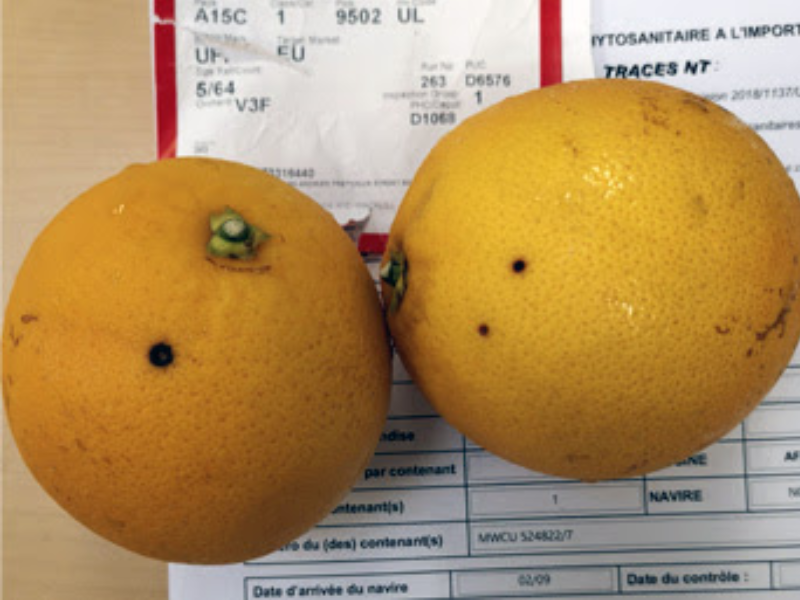
The review of the European priority pest list could remove four organisms of particular relevance to citrus and other fruit crops: citrus black spot (Phyllosticta citricarpa) and three fruit flies, Bactrocera dorsalis, Bactrocera zonata and Anastrepha ludens.
The proposal comes as part of an update to the economic, social and environmental impact assessment of the 46 quarantine organisms regulated in the EU, prepared by the Joint Research Centre (JRC) and the European Food Safety Authority (EFSA). This proposal would add nine new pests to the priority list and, if the current number of priority pests is not increased, remove another nine.
Less monitoring and fewer resources
The Citrus Management Committee (CGC) opposes the possible loss of priority status because of its potential impact on monitoring systems. Priority pest status currently requires EU Member States to carry out annual surveillance, establish contingency plans and prepare eradication or containment measures.
According to the CGC, removing these four pests from the list would reduce the resources devoted to their surveillance and make early detection more difficult, increasing the risk of their establishment in Spanish production areas.
The organisation also considers the funding allocated to implementing the relevant regulation insufficient. In 2023 and 2024, the EU budget allocated to these measures barely exceeded €8 million for the 27 Member States.
Economic risk reaches €5.737 billion
The potential removal of these pests is particularly significant given the estimated economic impact should they become established. According to EFSA and JRC calculations, the losses associated with the four pests could reach €5.73688 billion, of which approximately €2.49 billion would be attributable to citrus black spot.
According to the CGC, this fungus is the quarantine organism responsible for the highest number of interceptions in citrus imports from third countries. It is also already established in Tunisia.
The three fruit flies also pose a threat to European production. The oriental fruit fly (Bactrocera dorsalis) was detected for the first time in Spain in 2025, in Cantabria, after outbreaks had already been recorded in France, Italy and Greece.
Meanwhile, the peach fruit fly (Bactrocera zonata) has been intercepted in consignments of citrus from Egypt and has also been detected in France, Italy and Greece. The Mexican fruit fly (Anastrepha ludens) has not yet been detected in Spain.
The sector calls for a broader list
In response to the proposed changes, the CGC believes that the priority pest list should instead be expanded, particularly given that the review incorporates forestry and agroforestry organisms and applies new assessment criteria.
RELATED NEWS: Citrus greening continues to threaten Brazilian citrus production
The organisation argues that maintaining effective surveillance is essential to prevent quarantine organisms from becoming established in production areas and causing damage that could be difficult to reverse.
The debate gains further relevance following the recent detection on the Greek island of Rhodes of the most effective and aggressive vector of HLB, one of the most destructive diseases affecting citrus.
Strengthening surveillance against HLB
Against this backdrop, the CGC highlights the approval of plant health measures promoted by Intercitrus through its regulatory extension.
The measures include a programme developed with the IVIA to obtain rootstocks and varieties that are resistant or tolerant to HLB, as well as strengthening surveillance points in Spain’s autonomous regions producing oranges and mandarins.
For the citrus sector, the objective is to maintain the capacity for early detection and rapid response to organisms that could have a significant impact on European production.