









The global fruit and vegetable trade is entering a period of growing uncertainty, with trade growth virtually stagnating and geopolitical, climatic and logistical pressures reshaping the way companies operate.
Between 2021 and 2025, the value of global fruit and vegetable trade increased by an average of just 0.1% per year in inflation-adjusted terms, according to the new FRUIT LOGISTICA Trend Report.
Entitled “How to weather the storm?”, the report examines the challenges facing producers, exporters, retailers and logistics providers and explores how companies can remain competitive in an increasingly unpredictable environment.
Drawing on analysis and insights from international industry experts, the report highlights a clear shift in priorities: efficiency remains important, but the ability to adapt quickly to disruption is becoming a critical competitive advantage.
“The international fruit and vegetable sector has already weathered many crises. But today’s challenges are coming faster, more frequently, and often simultaneously,” said Mike Knowles, Managing Director of Fruitnet Europe.
“Companies must therefore rethink their approach: it is no longer enough to optimise supply chains for maximum efficiency. What is crucial is to remain capable of acting even when markets collapse, harvests fail, or transport routes suddenly cease to function,” he added.
Geopolitics is reshaping global fruit trade
Tariffs, trade restrictions and international conflicts are increasingly challenging established trading relationships. One of the main difficulties for the fresh produce sector is the mismatch between the speed of political decisions and the timescales involved in agricultural production.
While new tariffs or trade measures can be introduced within weeks, fruit orchards take years to establish and bring into production.
Against this backdrop, companies are being encouraged to diversify their markets, assess geopolitical risks earlier and reduce excessive dependence on individual trading partners.
The report also highlights significant differences between individual commodities. While international trade in apples, grapes and oranges is declining, other categories, including blueberries and avocados, continue to record significant growth.
Climate change is altering production conditions
Climate change is another factor increasingly influencing where and how fruit and vegetables can be produced profitably.
Drought, heatwaves and changing rainfall patterns are already affecting growing conditions, while longer-term projections suggest that production regions could shift significantly over the coming decades.
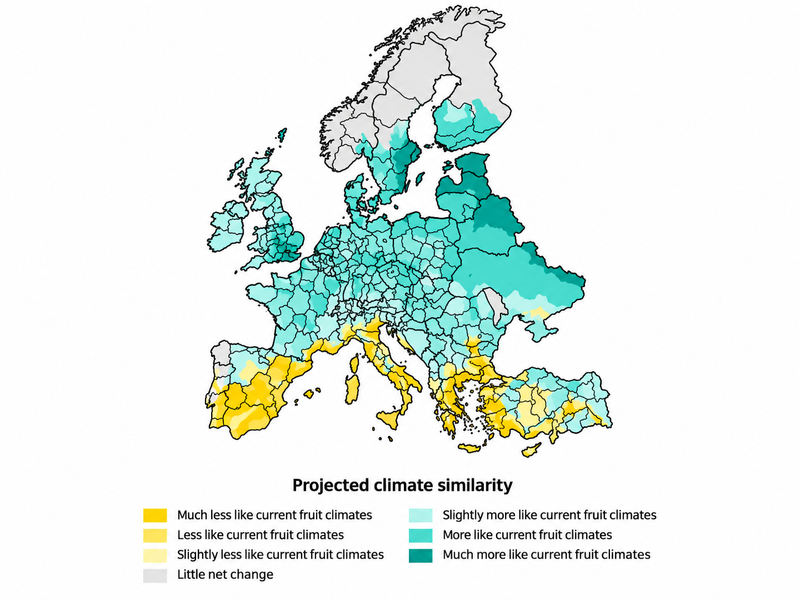
Analysis by RaboResearch indicates that the climatic conditions for European fruit production could change substantially by 2050. While parts of the Mediterranean region are expected to face greater pressure from heat and water scarcity, cooler regions could become increasingly relevant for certain fruit crops.
RELATED NEWS: Fruit Logistica 2027 to bring innovation together in a new dedicated zone
The report points to a growing need for climate-resilient varieties, more efficient irrigation systems and long-term investment planning.
These changes will also have implications further along the supply chain. Wholesale and retail businesses will need to adapt more flexibly to fluctuations in harvest volumes and changes in product characteristics.
Resilient supply chains become a competitive advantage
The logistics sector is also facing a more complex operating environment. Low water levels in strategic waterways, including the Panama Canal and the River Rhine, together with geopolitical conflicts and higher transport costs, are putting additional pressure on the reliability of global supply chains.
For perishable products, even relatively short delays can have a significant impact on quality and commercial value.
The report therefore argues that future supply-chain strategies cannot focus exclusively on finding the fastest or cheapest transport option. Companies will increasingly need to identify alternative routes, anticipate potential disruptions and strengthen cooperation across the supply chain.
From efficiency to resilience
The report’s central message is that the fresh produce sector cannot eliminate every source of disruption, but businesses can improve their ability to withstand them.
Companies that invest early in innovation, resilient partnerships and flexible business models will be better positioned to remain competitive when markets, production conditions or logistics networks are disrupted.