





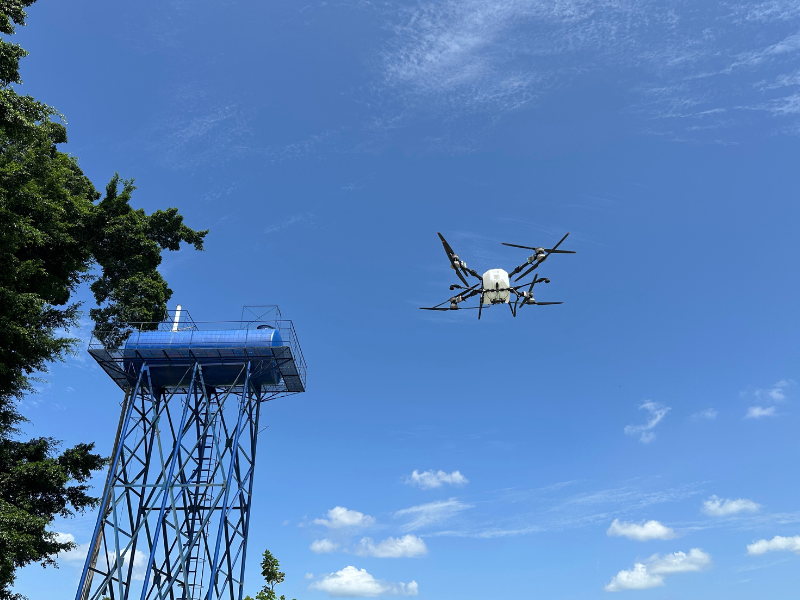
The Foreign Trade Promotion Agency of Costa Rica (PROCOMER) and the National Banana Corporation (CORBANA), through the Compañía Nacional de Banano S.A. (CIBSA), are promoting a technical training project to prepare specialised talent in technologies applied to the banana sector. The programme includes training in agricultural drone operation, precision agriculture, geospatial analysis, leadership and entrepreneurship.
The initiative seeks to respond to the needs of a more technological, efficient and sustainable agriculture, through the development of skills among people linked to the agricultural sector. In this way, the project goes beyond corporate training and contributes to building talent capable of applying this knowledge to production processes related to agriculture and banana activity.
“The competitiveness of the export sector increasingly depends on the country’s ability to train specialised talent, prepared to incorporate technology, innovation and sustainability into production processes. At PROCOMER, we promote this type of initiative because it brings new skills closer to people linked to strategic sectors, creates employability opportunities and strengthens Costa Rica’s ability to respond to the demands of international markets,” said Laura López, General Manager of PROCOMER.
An investment of more than ₡26 million
The project is part of PROCOMER’s Human Talent Development Programme for Exporting Companies, through which projects are co-financed to strengthen the capacities of companies and talent linked to foreign trade. In this case, the initiative represents a total investment of more than € 26 million, of which PROCOMER will cover 70%.
The training is aimed at 155 people: 15 CIBSA employees and 140 jobseekers. As part of the process, CIBSA contributes its production experience and knowledge of banana operations as a practical application environment, so that participants can develop skills in the use of drones, remote sensing, sensors, geospatial data analysis and specialised software in real agricultural production settings.
“This initiative reflects our conviction that continuous training and access to knowledge are key tools for generating development and creating new opportunities for people. Specialised training such as that offered by this project allows employees and future workers to join the modernisation of Costa Rican agriculture. We are not only investing in innovation and competitiveness for the industry, but also in wellbeing for communities,” said Marcial Chaverri, General Manager of CORBANA.
Technology to modernise banana production
For his part, Antonio Juarez, Farm Manager at CIBSA, said: “This joint effort shows how collaboration between institutions, companies and academia can create real opportunities for the development of human talent and the adoption of new technologies. For CIBSA, it represents a strategic investment that strengthens the competitiveness, sustainability and efficiency of our operations; while for the national banana sector, it means moving towards a more modern, precise and innovative agriculture, developing capacities that will help address future challenges and maintain Costa Rica’s leadership in international markets.”
RELATED NEWS: Costa Rica launches pineapple and cassava promotion campaign in France
Currently, 25 people are progressing through the theoretical-practical course to obtain a licence in the operation of agricultural RPAS, including CIBSA employees and students from the University of Costa Rica (UCR), the Technological Institute of Costa Rica (TEC) and the National University (UNA). This process began in April and includes an academic stage, official theoretical examinations and, subsequently, the necessary practical skills to qualify for the practical test before the Directorate General of Civil Aviation.
At the same time, the first Precision Agriculture workshop has already concluded, with the participation of 35 UCR students in San José. In addition, during August, leadership and entrepreneurship workshops are being held at the Pococí Bilingual School. In total, six workshops are planned at different UCR, UNA and TEC university campuses, with an estimated participation of 30 people per workshop.
More efficient monitoring and reduced use of inputs
From the perspective of CORBANA and CIBSA, the initiative is seen as an opportunity to contribute to capacity building beyond business operations and to support the modernisation of the talent available to the national banana sector.
Although the project is still ongoing, it has already made progress in its main training components. Expected results and indicators include the certification of 25 participants in agricultural drone operation, access to specialised data analysis tools for beneficiaries of the Precision Agriculture course, and the implementation of more efficient monitoring practices to help reduce the use of agrochemicals.
At sector level, this training is expected to improve crop monitoring, strengthen early response to pests and diseases, optimise the use of agricultural inputs and support more precise agronomic decision-making based on data and images collected through drones and other technologies applied to agriculture.
With this initiative, PROCOMER and CORBANA are contributing to the development of specialised talent for a more technological, efficient and sustainable agriculture, while strengthening the capacities required by the Costa Rican banana sector to maintain its competitiveness in international markets increasingly focused on innovation, traceability and sustainability.