









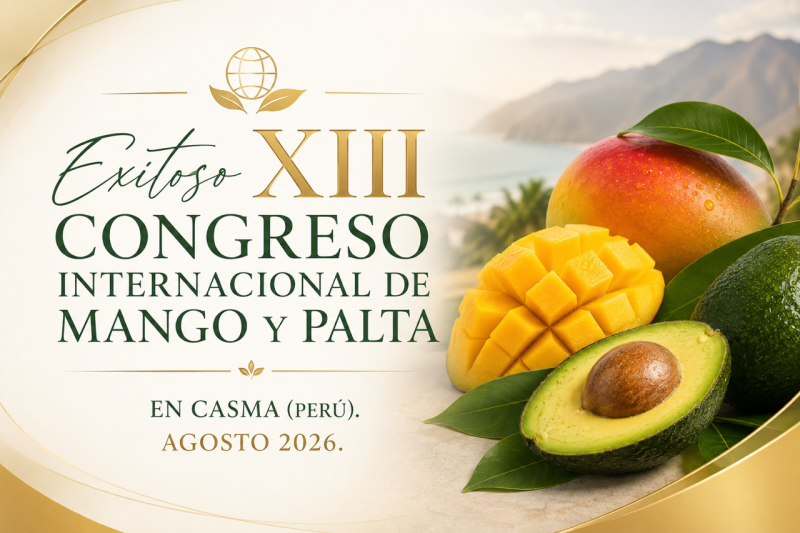
Casma once again became a meeting point for Peru’s agri-food sector with the celebration of the XIII International Mango and Avocado Congress “Félix Antonio Meza Cervantes – Rafael Ricardo Santolalla Coral”, organised by the Casma Farmers’ Association.
Over three days, growers, technicians, researchers and companies analysed the main challenges facing both crops, from production and plant health to post-harvest management, climate and international marketing.
The overall assessment of the Congress is positive and timely. Rather than providing definitive answers, the event succeeded in bringing to the table the issues that will shape the future of the sector: climate uncertainty, productivity, quality, plant health and the need to maintain the competitiveness of Peruvian mangoes and avocados.
Climate takes centre stage
One of the key topics at the Congress was the climate factor. Agroclimatic forecasts for 2026-2027, the possible effects of El Niño and strategies for dealing with adverse environmental conditions featured prominently in the programme.
The conclusion is clear: agriculture needs to move from reactive management towards an increasingly predictive model.
Growers’ experience remains essential, but it needs to be complemented by meteorological information, forecasting tools and more precise crop monitoring. In mango and avocado production, anticipating changes can prove decisive for the profitability of a season.
Greater precision, less improvisation
Plant health and nutrition were also central to the debate. The sector needs to move towards more efficient, sustainable and precise agriculture, capable of applying the right inputs at the right time.
Scientific knowledge must therefore be translated into practical solutions for growers. The objective is not simply to produce more, but to produce better and more efficiently.
The major challenge: turning knowledge into profitability
One of the challenges remaining for future editions is to strengthen the link between technical knowledge and grower profitability.
International competitiveness requires answers to questions such as which varieties offer the best prospects, which markets have the greatest potential, how logistics costs can be managed, how Peruvian fruit can be differentiated and, above all, how more value can be generated at origin.
The success of the sector should not be measured solely in terms of export volumes, but also by the value retained within the supply chain and ultimately reaching growers.
A meeting point for the future
The Congress also demonstrated that these events are much more than a series of conferences. The participation of growers, companies, technicians and other professionals turned Casma into a forum for exchanging experiences, building contacts and developing a shared vision for the future of Peruvian fruit production.
Overall, the XIII International Mango and Avocado Congress deserves a highly positive assessment. Its main strength was its ability to bring together the major challenges facing the sector: climate, productivity, plant health, innovation, quality and markets.
The next step should be to consolidate these congresses as permanent platforms for knowledge and practical solutions for growers.
RELATED NEWS: Eosta prepares European launch for Raingrown avocados
The future of Peru’s mango and avocado sectors will not depend solely on opening new markets. Above all, it will depend on the sector’s ability to anticipate change, innovate, produce efficiently and ensure greater profitability for those working in the field.
Casma has once again put these challenges on the table. It is now up to the sector to turn the knowledge shared into decisions and results.
Francisco Seva Rivadulla. International Agri-food Journalist