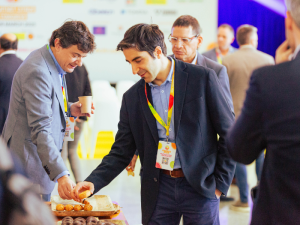








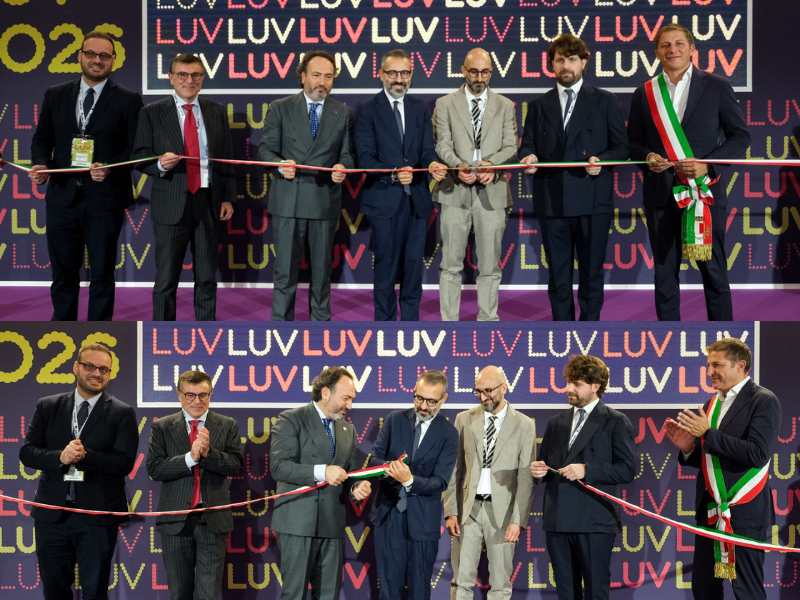
The second edition of LUV – The Table Grape Fair enters its second day with a programme focused on the main challenges and opportunities facing the table grape sector. The event brings together 192 exhibitors from 19 countries in Bari and, on 21 October, features a programme combining market analysis, varietal innovation, research and technical solutions for growers.
2nd day will be marked by the Table Grape Conference, which will bring together growers, agronomists, researchers, buyers, institutions and international operators from across the value chain at the LUV Auditorium and LUV Agorà.
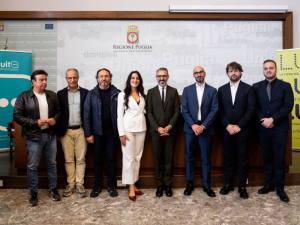
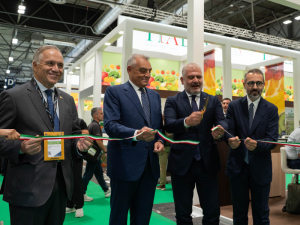
During the opening ceremony, it was also confirmed that LUV Fiera will return to Bari on 4, 5 and 6 July 2028, with the aim of positioning the event at the beginning of the table grape commercial season.
Bari, a new international meeting point
The organisers, Mirko Sgaramella and Francesco Menelao of Fruit Comunication, explained that moving LUV Fiera to July will place the event at a strategic time for the sector, when there is still an opportunity to influence commercial agreements and the evolution of product prices.
Looking ahead to 2028, the aim will be to further consolidate LUV’s role as an international platform for business, knowledge exchange and development across the entire value chain.
The international dimension of the fair has been one of the highlights of this second edition. Ferdinando Natali, Regional Director for Southern Italy at UniCredit, stressed the importance of supporting a sector that is strategic to the Apulian economy, combining strong local roots with an increasingly international market focus.
He also highlighted some of the main challenges facing companies, including energy costs and difficulties in finding labour, and called for stronger connections between the different players across the value chain.
For his part, Francesco Paolicelli, Agriculture Councillor for the Apulia Region, thanked the more than 192 exhibitors taking part and highlighted the importance of promoting quality, collaboration and the search for new markets in a challenging commercial environment.
Gaetano Frulli, President of Nuova Fiera del Levante, also highlighted the growth achieved by LUV since its first edition in 2024 and the role of the event in positioning Apulian and Italian table grapes in international markets.
Consumers and markets take centre stage at the Auditorium
The programme at the LUV Auditorium will begin at 10:00 with a session focusing on market and consumer dynamics.
The In the consumer’s mind session will feature Hannes Tauber of VOG, who will examine the apple sector as a benchmark for table grapes. Raquel Herce of Mint will then address marketing strategies applied to the grape sector, while Salvo Garipoli of SG Marketing will present a comparative study of Italian and German consumers.
Representatives from Coop Italia, Megamark, Gruppo Arena, Unicomm and Veronamercato will subsequently analyse the journey of table grapes from the retail shelf to the final consumer.
RELATED NEWS: LUV Fiera: Bari becomes the international capital of table grapes
The session dedicated to northern European markets will focus on imports, sustainability and commercial dynamics, with the participation of O.P. Giuliano Puglia Fruit, FIS Group and Olympic Fruit.
In the afternoon, the debate will turn to labour and competitiveness, bringing together representatives from the Apulia Region, Coldiretti, Confagricoltura, CIA, Fruitimprese, ARPAL and UILA Puglia.
The final block will focus on The table grape of the future, with new varieties presented by Rete IVC, SicilGrape, Grape & Grape, AgriUnitech and Nu.Va.U.T. The International Varietal Outlook session will subsequently bring together international operators including Hort-IP, Bloom Fresh, Grape Evolution, Sun World and AVI – RK Growers.
Xylella, genetics and water management
At the same time, the LUV Agorà will host the scientific and technical programme. The day will begin with an analysis of Xylella and Pierce’s disease.
Donato Boscia of CNR-IPSP will explain how to identify and prevent these threats, while Salvatore Infantino of the Phytosanitary Observatory of the Apulia Region will present the regional containment strategy.
Grape genetic improvement will then take centre stage in another of the main sessions. Cinzia Montemurro of the University of Bari will address general genetic improvement strategies; Giorgio Gambino of CNR IPSP Torino will analyse the opportunities offered by Assisted Evolution Technologies (TEAs), while Costantino Pirolo of Rete IVC will explore the possibility of developing a seedless Italia grape.
Water management will close the morning programme, with Giuseppe Cacucci of Food Agri Service discussing the physiological relationships of the grapevine, followed by a round table with Netafim, Agriproject Group and the University of Bari on strategies to reduce water consumption without compromising yields.
Soil health and regenerative viticulture
The LUV Agorà programme will continue in the afternoon with a block dedicated to soil health and the microbiome.
CREA-VE, Tenute D’Onghia and Graper will take part in a round table on the scientific evidence surrounding regenerative viticulture. Giacomo Mastrosimini of Graper will subsequently provide practical guidance on how to transform degraded land into living soil.
LUV’s programme will also address the role of organic matter in dealing with abiotic stress, the effects of soil management and different solutions aimed at regenerating soils and reducing water and heat stress.
The technical programme will conclude with a session on the effects of integrated protocols on the Arrathirty variety, followed by a FIMAA-organised round table on regulation, transparency and value creation in table grape commercial intermediation.
The sector calls for greater cohesion
Coinciding with LUV Fiera, a survey promoted by uvadatavola.com has highlighted some of the sector’s main structural challenges. 77.5% of respondents said they do not feel part of a cohesive sector, while 68.3% consider active coordination between commercial operators essential.
In addition, 71.8% identify producer grouping and shared supply policies as the main way to rebalance relations with modern retail, compared with 10.6% who primarily rely on political intervention.
The assessment of sector associations also reflects this lack of confidence, with an average score of 4.3 out of 10, falling to 3.9 among those who do not perceive cohesion within the sector.
With its second edition, LUV Fiera aims to consolidate its position as an international meeting point for addressing these challenges and strengthening connections between growers, buyers, researchers, suppliers and institutions.