









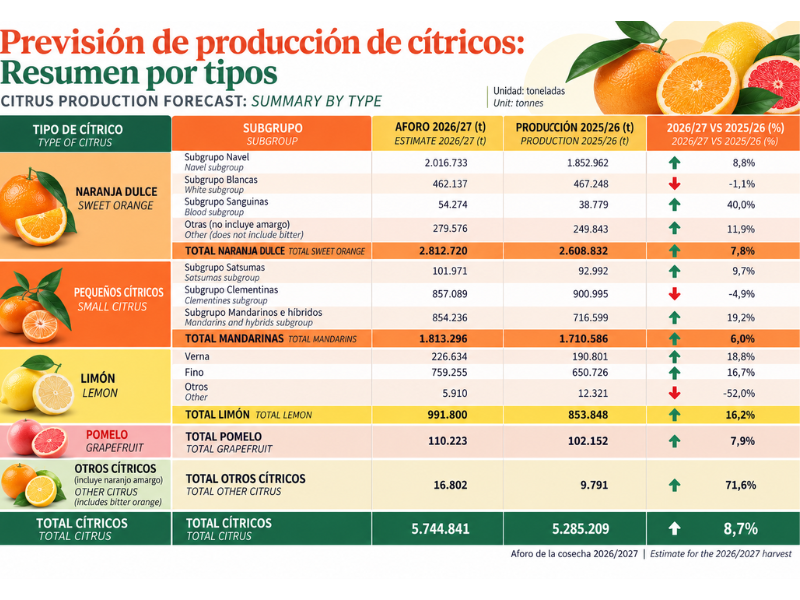
Based on data provided by the main producing autonomous communities, Spain’s initial citrus production forecast for the 2026/27 season, which began on 1 September, stands at 5,744,841 tonnes.
This estimate represents an increase of 1.1% compared with the 2025/26 season, which ended with the lowest production of the past decade. Despite this recovery, the forecast harvest will remain 4.2% below the average for the past five seasons.
According to the Spanish Ministry of Agriculture, Fisheries and Food (MAPA), the season has benefited from good water availability following rainfall during the winter and spring. However, high summer temperatures caused fruit drop, reducing initial harvest expectations, particularly for oranges and clementines.
By product group
Orange production is expected to reach 2.8 million tonnes, 4.6% lower than last season. As usual, oranges will remain the largest citrus category, accounting for 49% of total production. Navel varieties will represent 72% of the oranges produced in Spain.
Small citrus production is forecast at 1.8 million tonnes, 0.8% higher than last season but 4.5% below the average. This category will account for 32% of total citrus production. Satsumas will represent 5.6% of the category, recovering from last season’s particularly low levels; clementines will account for 47.3%; and other mandarins and hybrids for 47.1%, with the latter recording a significant 19% increase compared with the 2025/26 season.
RELATED NEWS: The citric fruit production has reached 5.8 million tonnes: 8.6% less than over the last 5 years
The lemon harvest is expected to recover to 991,800 tonnes, 21% above last season, although still below its potential. This would represent an increase of 172,900 tonnes (+21%) compared with last season and 29,000 tonnes (+3%) above the five-year average. Fino lemons will account for 76% of production and Verna for 23%.
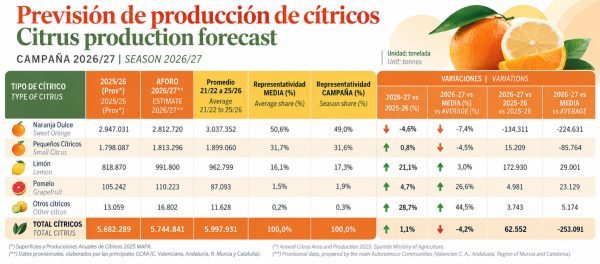
Grapefruit production is expected to reach a new record for the third consecutive year, exceeding 110,000 tonnes, 4.7% more than in 2025/26.
During the Sector Committee meeting, participants also analysed the market outlook, developments in foreign trade and the phytosanitary situation, with particular attention to citrus vein clearing virus, as well as the sector’s promotional programmes.