









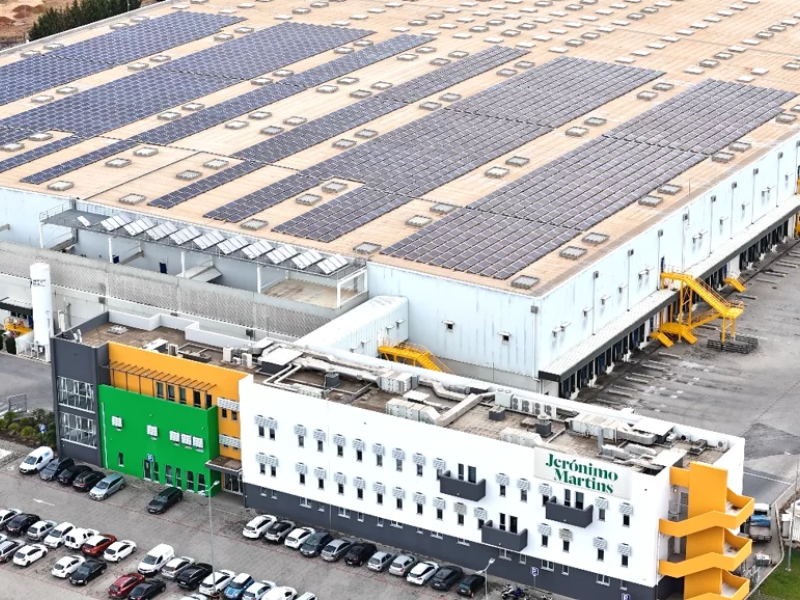
GreenYellow, an international specialist in decarbonisation and flexible electrification, is supporting Jerónimo Martins, one of Portugal’s leading food retail groups, in advancing its energy transition strategy through the commissioning of 18 self-consumption photovoltaic plants.
Installed on the rooftops of Pingo Doce and Recheio Cash & Carry stores, as well as at a facility operated by Luis Vicente, a Portuguese fruit and vegetable producer, the solar installations have a combined capacity of 8 MWp and will generate approximately 11.6 GWh of renewable electricity per year.
By producing part of the electricity required for its operations directly on site, Jerónimo Martins will reduce its exposure to energy market volatility, improve cost predictability and contribute to the decarbonisation of its activities.
Solar generation adapted to each site’s needs
The 18 photovoltaic plants will prevent the emission of more than 1,230 tonnes of CO₂ annually, equivalent to the yearly electricity consumption of over 3,860 households.
For the retail sector, where energy demand is continuous and significant due to refrigeration systems, lighting and air conditioning, self-consumption allows renewable electricity to be generated and used directly where it is needed.
In this context, energy becomes not only a sustainability tool but also a driver of operational efficiency, electrification and competitiveness.
A multisite approach to accelerate decarbonisation
The project highlights one of the main challenges faced by companies operating extensive networks of facilities: implementing a consistent energy strategy across multiple locations while adapting solutions to the specific characteristics of each site.
The installations are distributed across 18 locations throughout Portugal, each with different technical, regulatory and operational requirements, including rooftop configurations, grid connection conditions and consumption patterns.
GreenYellow combines standardised processes, local expertise and tailored solutions to ensure that each installation responds to the needs of the individual asset while maintaining a scalable approach.
“In the retail sector, energy is a strategic operational cost and an important factor in competitiveness. Generating renewable energy directly on site enables our customers to better control their costs, reduce their exposure to market volatility and make tangible progress towards their decarbonisation goals,” explains Luis Almeida, Managing Director of GreenYellow Portugal.
Energy-as-a-Service model removes investment barriers
The project is being developed through a 15-year on-site power purchase agreement (PPA), allowing Jerónimo Martins to benefit from the electricity generated by the solar plants without directly financing the installations.
Under this model, GreenYellow is responsible for the complete project lifecycle, including assessment, investment, design, engineering, procurement, installation, operation and maintenance throughout the contract period.
This turnkey approach enables companies with multisite operations to deploy renewable energy infrastructure more rapidly while relying on a single partner to manage the entire process over the long term.
International expertise supporting energy transformation
The collaboration with Jerónimo Martins builds on GreenYellow’s experience supporting major companies with multisite and multigeographic operations.
Across markets including Poland, Portugal, France and Spain, the company develops energy solutions designed to generate renewable electricity closer to consumption points, increase electrification and improve energy flexibility.
With this project, GreenYellow continues to support retail and industrial companies in their transition towards a new energy model, where decarbonisation, electrification and flexibility become key drivers of sustainable performance.