







The average decline, however, masks much sharper losses in certain producing areas, where volumes could fall even further following the latest adverse weather events. The organisation warns that the impact will not be limited to lower yields, but could also result in reduced marketable quality and higher rejection rates.
Weather reduces fruit load
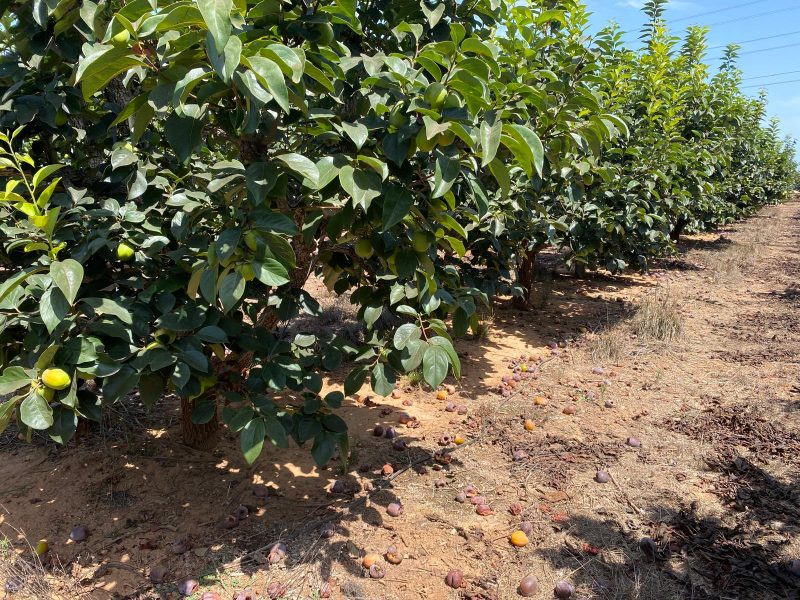
From an agronomic perspective, adverse weather conditions have affected the physiological development of the trees. Natural fruit drop has been unusually severe on many farms this year, causing excessive thinning and significantly reducing the crop load.
This has been compounded by high temperatures and heatwaves, which have caused sunscald damage to the fruit. Recent storms have also severely affected production across several growing areas.
Against this backdrop, LA UNIÓ has already called for insurance cover against other climatic risks, including wind damage, to begin on 1 August. In the meantime, it is asking the Valencia regional Department of Agriculture to establish compensation for insured growers who have suffered wind-related losses.
Fewer tools available for pest control
The fall in production comes alongside growing concern over the development of certain pests. Growers continue to face significant difficulties controlling mealybug, particularly Pseudococcus longispinus, as well as several species of whitefly, including Dialeurodes citri, Paraleyrodes minei and Aleurothrixus floccosus.
LA UNIÓ argues that growers cannot be expected to achieve effective pest control while having access to fewer and fewer crop protection tools. Although these pests may not directly reduce the initial crop forecast, they can damage the fruit and increase rejection rates, further reducing the volume ultimately available for marketing.
Higher costs put margins under pressure
The farming organisation warns that grower profitability is being squeezed by a combination of factors: fewer kilos per hectare, higher production costs, additional treatments, greater water use and rising expenditure on energy, diesel and fertilisers.
High temperatures are also forcing growers to irrigate more frequently on many farms, adding further financial pressure.
RELATED NEWS: Valencian Community’s organic sector approaches €1 billion
LA UNIÓ hopes prices will remain at levels capable of partly offsetting the reduced supply. However, it stresses that higher prices alone do not guarantee profitability.
“There is no point looking only at the price per kilo; profitability depends on the kilos the grower is ultimately able to sell and how much it has cost to produce them,” the organisation states.
Calls for emergency authorisations
Against this backdrop, LA UNIÓ is calling on the relevant authorities to grant emergency authorisations for plant protection products where sufficiently effective alternatives are unavailable, particularly against mealybug and whitefly.
Solutions highlighted by the sector include acetamiprid against these pests and cyantraniliprole against whitefly.
The organisation also considers it essential to strengthen applied research and knowledge transfer to growers, speed up access to effective solutions and continue developing biological control, while warning that it should not be presented as a stand-alone answer to all current phytosanitary challenges.
A key crop for many areas of Valencia
For LA UNIÓ, the situation facing persimmons goes beyond the current season. The crop has played an important role in diversifying agriculture and generating economic activity across numerous areas of Valencia, complementing citrus and other crops. In some locations, it has become one of the few viable alternatives available to growers.
“Persimmon has been an alternative that has diversified agriculture and the economy in many producing areas of Valencia. We cannot allow a crop that has generated opportunities and agricultural activity to progressively lose profitability because growers do not have the tools they need to deal with the problems they face in the field,” LA UNIÓ says.
Accepting skin blemishes could reduce food waste
The organisation also believes consumers should become more accustomed to finding persimmons with superficial skin marks, as the fruit is particularly sensitive to external damage.
These blemishes do not affect the fruit’s eating quality or internal characteristics. Greater consumer acceptance could therefore help maximise the amount of fruit marketed and reduce food waste during what is shaping up to be a particularly difficult season for the sector.