








Kissabel continues to gain ground in the European apple market, with demand for its distinctive red-fleshed varieties exceeding available production in several key countries. The brand is strengthening its position in the United Kingdom, France and Italy, where consumer interest is creating new commercial opportunities.
According to Jeremy Linsell, programme manager for Kissabel, European production will reach just under 7,000 tonnes in 2026, with most of the crop expected to be marketed before Christmas.
The brand currently comprises nine apple varieties, including six with red skin and red flesh and three with yellow or orange colouring. Their different ripening periods allow the commercial season to extend over several months.
A distinctive product attracting consumer interest
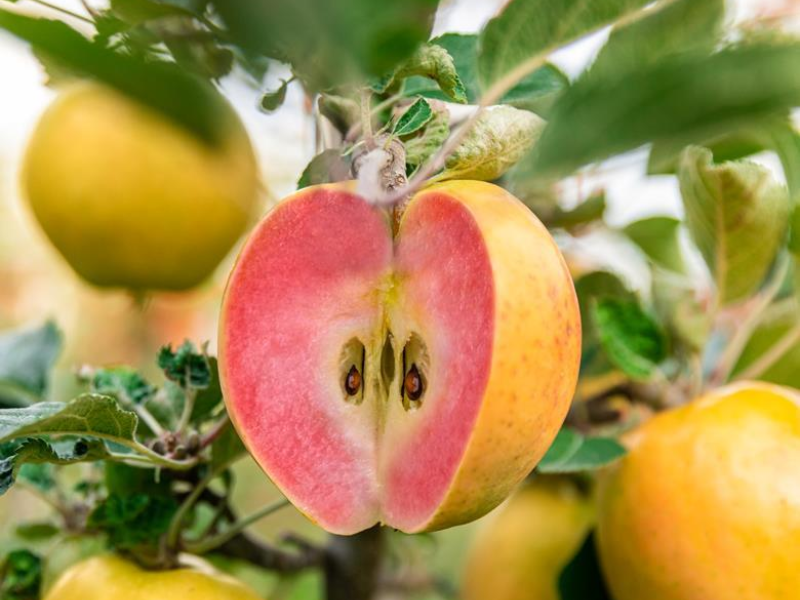
Kissabel apples are characterised by their coloured flesh, which ranges from pink to deep red, offering a point of differentiation within the apple category.
The varieties have been developed through conventional breeding techniques under the Ifored programme, an international partnership involving 13 leading fruit production and marketing companies.
For Linsell, the brand’s potential goes beyond occupying a small premium segment. He believes its distinctive appearance and eating characteristics can help generate additional interest in the wider apple category.
Demand is currently particularly strong in Italy, France and the United Kingdom, where sales have developed faster than production capacity.
Communicating the product’s distinctive characteristics remains an important part of the commercial strategy. Packaging that shows the apple’s coloured interior is one of the tools being used to ensure consumers recognise what makes Kissabel different from conventional varieties.
A longer marketing season
Kissabel’s varietal portfolio provides opportunities to extend the harvesting and marketing period.
In the United Kingdom and France, commercialisation begins in early September with the Y101 selection, while the later-maturing R201 is not harvested until early October.
However, availability is still largely concentrated in the autumn, prompting the programme’s partners to investigate new storage solutions.
In Italy, NovaMela is conducting longer-term storage trials with R205, while British partners are assessing the storage potential of R204, a selection that has shown particularly promising commercial performance in the UK.
These initiatives aim to extend the sales window and improve continuity of supply, giving retailers more opportunities to incorporate the red-fleshed apples into their assortments.
Expansion into the Southern Hemisphere
European Kissabel production is currently established in the United Kingdom, France, Italy, Germany and Switzerland.
The programme’s longer-term ambition is to develop counter-seasonal supply from the Southern Hemisphere, with the objective of making the brand available throughout the year.
Australia is among the most advanced markets in this expansion strategy. Local partner Montague has established commercial production and planted a significant number of trees.
RELATED NEWS: Kissabel® grows in Europe and kicks off the Southern Hemisphere season
In South Africa, Dutoit is preparing to begin commercial plantings as part of its development plan for the brand.
Progress outside Europe has been slower in some cases because plant material must undergo quarantine procedures before it can be introduced into new production regions.
Varietal adaptation and grower profitability
Despite growing commercial interest, expanding Kissabel production requires careful evaluation of local growing conditions.
The selections are particularly sensitive to factors such as altitude, soil characteristics and climate, making regional trials essential before commercial planting.
This sensitivity means that varieties performing successfully in one production area may not necessarily achieve the same results elsewhere.
For the Ifored partners, selecting the right varieties for each growing region is therefore a priority, both to maintain fruit quality and to protect growers’ returns.
Linsell emphasises that producer profitability remains central to the programme’s development, with commercial expansion dependent on varieties that deliver consistent performance under local conditions.
With demand continuing to exceed European supply, Kissabel is focusing on increasing production, improving storage performance and establishing new growing regions to support the brand’s international growth.