








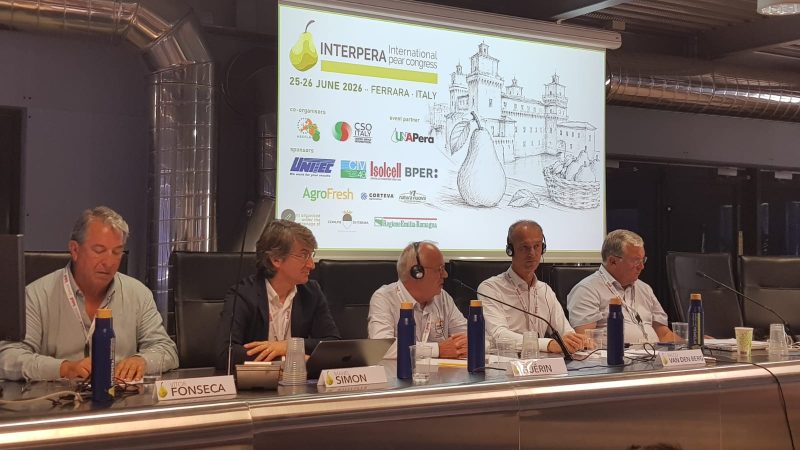
The International Pear Congress, Interpera 2026, held in Ferrara, presented the first pear production estimates for the 2026/2027 season in the main European producing countries.
The figures point to a mixed campaign, with expected declines in Spain, France and Belgium, a significant increase in Portugal, and still no final estimate for Italy and the Netherlands.
Manel Simon, general director of Afrucat, said: “The 2026/2027 campaign will be shaped by the final harvest volume, but also by the sector’s ability to manage rising costs, labour availability, varietal adaptation, access to water and increasing restrictions in crop protection.”
“The European pear sector is facing a technically complex season. Geopolitical instability has driven up the cost of key inputs, especially fertilisers and energy. This is compounded by rising labour costs, not so much due to the evolution of the minimum wage, but because of the growing difficulty in finding qualified labour,” he added.
Joan Serentill, president of Afrucat’s apple and pear committee, said: “Legislative difficulties and restrictions on control methods in the fruit sector mean that producing pears has become a task reserved for the bravest.”
The figures
Spain is expected to reach 251,265 tonnes, 6% less than in 2025. France would stand at 143,000 tonnes, also down 6%, while Belgium forecasts 363,875 tonnes, a 7% decrease.
By contrast, Portugal estimates a harvest of 130,500 tonnes, representing a 13% increase compared with the previous year.
Italy and the Netherlands have not yet provided a specific figure. However, Italy expects production to be higher than in 2025, while the Netherlands could remain at levels similar to those of the previous season.
Structural changes in the European pear sector
The presentation also highlighted the structural transformation taking place in the European pear sector. Productive area is evolving differently depending on the country: Italy has recorded a very significant cumulative reduction in recent years; Spain maintains a slight downward trend; Portugal is also reducing its area; while Belgium and the Netherlands remain stable and France shows a positive trend.
In 2025, the main pear-growing areas were located in Italy, with 19,576 hectares; Spain, with 17,722 hectares; Belgium, with 10,834 hectares; Portugal, with 10,230 hectares — 2024 data —; the Netherlands, with 9,979 hectares; and France, with 6,200 hectares.
Conference remains the leading variety
At varietal level, Conference remains the dominant pear variety in several European markets, especially in Belgium and the Netherlands, while Portugal maintains an almost complete specialisation in Rocha.
RELATED NEWS: The European apple and pear sector meets at Prognosfruit
Spain and Italy have a more diversified varietal structure. In Spain, Conference is the main variety, followed by Williams, Ercolini, Guyot-Limonera, Blanquilla and other varieties.
In Italy, production continues to be distributed between Williams, Abate Fetel, Coscia-Ercolini, Conference and other varieties.
Localised weather impacts
Regarding weather conditions, the different countries reported localised incidents.
Spain recorded specific damage from frost, hail and storms, as well as episodes of intense heat in May and June, with temperatures close to 40ºC.
France experienced heatwaves during flowering and fruit set. Portugal reported frost and hail events in some areas, while Italy and the Netherlands pointed to limited or localised climatic impacts, mainly linked to storms or hail.