








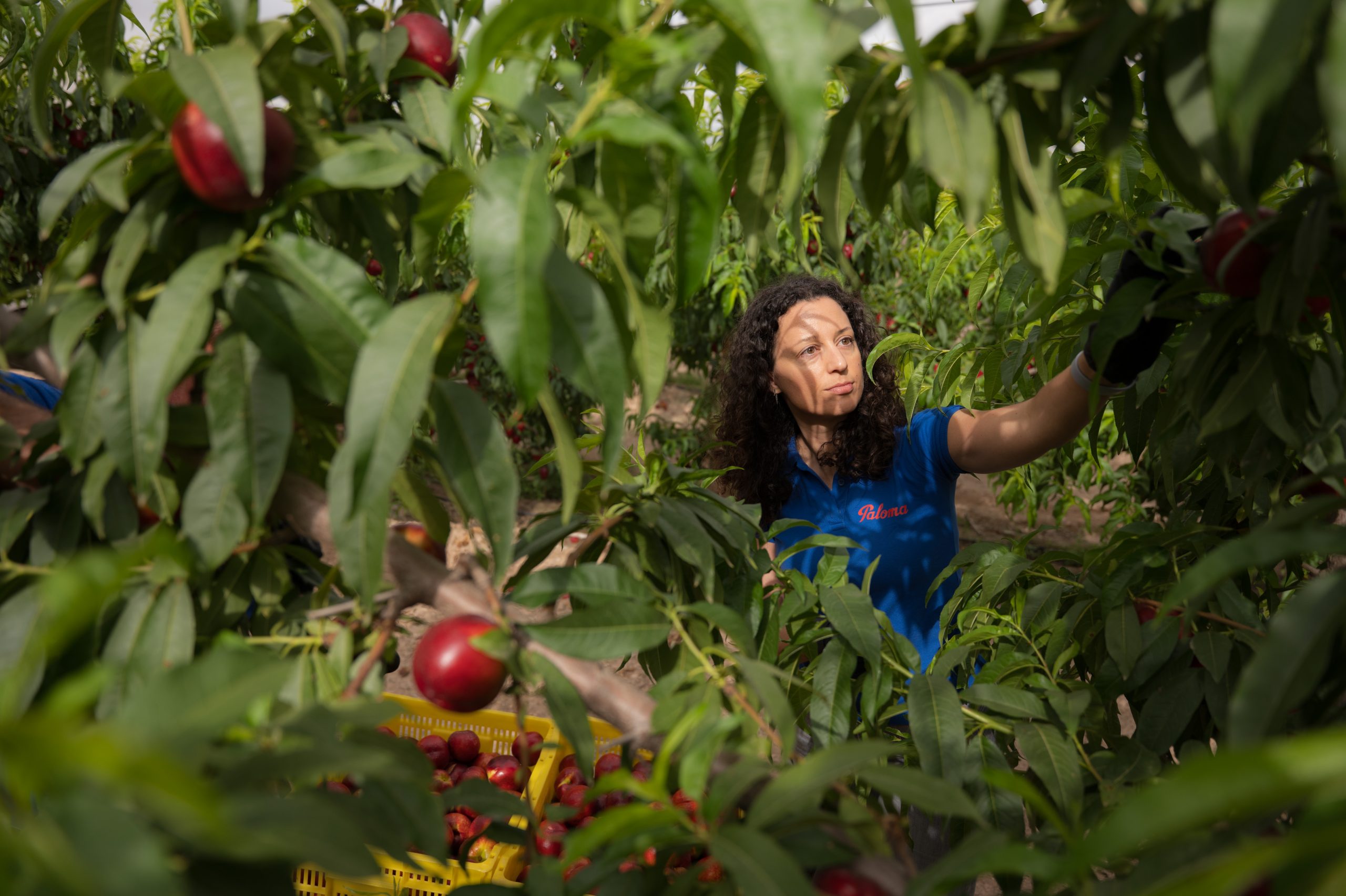
The group is already working on a varietal research line aimed at entering categories that, until now, have not been part of its commercial portfolio: peaches, flat nectarines and flat peaches.
Ana Hernández, Innovation and New Development Manager, explains that the company is testing new materials under its own growing conditions to assess whether these varieties are capable of meeting the demands of such early production.
For years, Paloma left peaches out of its range because the available varieties did not offer the necessary organoleptic qualities at such an early stage of the season, “but today we are already carrying out trials with peaches, flat nectarines and flat peaches to evaluate their adaptation.”
In this context, varietal innovation is supported by work with specialised breeders. Paloma works with PSB, whose developments are geared towards early production areas and calendars. The new varieties gaining ground in this segment respond to a very specific profile: sub-acid fruit, with firmness, attractive colour and good flavour levels, even outside the traditional season.
RELATED NEWS: Grupo Paloma: “what matters is not arriving early, but arriving with quality”
The most significant leap is taking place in the use of technology applied to the field. As Paloma works under netting, it cannot rely on drone-based analysis, so it has incorporated image-capture systems using cameras mounted on a quad that moves through the plots. This technology makes it possible to analyse the crop tree by tree and obtain key information for decision-making.
One of its most relevant uses is during thinning. In stone fruit, leaving the right number of fruits on the tree is essential to achieving the desired size and quality.
The same technology is later used for crop forecasting. Once the fruit has grown, the system makes it possible to estimate the real production of each plot.
This tool is complemented by dendrometers, devices that measure fruit growth in real time. Combining these data with records from previous campaigns, weather information and artificial intelligence makes it possible to anticipate the start of harvesting with greater accuracy.