







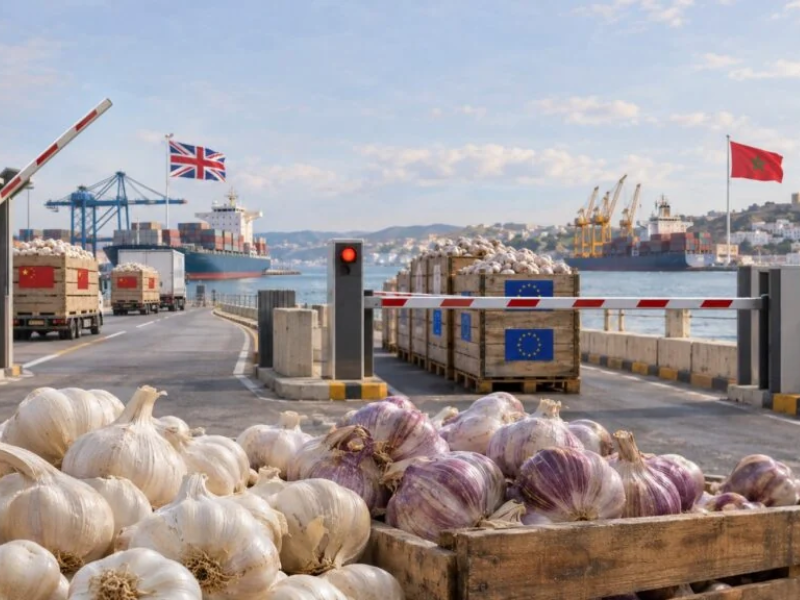
The National Association of Garlic Producers and Marketers of Spain (ANPCA) is calling on the Spanish Government and the European Commission to take coordinated action in response to changes affecting access for Spanish garlic to Morocco and the United Kingdom, two key markets for the sector’s exports.
ANPCA is concerned about the introduction of a licensing system for imports of fresh or chilled garlic into Morocco, announced with a duration of 18 months. Although the measure does not in itself amount to an import ban, ANPCA believes it could create uncertainty among operators if delays or restrictions arise in the granting of licences.
The association is therefore calling for greater clarity on the criteria governing the granting of licences, processing times and the impact that the new system could have on commercial operations.
UK move could increase competitive pressure
The situation comes alongside the decision announced by the British Government to temporarily suspend tariffs on certain products, including garlic, from 26 November. This measure is expected to remain in place until the end of 2028.
The published tariff reference for garlic is 8% plus £100 per 100 kilograms. ANPCA warns that the change could increase competitive pressure from suppliers in third countries in the UK market.
ANPCA considers it particularly important to determine whether the suspension will apply to garlic imported outside tariff quotas and, specifically, what its scope will be in relation to imports from China.
UK and Morocco account for more than 20% of Spanish exports
The importance of both destinations explains the sector’s concern. In 2024, Spain exported 14,889.5 tonnes of fresh or chilled garlic to the UK and 15,215 tonnes to Morocco.
Together, the two markets received 30,104.5 tonnes, equivalent to 21.26% of the 141,600 tonnes exported by Spain to all destinations that year. The UK accounted for 10.52% of the total volume, while Morocco represented 10.74%.
In 2023, Spanish garlic sales to the UK reached 17,160.8 tonnes, representing 11.52% of the country’s total garlic exports that year. In Morocco, the volume received in 2025 stood at approximately 11,284 tonnes, according to international trade data.
“These are not marginal markets, but key destinations for Spanish garlic. The combination of new market-access requirements in Morocco and the potential increase in competition in the UK means that Europe needs to act quickly,” said Juan Salvador Peregrín Cervantes, president of ANPCA.
ANPCA calls for closer monitoring of trade flows
Against this backdrop, the association is asking the European Commission to assess the compatibility and practical implementation of the Moroccan licensing system with existing trade commitments and to request information from the Moroccan authorities on the criteria and conditions governing its application.
Regarding the UK, ANPCA is calling on Spain and the EU to assess the scope of the tariff suspension and its potential impact on garlic quotas from third countries.
RELATED NEWS: Spanish garlic sector reports high-quality campaign
The association considers it necessary to establish mechanisms for monitoring trade flows and to make use of the trade defence measures available under current legislation whenever the requirements for their application are met.
ANPCA is also proposing technical dialogue between the Spanish authorities, European institutions and the sector itself before the planned changes in the UK come into force.
“Europe must guarantee a level playing field and defend a production sector that generates employment, economic activity and added value in rural areas,” ANPCA concludes.