








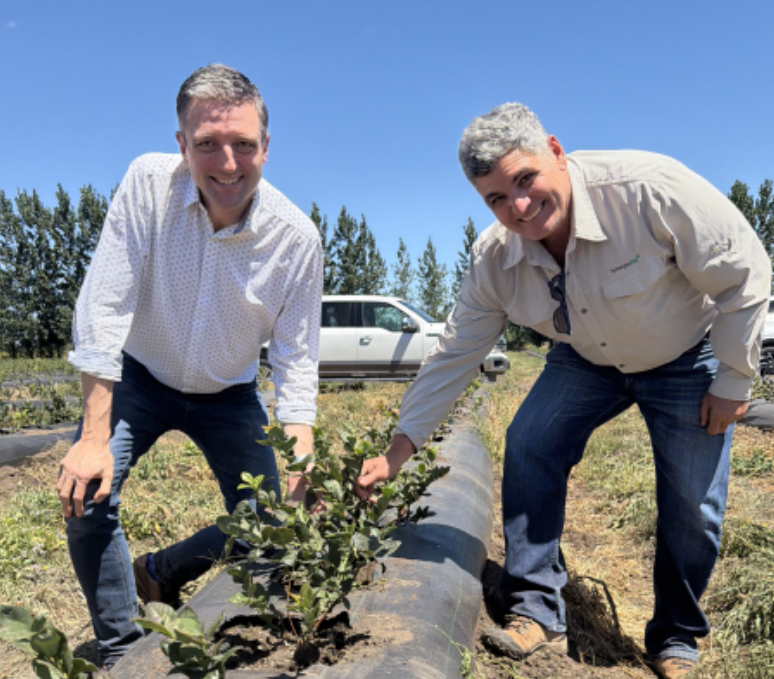
After spending a week in Chile visiting growers, nurseries, trial sites and tissue culture laboratories, Jamie Petchell, co-founder of Global Plant Genetics (GPG), says one message stood out clearly: Chile’s blueberry industry is not in decline, but in deliberate transition.
“The conversations I had were not about whether change is coming — but about how quickly it can be implemented, and which producers will be best positioned when the dust settles,” he says.
From maturity to modernisation, Chile was one of the early pioneers of the global blueberry industry, helping to shape international markets and consumer demand. However, Petchell believes that the same maturity now means the industry must continually renew itself in order to remain relevant.
Across multiple regions, he observed widespread replanting, modernised production systems and a growing reassessment of what constitutes a commercially viable variety.
“This is not just a varietal refresh — it is a structural shift,” he explains.
Genetics as a strategic decision
One of the most consistent themes Petchell encountered was how central variety choice has become to long-term commercial survival.
Growers, he says, are acutely aware that they are no longer competing solely with neighbouring farms, but with high-quality production from across Latin America, Africa, Europe and Asia.
“Quality is no longer a differentiator — it is the baseline,” Petchell notes. “The real competition now lies in consistency, shelf life, flavour, firmness, fruit size and post-harvest resilience.”
This is particularly important for Chile’s fresh export markets, where retailers are tightening specifications and consumers are becoming increasingly discerning.
“Without the right genetics, even the most experienced producers will struggle to maintain margins,” he adds.
RELATED NEWS: Andalusia leads European blueberry production
Climate realities shaping decisions
Climate change is no longer an abstract discussion in Chile, according to Petchell — it is influencing practical decisions on the ground.
Formerly high-chill zones are now being reclassified as mid-chill or even low-chill, while heat tolerance and seasonal stability have become essential traits.
“This climatic shift is reshaping what breeders, nurseries and producers consider to be viable long-term options,” he explains.
Insights from the ground
Petchell says that visiting trials, nurseries and tissue culture laboratories together with GPG’s licensed partners SynergiaBio, Viveros Hijuelas and Viveros Sunnyridge offered a valuable glimpse into how quickly the industry can move when aligned.
One of the most striking developments he observed was the rapid speed to production of newer low-chill varieties, significantly improving the economics of establishment years.
“Five or ten years ago, varietal change was often incremental,” he says. “Today, it feels purposeful. This change is no longer theoretical — it is happening.”
Chile’s next phase
Looking ahead, Petchell believes Chile’s blueberry industry will look markedly different within the next five to ten years.
He expects to see larger, more consolidated production areas with greater average field sizes, supported by industry-leading varieties capable of performing across extended windows.
“Success will not be defined by volume alone, but by consistency, fruit quality, cost efficiency and post-harvest performance, all traits being developed by our breeding partners at Oregon Blueberry and The University of Georgia,” he says.
With harvesting costs and labour pressures unlikely to ease, the varieties that succeed will be those that reduce inputs, simplify management and still deliver premium fruit.
A strategic crossroads
Petchell concludes that Chile’s future competitiveness will not be decided by hectares alone, but by decisions being made today around genetics, production systems and long-term planning.
“What I saw was not an industry looking backwards,” he says. “It was one preparing itself for a more demanding, more competitive, and ultimately more rewarding future.”