







The company works to ensure that this calendar does not overlap with domestic production, so that the last imports are usually positioned between 8 and 10 April, just before the transition to Spanish production.
Candil highlights that Senegal offers agronomic conditions that fit the company’s programme requirements, with soils and water comparable to those in Spain and climatic behaviour that, in his view, resembles production areas such as La Mancha, particularly due to the temperature difference between day and night. This variation, he notes, favours the production of high-quality watermelon.
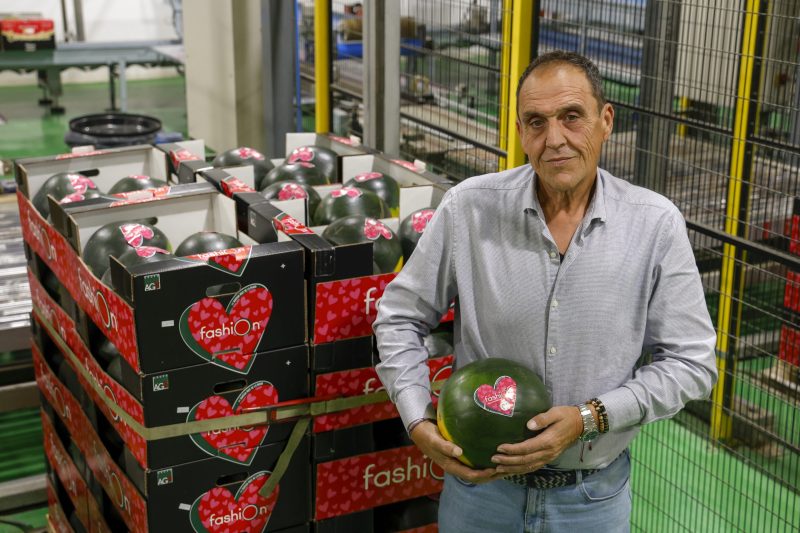
He also stresses that, although there are other international origins, “Senegal is the country that best complies with the protocol and standards required by Fashion.”
This transition between campaigns is part of a broader strategy. Domestic greenhouse production of Fashion watermelon is expected to start between 20 and 25 April in Almería, followed later by open-field production.
Fashion is a well-known commercial brand driven by a group of growers who joined forces with the aim of offering the widest possible calendar to customers, without compromising on consistent quality. The brand is built on a specific seed, its own quality protocol and a commitment to maintaining consistency throughout the campaign.
Within this structure, each production area enters the market at the most suitable time. In Cuevas de Almanzora (Almería), where SAT AgroAlmanzora operates in open field, harvesting begins in June, once the greenhouse cycle concludes.
This territorial rotation within the Fashion programme allows for a continuous supply over approximately seven months, supported by growers across different regions and complementary production windows.
The new Spanish campaign
Regarding the new Spanish campaign, Candil remains cautious. He avoids setting firm volume forecasts, arguing that counting transplanted plants is not enough: it will be the evolution of flowering, fruit set and weather conditions that ultimately determine production levels.
What he does confirm is that “the planted area appears to be very similar to last year, although with adjustments between regions.”
Among these regions, Seville could gain prominence this campaign. Candil points out that abundant rainfall has left sufficient water reserves and well-prepared soils, suggesting favourable conditions for crop development in the province.
RELATED NEWS: Watermelon: Almería’s season faces ‘serious difficulties’
At the same time, he recalls that winter has been challenging, and greenhouse performance has been influenced both by climatic conditions and by the context of other crops, although planting volumes eventually exceeded initial expectations.
Beyond watermelon, SAT AgroAlmanzora complements its activity with other horticultural crops. During winter, it grows open-field lettuce, broccoli, pak choi and other leafy vegetables, before watermelon takes centre stage in spring.
Not surprisingly, Candil emphasises that watermelon is the company’s flagship product, with production reaching 32,000 tonnes last year.
However, the leafy vegetable campaign has not been easy. Heavy rainfall has marked the winter in the region, with more than 400 mm of rain in two months, a situation Candil describes as particularly challenging for lettuce production.