










The spread of Thrips parvispinus is causing increasing damage to pepper crops in Almería, prompting the Andalusian Government to renew its call for emergency authorisation of additional plant protection products.
According to Ramón Fernández-Pacheco, Andalusia’s Regional Minister of Agriculture, Fisheries, Water and Rural Development, more than 6% of the province’s pepper-growing area was cleared in October 2026 alone, compared with approximately 2% during the entire previous season.
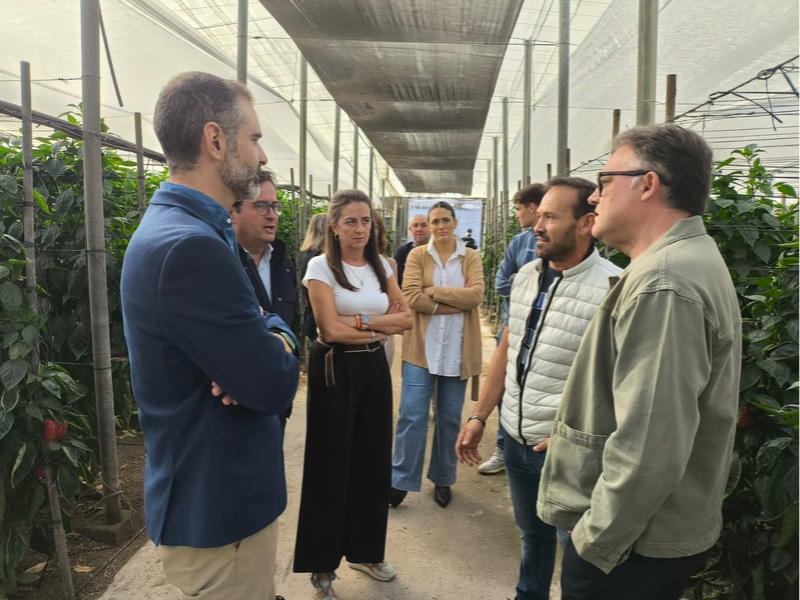
The minister highlighted the seriousness of the situation during a visit to a pepper greenhouse in Berja, accompanied by the town’s mayor, José Carlos Lupión, and representatives of the regional administration.
“During the entire previous agricultural season, around 2% of Almería’s pepper-growing area had to be cleared. In October 2026 alone, that figure had already exceeded 6%,” Fernández-Pacheco explained.
The figures highlight the growing impact of a pest that has become one of the main phytosanitary challenges facing Almería’s greenhouse production sector.
Andalusia requests emergency authorisations
In response to the worsening situation, the regional minister announced that the Andalusian Government had once again asked Spain’s Ministry of Agriculture to grant emergency authorisation for two crop protection solutions.
The request, submitted following an appeal from COEXPHAL, includes Movento, a product for which the regional administration had previously sought emergency authorisation. The Ministry rejected that application on 22 October.
Fernández-Pacheco argued that countries including Portugal, France, Italy and Germany had granted emergency authorisations for the product, and called for Spain to consider a similar approach.
The second requested solution is spinetoram, which the minister believes could help contain the pest while remaining compatible with the biological control strategies used in Almería’s greenhouses.
He also referred to sulfoxaflor, noting that the possibility of an emergency authorisation had been raised, although the substance already has an existing authorisation.
“Almería’s agricultural sector needs effective tools now. We cannot keep waiting,” Fernández-Pacheco insisted.
Current measures are proving insufficient
The Andalusian Government has already introduced several measures to limit the impact of Thrips parvispinus, including financial assistance for growers affected during the previous season.
These efforts have been accompanied by initiatives to promote good agricultural practices through IFAPA and the Regional Delegation of Agriculture, alongside inspections aimed at ensuring compliance with crop management requirements.
The inspections also seek to prevent practices that could increase phytosanitary risks for neighbouring farms.
However, Fernández-Pacheco acknowledged that the measures implemented so far have not been enough to stop the pest from spreading.
The minister stressed that an effective response requires coordinated action involving growers, research institutions and public administrations.
He also warned of the urgency of the situation for farms in higher-altitude production areas such as Berja, where some growers are approaching the start of harvesting.
“The problem is much greater than it was last year,” he said, expressing hope that further measures could help contain the damage before the end of the pepper season.
Concerns over the future of pepper production
The growing incidence of Thrips parvispinus is adding further pressure to Almería’s pepper producers, who face the challenge of protecting their crops while working with a limited range of available plant protection products.
For the regional administration, access to effective pest control solutions is essential to prevent further crop losses and protect the economic viability of affected holdings.
During the visit, Berja Mayor José Carlos Lupión welcomed the opportunity for direct dialogue between the authorities and local growers.
He emphasised the importance of greenhouse agriculture to the municipality’s economy and called for continued cooperation between public administrations to address the challenges facing the sector.
With pest pressure already exceeding the levels recorded throughout the previous season, the Andalusian Government is urging the Ministry of Agriculture to respond to its emergency authorisation requests and provide growers with additional tools to protect their pepper crops.