






Rijk Zwaan continued its steady growth during the 2025/2026 financial year, increasing net revenue by 7.5% to €735 million. Growth was recorded across virtually all of the company’s active regions and crops.
Net profit also increased significantly, reaching €90 million, compared with €68 million in 2024/2025. During the financial year, Rijk Zwaan also opened new facilities in Brazil, the Netherlands and South Korea.
“Stability is a hallmark of our business operations,” said Ben Tax, member of the Rijk Zwaan board. “Our primary objective is to offer employees a job for life, and financial stability plays an essential part in this. It enables us to continue investing in our employees, in innovation and in sustainable solutions for the world food supply.”
Innovation with a practical impact
Research and innovation remain at the heart of Rijk Zwaan’s activities. Through continuous investment in breeding, the company develops fruit and vegetable varieties designed to respond to challenges such as climate change, pests and diseases, while also meeting changing consumer expectations.
During the past financial year, Rijk Zwaan launched a number of new concepts. These include aphid-resistant iceberg lettuce varieties, cabbage varieties designed for mechanised harvesting and processing, and Candy Ball watermelons weighing between 1 and 2 kilograms.
The smaller watermelon format responds to the growing demand for convenience and is particularly suited to smaller households.
These developments reflect the company’s approach across the fresh produce value chain, from more sustainable cultivation and more efficient processing to products that respond to consumer preferences.
Expanding the global network
Rijk Zwaan is continuing to expand its international network in order to remain close to customers and respond to developments in local markets.
The company has opened a new breeding station in Brazil focused on developing varieties suitable for tropical and subtropical climates. In South Korea, a new Rijk Zwaan subsidiary has been established to strengthen the company’s presence and service in the market.
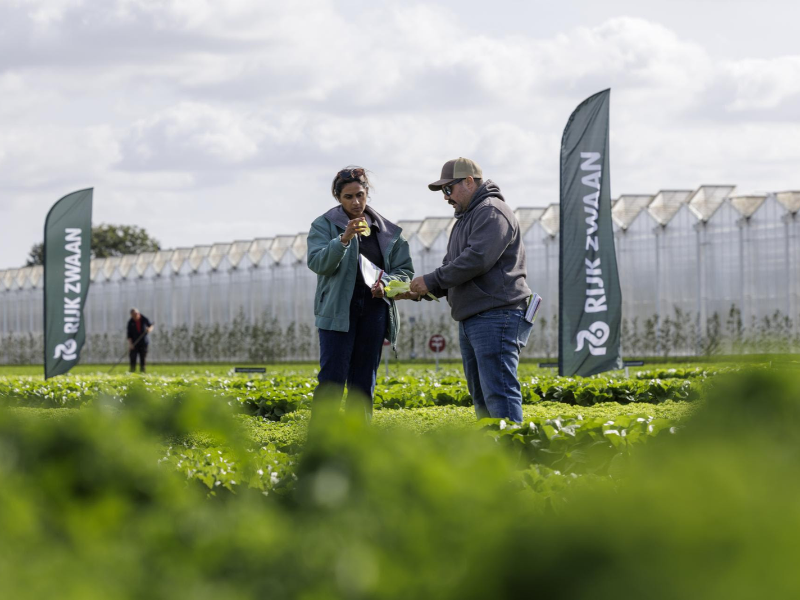
Another new facility is the Trial Centre Open Field in Heijningen, in the Netherlands, where customers and value-chain partners can assess new varieties and cultivation concepts for open-field crops such as lettuce, brassicas and leeks under real-world conditions.
RELATED NEWS: Rijk Zwaan turns innovation into solutions for the entire value chain
These investments reinforce a global network spanning more than 100 countries, based on close cooperation with growers, processing companies, retailers and other partners across the fresh produce chain.
Alongside its physical presence, Rijk Zwaan is also expanding the use of digital tools to share knowledge and stay connected with customers. These include making crop data available to growers, increasing the number of countries where seeds can be purchased online and providing technical knowledge through digital e-learning modules.
A global network with a shared culture
The company’s expansion across different countries also means operating across a wide range of cultures and markets. According to Ben Tax, Rijk Zwaan’s company culture remains a key unifying factor throughout the organisation.
The same principles continue to underpin the company’s activities worldwide, regardless of local market conditions or cultural differences.
Contributing to global food supply
Hundreds of millions of people worldwide consume vegetables grown from Rijk Zwaan seeds, underlining the role of the breeding company in supporting the availability of fresh and healthy produce.
In a global environment marked by geopolitical tensions, changing trade routes and logistical challenges, the development of reliable and future-proof solutions for fruit and vegetable production is becoming increasingly important.
“It is precisely against this dynamic backdrop that we aim to be a stabilising force,” said Ben Tax. “We do this together with our colleagues and partners across the globe. This is how we – and our seeds – will continue to build a stable foundation for the world’s food supply.”