




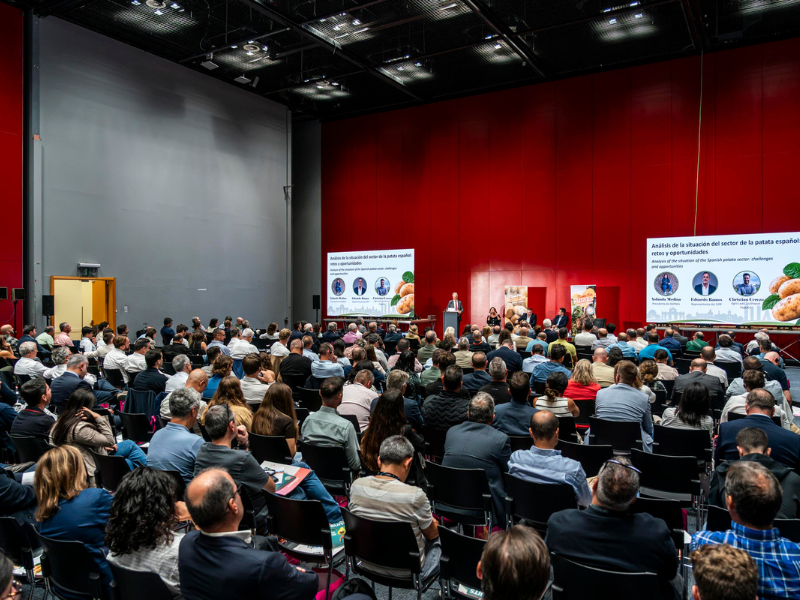
The 1st International Potato Symposium, held in Madrid on the eve of Fruit Attraction 2026, brought together nearly 250 European potato sector professionals to analyse the main challenges facing the crop. Climate change, plant health, water availability and rising production costs were among the key issues addressed during the event.
The symposium was opened by Cecilio Peregrín, President of FEPEX; Alejandro Lorca, Deputy Director-General for Fruit, Vegetables and Wine at the Spanish Ministry of Agriculture, Fisheries and Food, and Joaquín Antonio Pino, Regional Minister for Agriculture, Livestock, Rural Affairs and Environmental Policy of Castilla y León.
Peregrín highlighted the historical importance of potatoes in Europe, where around 48 million tonnes are produced, although he warned of a downward trend in production growth. Lorca, meanwhile, pointed to the Spanish market’s dependence on imports, which exceed 1.5 million tonnes per year, with France accounting for around 80% of these supplies, followed by Portugal.
Pino stressed the need to guarantee equivalent competitive conditions for European production compared with products originating from third countries.
A sector shaped by climate and costs
The programme examined the evolution of European potato production and trade, the competitiveness of the processing industry, plant health and the opportunities offered by innovation.
Peter Ton, President of Europatat, analysed the situation of potato production and trade in Europe, focusing on climate change, costs, access to water, market developments and the functioning of the single market.
In the processing sector, Nuria Moreno, Secretary General of EUPPA, outlined the main challenges facing the European processed potato industry, including raw material supply, production costs, international competition and sustainability.
Fewer tools to protect the crop
Plant health was another major focus of the symposium. Romans Vorss, Technical Affairs Director at PataFEST/Europatat, and Michal Kicinski, from CropLife Europe, addressed current and emerging plant health threats and the need for effective tools to protect crops.
The symposium highlighted the progressive reduction in the active substances available in the European Union: over the past seven years, 86 conventional active substances have been withdrawn, while only one new active substance has been registered.
RELATED NEWS: French potato crop faces historic production drop
This reduction coincides with climatic conditions that can favour the emergence and spread of certain pests and diseases. The sector warned that some organisms that previously had limited impact are becoming increasingly relevant to potato production.
Against this backdrop, Alberto Martín, from Corteva Agriscience, presented the opportunities offered by biological solutions as a complementary tool to improve crop efficiency.
Spain retains opportunities in new potatoes
The situation of Spain’s potato sector was analysed in a round table moderated by Alfonso Sáenz de Cámara, Chairman of FEPEX’s Potato Sector Committee, with the participation of Yolanda Medina, President of ASONAL; Eduardo Ramos, representing CIPP; and Christian Cerezo, from PepsiCo.
The discussion focused on the impact of high temperatures on potato production. Rising summer temperatures are contributing to a greater presence and virulence of certain pests, while this season has also seen smaller tuber sizes and storage difficulties.
Despite these challenges, participants also highlighted an opportunity for the Spanish sector: its capacity to produce and market new potatoes for much of the year, thanks to the diversity of production areas and growing calendars.
For FEPEX, the strong participation in this first edition demonstrates the sector’s interest in having platforms for dialogue and cooperation both in Spain and at European level. The event also helped raise the profile of potatoes as a strategic crop for European agriculture, food supply and the economy.
Organised by FEPEX, with the collaboration of Europatat and Fruit Attraction, the symposium took place on 5 October, ahead of Fruit Attraction, which this year placed potatoes in the spotlight as its Star Product and hosted a range of activities dedicated to the crop.