








Against this trend, Spain is growing, with Catalonia standing out with a 9% increase in its harvest, supported by a recovery in production and varietal renewal aimed at responding more effectively to a new climate scenario.
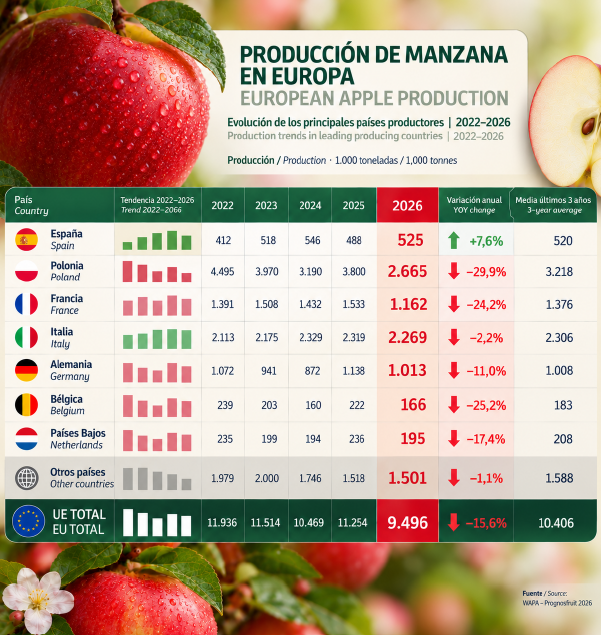
Europe’s apple sector is facing one of its smallest harvests in recent years. Production in the main EU producing countries stands at 9.49 million tonnes, 15.6% below the previous season and 14.3% below the average for the past three years.
There is no single cause behind this decline. Climate is once again the common denominator, but increasing pest and disease pressure, fewer control tools, rising costs and a gradual reduction in acreage are also playing a role.
WAPA (World Apple and Pear Association) itself warns that the sector is operating in an increasingly complex production environment, where extreme weather events directly affect both yields and quality. Moreover, the impact is far from evenly distributed.
Significant disparities
Poland, Europe’s leading producer, is experiencing one of the largest declines. Its harvest is estimated at 2.66 million tonnes, almost 30% below last year. Frost has played a decisive role in a country that, despite the decline, will still account for approximately 28% of EU production.
The situation is no more favourable in France, where production of around 1.16 million tonnes is expected, down 24.2%. In addition to weather-related factors, industry analyses point to high aphid pressure and other phytosanitary problems.
Germany is down by around 11%, to just over one million tonnes, while Belgium and the Netherlands are recording declines of approximately 25% and 17%, respectively. Italy, the EU’s second-largest producer, is weathering the downturn much better: its 2.27 million tonnes represent a fall of just 2.2%.
The picture that emerges is therefore one of a Europe with less fruit and increasingly recurrent problems involving yields, fruit size and production consistency.
Catalonia bucks the trend
Spain is one of the main exceptions among Europe’s major producers. Prognosfruit forecasts a national harvest of around 525,000 tonnes, 7.5% higher than last year.
Much of this positive performance comes from Catalonia, where Afrucat estimates production of 289,600 tonnes, 9% more than in 2025 and 12% above the average for the past five years. Girona stands out in particular, with forecast growth of 30%.
Catalonia is not literally the only European region where production is increasing — Greece and some smaller-producing countries are also recording growth — but it clearly stands apart from the main production hubs in Western Europe.
RELATED NEWS: The global apple sector enters a period of change
There is also a structural factor worth highlighting: varietal renewal. In Girona, 26% of new orchards aged between zero and two years are already planted with new varieties from varietal innovation programmes. This provides a clear indication of where the Catalan sector is heading: towards plant material capable of delivering better agronomic and commercial performance in the face of higher temperatures, new pest and disease pressures and changing market requirements.
This year’s increase in production cannot be attributed exclusively to varietal change — the recovery following seasons affected by drought and other adverse conditions has also played a role — but the strategy places Catalonia in an interesting position in the face of a problem now affecting the entire continent: varieties and production systems designed for yesterday’s climate do not always perform in the same way under today’s conditions.
Europe’s major varieties decline
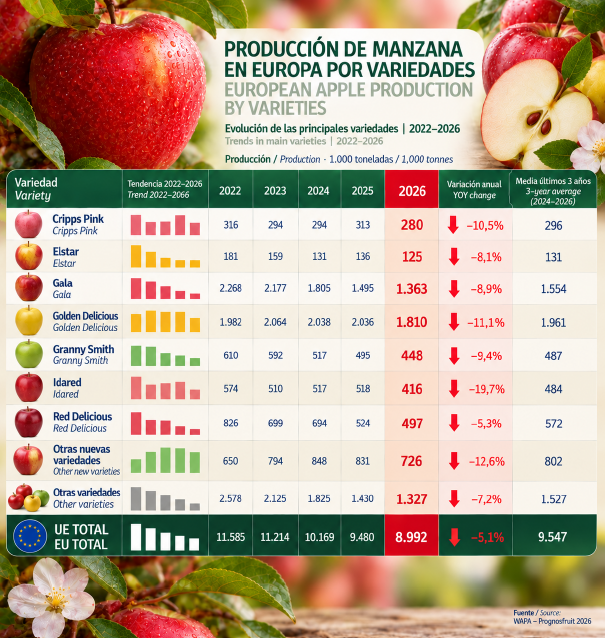
The fall in production is clearly reflected in the varietal landscape. Golden Delicious, Europe’s largest variety by volume, is down 11.1% to approximately 1.81 million tonnes. Gala falls by 8.9% to 1.36 million tonnes, while Red Delicious declines by 5.3% and Idared records one of the sharpest falls, down 19.7%.
The performance of these major varieties confirms that Europe’s production decline is not confined to a specific niche, but affects varieties that are essential to the continental market. It also brings the varietal debate back into focus. Adaptation to heat, chilling requirements, resistance to certain pests and diseases, colour development and storage performance are becoming increasingly important factors when deciding what to plant.
Asia becomes more challenging just when Europe needs to export
The paradox for the sector is that a smaller harvest comes at a time when Europe still needs to find new consumers. EU apple consumption has failed to grow sufficiently in recent years to comfortably absorb the full production potential, making markets in Asia and the Middle East increasingly attractive for higher-value varieties and brands.
However, geopolitics is making these outlets more difficult to access. Tensions in the Middle East and security concerns at strategic locations such as the Red Sea and the Strait of Hormuz are disrupting maritime flows and increasing fuel, insurance and transport costs. Although some shipping lines are gradually reinstating certain services via Suez, decisions remain dependent on developments in regional security.
Costs remain high. At the beginning of September, rates on some shipping routes to Europe remained $1,000–1,700 per 40-foot container above pre-peak-season levels, against a backdrop of expensive fuel, congestion and considerable logistical uncertainty.
Europe once again becomes the safe-haven market
Under these conditions, the season points towards greater commercial concentration within Europe itself. This does not mean that Asia is closed to European apples, but higher logistics costs and risks are reducing the appeal of distant destinations. For many operators, Europe will once again be the most logical and secure market this season.
Spain’s increase in production comes at a time when the European market has less domestically produced fruit available, which could work in Spain’s favour, and particularly that of Catalonia.
The challenge will be to take advantage of this opportunity without losing sight of the underlying issue. The decline in 2026 does not appear to be merely a one-season anomaly. Extreme weather, shrinking acreage, cost pressures and the need for varietal renewal are reshaping Europe’s apple production map.
Catalonia is managing to buck the general trend this year. But perhaps the most significant point is not simply that it is producing more, but that it has been preparing its orchards for some time to produce differently.