







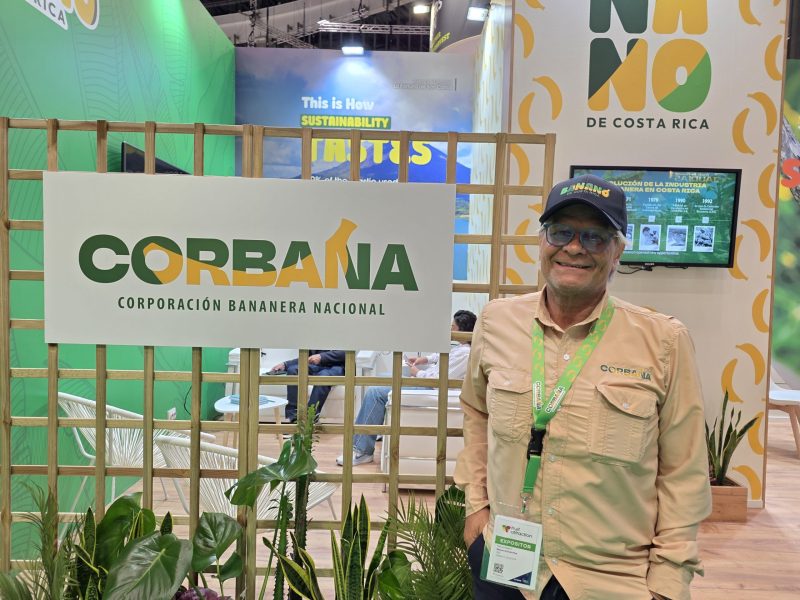
Costa Rican bananas are seeking greater differentiation in international markets while facing an increasingly difficult equation: production costs are rising, commercial requirements are multiplying and prices do not always keep pace. Marcial Chaverri, general manager of the National Banana Corporation (CORBANA) since October 2024, is proposing a change of direction that combines origin identity, innovation and profitability.
A Geographical Indication with new functions
Costa Rica has had a Geographical Indication for its bananas since 2011, but it was barely used for many years. At the beginning of 2025, CORBANA began reviewing how to turn it into an effective differentiation tool. “We considered, initially, using the Geographical Indication as an instrument to turn it into a super-certification for Costa Rican bananas in their target markets,” Chaverri explains.
The proposal responds to a common challenge for exporters: the accumulation of certifications requested by different buyers, many of which include similar requirements covering environmental, social, labour and sustainability issues. After comparing these schemes, CORBANA has designed a model which, according to its general manager, brings together the common criteria in around 280–300 questions. The aim is to simplify audits and reduce costs which, for companies holding between 10 and 15 certifications, can reach around US$100,000 a year, according to its estimates.
Recognition from supermarket chains will be crucial. Chaverri says discussions have already begun with some retailers and considers the possibility of working with one of them on this instrument during 2027. For now, however, this remains a goal under development rather than an effective replacement for the certifications required by the market.
Price, a condition for continued investment
Differentiation cannot be separated from the economic argument. Chaverri questions the continued use of bananas as a promotional product in supermarkets while labour, production and compliance costs continue to rise. According to his calculations, the price has lost 57% of its value compared with 1980.
“If you want to talk about decent wages, let’s talk about decent prices,” the executive argues. “Demanding greater investment in sustainability or better working conditions without addressing the remuneration received for the fruit puts the economic balance of farms at risk. The proposal is for the value of bananas to also reflect the cost of producing them responsibly.”
The sector’s social dimension reinforces this argument. Chaverri attributes 41,759 direct jobs and 100,000 indirect jobs to Costa Rica’s banana industry and estimates that its activity affects around 275,000 people in a province with a population of 450,000. He also highlights that banana-sector wages are, according to him, the highest in the country’s agricultural sector.
He also points to the medical care available on farms, public healthcare coverage and community initiatives supported by CORBANA, ranging from improvements to schools to roads, bridges and flood-protection infrastructure.
Farms redesigned for a new generation
The other major focus is technology. Chaverri identifies the lack of generational renewal as one of the main threats to the future of Costa Rica’s banana industry. According to him, “many farm workers are between 45 and 50 years old, and it is becoming increasingly difficult to find young people willing to take on traditional farm jobs”.
The response goes beyond introducing machinery: it involves redesigning plantations and packing facilities to facilitate automation and the movement of robots. CORBANA is studying, for example, how drainage systems and field layouts could be adapted to accommodate these future operations.
RELATED NEWS: Costa Rica’s banana sector activates measures against the impact of El Niño
This vision includes drones equipped to capture spectral images that can help identify pests and diseases, as well as perform certain field applications. These transformation processes will require investment and more highly qualified professionals capable of managing equipment and data rather than relying exclusively on manual labour.
Chaverri stresses that robotisation is a response to labour shortages, not a plan to replace existing workforces. He also acknowledges that such a fundamental redesign requires financial resources and profound changes to farm organisation.
For CORBANA, the challenge is to advance on all three fronts simultaneously: ensuring that the origin is recognised, defending a price that makes investment viable and preparing an industry capable of producing in the future. The goal is not simply to sell Costa Rican bananas more effectively, but to ensure that there are still people willing and able to produce them.