









While banana-growing areas on the Pacific coast, concentrated in the canton of Parrita, are preparing for an intense drought over the coming months, the Caribbean and Sarapiquí regions are facing a second half of the year marked by excessive rainfall, high humidity and the risk of flooding. This scenario could affect fruit availability and, consequently, export volumes.
The National Banana Corporation (CORBANA) is already working in coordination with government authorities, industry representatives and agricultural sector bodies to strengthen prevention and response capacity across farms.
Two contrasting climate scenarios
Erick Bolaños, Director of Technical Assistance at CORBANA, explains that El Niño usually has a differentiated impact in Costa Rica. On the Pacific side, it tends to cause drought, while in the Caribbean it brings rainier conditions.
“El Niño has historically had two facets in Costa Rica: the Pacific dries out and the Caribbean becomes wetter. According to the historical data we have, when there have been moderate or strong El Niño effects, production conditions decline,” says Bolaños.
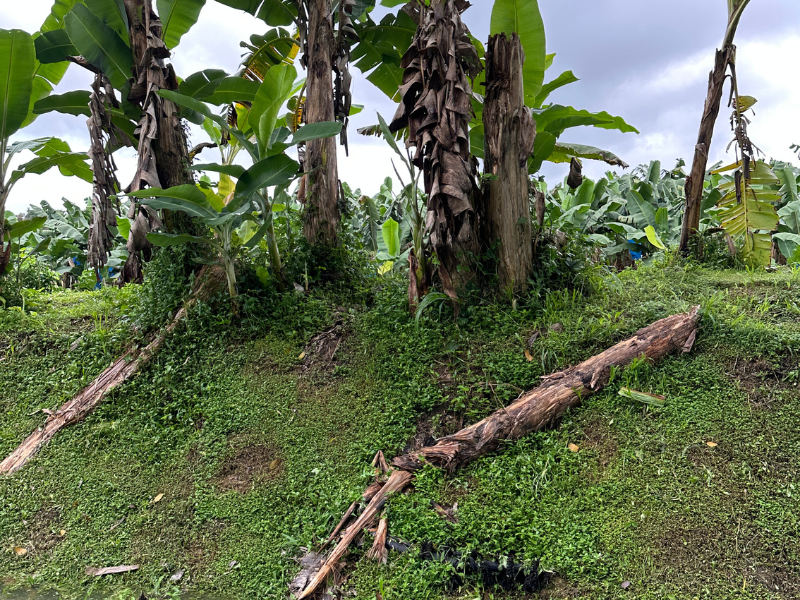
In areas with excessive rainfall, the rise in the water table in drainage canals can directly affect roots, plant development and banana bunch formation. This is compounded by the risk of flooding, which can worsen damage to plantations and make crop management more difficult.
A sector still recovering from difficult seasons
Costa Rica’s banana sector has been affected by El Niño on several occasions, with severe episodes in 1997-1998, 2008-2009, 2014-2015 and, more recently, in 2023. In the most intense years, productivity measured in boxes per hectare declined compared with seasons not affected by this specific phenomenon.
This comes on top of the cumulative effect of irregular weather conditions recorded in recent years. According to Bolaños, the sector has been dealing with impacts since 2024 and early 2025, when increased humidity favoured the spread of Black Sigatoka, a fungus that attacks foliage and, if not controlled, can destroy plantations.
“This caused significant fruit losses across all banana companies and affected income, as a large volume of bunches scheduled for export in 2025 could not be shipped,” he adds.
The possibility of recovering production levels has been hampered by further weather events, whose effects are seen weeks later in the form of fruit loss, reduced foliage and a decline in the number of boxes exported.
Fungi and bacteria, a growing threat
Black Sigatoka remains the main concern for growers in the face of higher humidity levels. Prolonged rainfall favours the spread of this fungus and makes field control more difficult, particularly when application windows are reduced by persistent rain.
This threat is compounded by Moko, a disease caused by the bacterium Ralstonia solanacearum race 2. The infection causes the plant to wilt rapidly and leads to fruit loss. One of its most efficient means of spread is water flowing between plantations as a result of excessive rainfall.
The combination of saturated soils, flooding, high humidity and disease pressure is forcing the sector to reinforce its monitoring and prevention systems, especially in the most exposed areas of the Caribbean and Sarapiquí.
An emergency protocol for farms
To anticipate the impact of El Niño, CORBANA is working in coordination with the Presidency of the Republic, the Ministry of Agriculture and Livestock, banana industry representatives and agricultural sector authorities.
At the same time, the institution is preparing an emergency protocol with key actions for crop prevention and management under scenarios of excessive rainfall. The document will be formalised and shared with production companies in the coming weeks.
RELATED NEWS: Climate change will decimate banana production in Latin America and Caribbean
Among the measures promoted by CORBANA are the maintenance of drainage systems, the construction of dikes and protective structures in low-lying areas and along riverbanks, as well as the use of cover crops to reduce erosion.
These good agricultural practices aim to mitigate the impact of flooding, protect the plants’ root systems and reduce farm vulnerability to extreme weather events.
Infrastructure and climate monitoring
Through the Special Prevention and Infrastructure Fund (FEPI), CORBANA works in coordination with state institutions and local governments to carry out technical studies that help prioritise infrastructure projects and works. The aim is to contribute to the prevention and rehabilitation of areas affected by flooding in communities surrounding banana farms.
In addition, the institution operates Banaclima, a real-time monitoring programme that tracks key climate variables through a network of weather stations strategically located on the Caribbean slope.
This system is essential for establishing forecasts, anticipating risks and strengthening decision-making on farms. In a context of growing climate variability, having accurate and up-to-date information becomes a decisive factor in protecting production and reducing losses.
Prevention to sustain exports
Bananas are one of Costa Rica’s main export products, meaning that any climate-related disruption affecting fruit availability can have a direct impact on the sector’s economic activity.
Against this backdrop, CORBANA’s strategy focuses on strengthening prevention, improving institutional coordination and providing growers with technical tools to deal with both drought on the Pacific side and excessive rainfall in the Caribbean.
The challenge is significant: protecting plantations, reducing disease pressure, maintaining productivity and sustaining export volumes in an increasingly demanding climate context for tropical agriculture.