









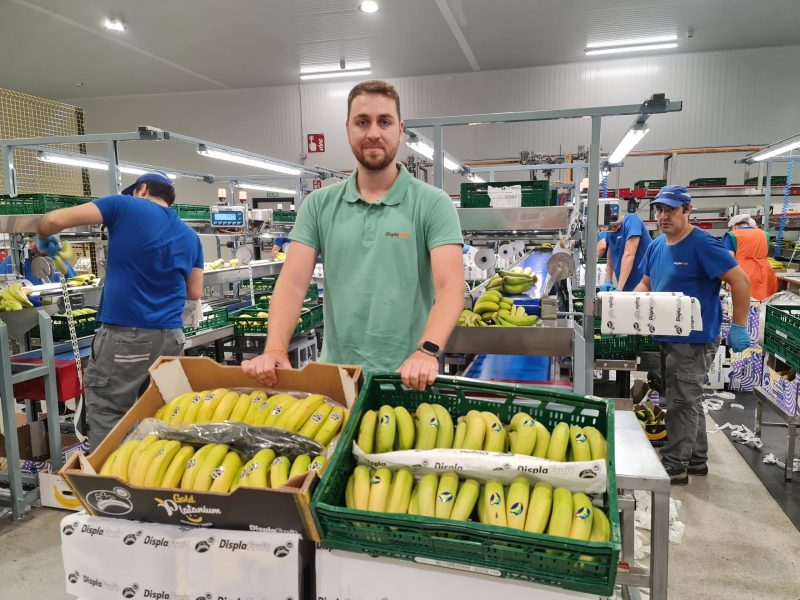
The company from Alginet, which is highly specialised in Plátano de Canarias and persimmons, is enjoying a new extension and automation of its ‘plátano’ workroom, turning it into one of the most up-to-date in Spain. “We were clear that we had to automate the ‘plátano’ packaging as far as possible and maximise the production processes,” explains Pascual García, the director of the company.
But this expansion has not only taken place in the ‘plátano’ working area: there has also been an extension and improvement in the persimmon production line that will provide greater efficiency in the preparation process of this fruit.
“The project started back in 2017, gradually extending and improving the ‘plátano’ ripening warehouse up until now in different phases. Currently, the installations have a total surface area of 10,000 m² and 5.000 m² for Plátano de Canarias and persimmons, respectively,” his son, Adrián García, indicates.
The new space houses all the work for both ripening and preparing the Plátano de Canarias. The company has 14 ‘plátano’ ripening rooms equipped with the latest technology and another 12 for conserving persimmons or other produce. They have around 2.5 million kilos of cooling capacity.
With the new infrastructures, the company’s capacity for ‘plátano’ ripening has reached around 25 million kilos per year. “The new infrastructures will give us more room for carrying out good, effective work, because we have got rid of many processes that previously had to be done by hand, and we have increased the quality filters.”
The company sells its produce in Mercavalencia, where it has its own stands, and it is deep-rooted in the Valencian distribution system, through which it serves today’s most important chains. “The new infrastructures allow us to increase our collaboration with them,” the executive assures.
Before up-dating machinery and space, the company ended the previous year with around 15 million kilos, all ripened in their own installations, without a single green ‘plátano’ leaving them.
With the new ‘plátano’ premises, around 300,000 kilos per week can be reached. “In fact, we are experienced in this type of situation, as at some points when the offers from several clients coincide, we have reached up to 70,000 kilos per day.
“Our philosophy does not involve ripening fast to ripen more, but it means doing things as they should be done. Plátano de Canarias need a minimum of 5 days in a ripening room. The product cannot be stressed, because this causes problems when it reaches the supermarket shelves.
Regarding the new persimmon campaign, the executive believes that the production will be very similar to last year’s, in spite of the disadvantages such as the lack of rainfall, pests such as mealybugs, thrips, or sunstroke. “What does seem to be clear is that we will have calibres that will be slightly smaller than last year’s,” he states.
The company marketed around 7 million kilos in the last campaign. “The forecasts were higher, but there were losses due to problems caused by fungus, sunstroke, wind etc.,” García concludes.