









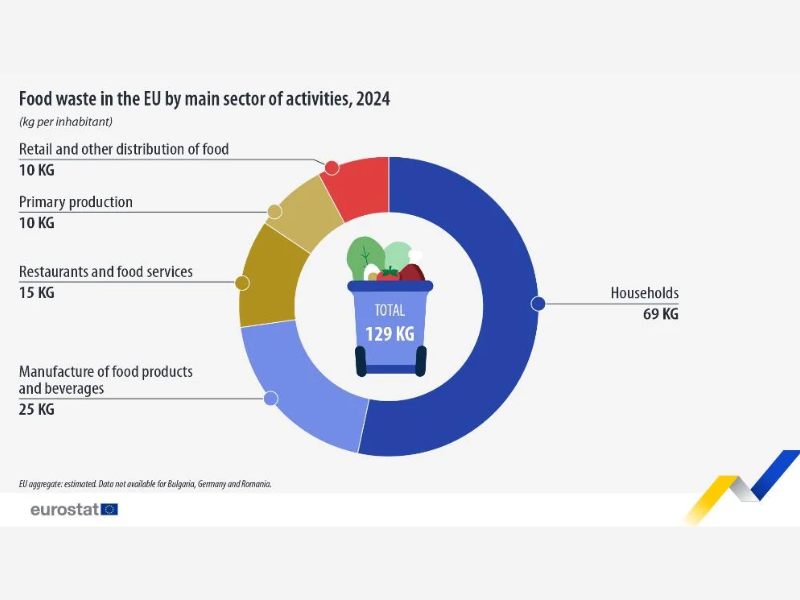
The European Union generated 57.9 million tonnes of food waste in 2024, equivalent to around 129 kg per person, according to the latest data from Eurostat. The figure, which includes both edible and inedible parts, represents a slight increase of 0.7% compared with 2023, when food waste stood at 57.5 million tonnes.
Households remain by far the largest source of food waste, accounting for 53% of the total, or around 69 kg per person. The figures highlight the importance of the consumption stage in the EU’s efforts to reduce food waste, although a significant volume is also generated across earlier stages of the food supply chain.
Households generate more than half of EU food waste
Around 31 million tonnes of food waste were generated by households in 2024, representing 53% of the EU total. This corresponds to approximately 69 kg per person.
Restaurants and food services generated a further 12%, equivalent to around 15 kg per inhabitant. Together, households and food services therefore account for a substantial share of food waste at the consumption end of the chain.
The remaining waste was generated further upstream. Food manufacturing and beverage production accounted for 19%, or around 25 kg per person, while primary production and retail and other food distribution each represented 8%, equivalent to approximately 10 kg per inhabitant.
Food waste across the entire supply chain
Eurostat’s figures show that food waste is not concentrated exclusively at the point of consumption. Around 47% of the total is generated before food reaches the household, covering primary production, manufacturing, retail and distribution, restaurants and food services.
Manufacturing represents the largest share among these stages, with approximately 11 million tonnes of food waste in 2024. Restaurants and food services generated around 6–7 million tonnes, while primary production and retail and distribution each accounted for roughly 4–5 million tonnes.
For the fruit and vegetable sector, the figures are particularly relevant because food waste can arise at different points between production and consumption, from harvesting and handling through to distribution and final use.
A €132 billion economic and environmental impact
The scale of the problem extends beyond the volume of food discarded. The European Commission estimates that food waste in the EU represents an economic loss of around €132 billion and generates approximately 254 million tonnes of CO₂ equivalent, accounting for about 16% of greenhouse gas emissions associated with the EU food system.
Reducing food waste is therefore increasingly linked to resource efficiency, climate objectives and food security. Avoiding waste also means making better use of the land, water, energy and other inputs already invested in producing food.
Binding targets for 2030
The latest figures come at a time when the EU has strengthened its regulatory framework on food waste. The revised Waste Framework Directive, adopted in 2025, introduced binding national targets for 2030.
Member States must reduce food waste from processing and manufacturing by 10%, compared with the annual average generated between 2021 and 2023. A second target requires a 30% per capita reduction jointly across retail, other food distribution, restaurants, food services and households.
RELATED NEWS: Spain, a model in the fight against food waste
The European Commission will also review the targets by the end of 2027, including the possibility of extending future reduction requirements to other stages of the food supply chain, such as primary production.
The challenge extends from farm to consumer
The latest Eurostat data underline the need for a coordinated approach across the food chain. While households account for the largest individual share, more than a third of food waste is generated through manufacturing, primary production, retail, distribution and food services.
For the EU, the challenge is therefore not limited to changing consumer behaviour. Improving planning, logistics, storage, processing, distribution and resource efficiency can also play a role in preventing food from becoming waste before it reaches the consumer.
Eurostat notes that the 2024 EU aggregates are estimated using the latest available data for countries where 2024 figures were not available, specifically Bulgaria, Germany and Romania.
With the 2030 targets already established, the latest figures provide a new baseline against which progress will be measured. The scale of the challenge suggests that reducing food waste will require action throughout the food chain, from primary production to the final consumer.