










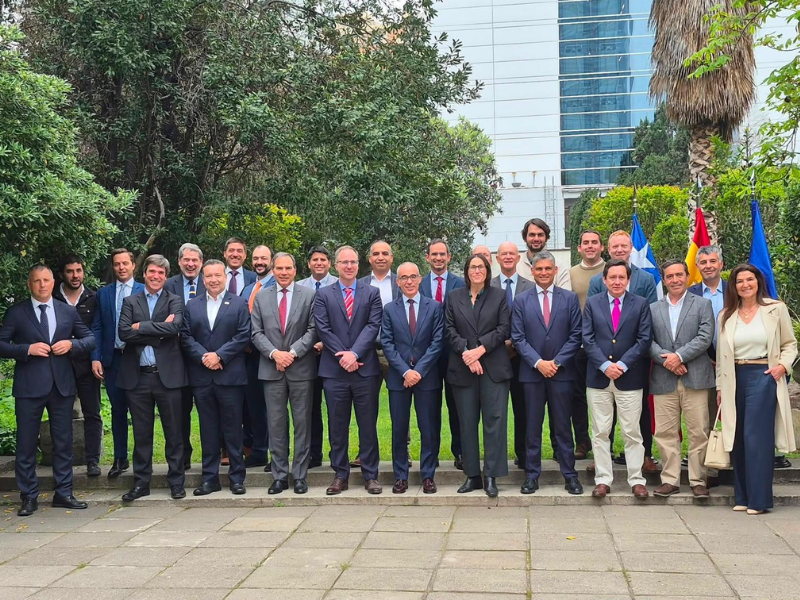
Port Authority of Malaga carried out a trade mission to Chile from 24 to 28 September with the aim of strengthening its relationship with the country’s fresh fruit export sector and exploring new opportunities for South American fresh produce to enter the European market through Malaga.
Malaga delegation, made up of José Moyano, director of the Port Authority of Malaga; Alejandro Martínez, head of International Relations, Commercial and Marketing; and César Cegarra, director of Noatum Malaga, held an extensive programme of meetings in Santiago with exporters, logistics operators and shipping companies active on the Chile-Europe trade corridor.
The programme also included an institutional meeting at the Residence of the Spanish Ambassador to Chile, Laura Oroz Ulibarri, supported by the Economic and Commercial Office of the Embassy of Spain. The delegation also visited different locations across the Santiago Metropolitan Region to gain first-hand knowledge of Chile’s fruit and logistics sectors and assess opportunities for developing new trade flows with Europe.
Chile becomes a new focus for Malaga’s South American strategy
This trade mission forms part of the Port Authority of Malaga’s strategy to strengthen links with long-distance markets, particularly those offering opportunities for the development of fresh produce and perishable goods traffic.
Malaga port has maintained commercial relationships with Peru and Costa Rica for several years and expanded its activity to Chile in 2026. The September mission follows an initial visit to the Chilean agro-export sector in March, continuing the contacts established during that first mission.
The fresh produce sector is a priority within this strategy because of the specific requirements of perishable goods in terms of speed and temperature-controlled logistics. In this context, the Port Authority is working alongside companies within the port community to offer logistics solutions tailored to international operators.
Malaga as a gateway to Europe
The Port of Malaga has infrastructure and services designed to handle refrigerated and perishable cargo. The facility has 42,000 square metres of storage space, 723 metres of quay, depths of up to 16 metres and 1,200 connections for refrigerated containers.
These facilities are complemented by Reefer Fast Track, a service designed to speed up the entry of refrigerated containers into the port, and a Border Inspection Post capable of operating seven days a week through coordination between the different agents involved in the logistics chain.
Its strategic location at the crossroads of major Atlantic and Mediterranean shipping routes, together with operations running 24 hours a day, 365 days a year, is another key element of Malaga’s offer for international cargo flows.
The port also has road and rail connections with major logistics hubs and distribution centres, extending its hinterland and facilitating the movement of goods to their final destinations.
Refrigerated cargo traffic grows
The commercial strategy is being developed against a backdrop of strong growth in refrigerated cargo traffic at the Port of Malaga.
In 2025, 4,300 refrigerated containers (reefers) were handled, compared with 3,027 in 2024, representing an increase of around 42%. The figures reflect the expansion of activity linked to perishable goods, particularly fresh produce.
RELATED NEWS: Chile and China ease requirements for fresh fruit exports
This growth has been accompanied by increased capacity on maritime services connecting Malaga with Latin American exporting countries, strengthening the port’s ability to channel perishable goods into the European market.
The Port Authority is continuing to consolidate existing connections and identify new commercial opportunities in origin markets by establishing direct relationships with producers, exporters, shipping companies and logistics operators.
A boutique port in southern Europe
The Port of Malaga’s commercial strategy is based on its positioning as a “boutique port in southern Europe”, built around high-quality logistics services, flexibility and personalised attention for international operators.
Its location at the intersection of the main Atlantic and Mediterranean maritime routes, combined with its year-round, 24-hour operations, forms part of this positioning.
With 42,000 square metres of storage capacity, 723 metres of quay, depths of up to 16 metres and 1,200 refrigerated-container connections, the port has the infrastructure required to handle the specific needs of perishable cargo.
Specialised services such as Reefer Fast Track and the Border Inspection Post, which operates seven days a week, further support the efficient handling of refrigerated cargo and help reduce processing times across the logistics chain.
The port’s road and rail connections with major logistics hubs and distribution centres complete its logistics offer, providing an additional route for Chilean fresh produce seeking access to European markets.