







The initiative aims to automate some of the most physically demanding tasks in a production area where, during August, ground surface temperatures can exceed 50°C.
Traditionally, workers have to carry grape baskets manually from the vineyards to collection points. Shortening this process also helps reduce the time between picking and delivery to processing areas, limiting the risk of dehydration and shrivelling.
Payload capacity of up to 35 kg
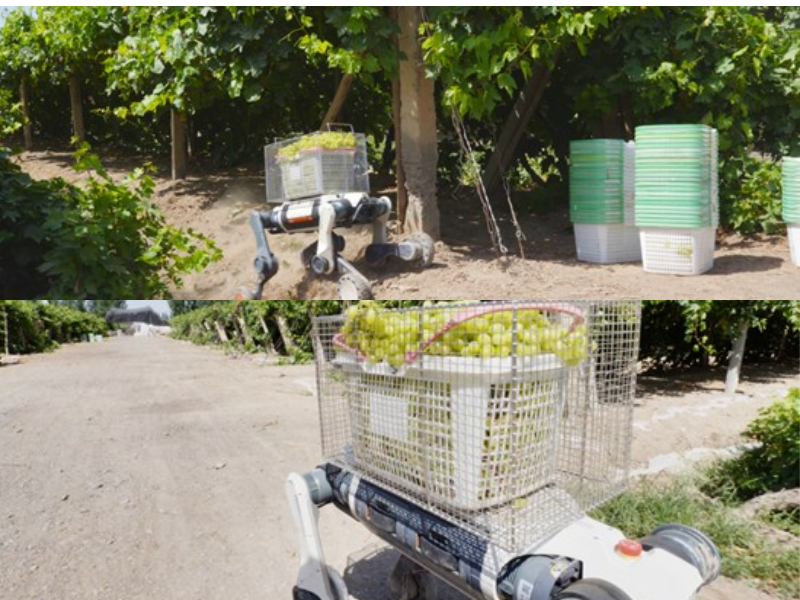
The vineyards are using DEEP Robotics’ Lynx M20S, which collects loaded grape baskets and transports them to collection points while workers remain focused on harvesting.
The robots have a payload capacity of up to 35 kg and are designed to operate in temperatures ranging from 50°C to -30°C.
Their wheeled-legged configuration allows them to move across gravel roads, slopes, shallow ditches and uneven terrain, conditions commonly found in some vineyard areas.
Access through passages just 50 cm wide
One of the challenges in Turpan’s vineyards is access to certain production areas. In some locations, larger vehicles cannot reach the plots, while narrow rows also restrict the movement of tricycles and other conventional transport vehicles.
The Lynx M20S design enables it to travel through passages as narrow as 50 cm without having to turn around, making transport easier in difficult-to-access areas.
Its onboard perception sensors also detect rocks, potholes, ditches and other obstacles. The system automatically adjusts its movement and route to reduce jolting during transport and limit fruit drop or surface damage.
Testing under real farming conditions
The use of these robots during the harvest season is also providing an opportunity to assess their performance under real agricultural conditions.
The tests include the impact of high temperatures on battery life and sensors, as well as the ability of the power system to operate for extended periods on gravel surfaces.
The Turpan deployment highlights the potential of agricultural robotics to automate internal logistics on farms, reducing the physical workload for workers and allowing them to concentrate on tasks such as harvesting.