






This year, Spain’s watermelon campaign has started with a delay of between 10 and 15 days compared to the usual dates for greenhouse production. This is confirmed by Joaquín Hidalgo, General Coordinator of Grupo AGF, who rules out any impact on final volumes.
“The planted area is in place and there is water availability. As long as weather conditions are favourable, it will be a normal production campaign, although the start will be slower than usual,” he explains.
Regarding open-field production, “we expect the delays in early transplanting caused by February rains to be offset by the arrival of spring temperatures”.
In terms of volume, Grupo AGF maintains its forecast of around 75 million kilos of Spanish watermelon, with production across all growing areas: from western Almería, through eastern Almería, Córdoba, Seville, Murcia, Alicante, Valencia, Tarragona and La Mancha.
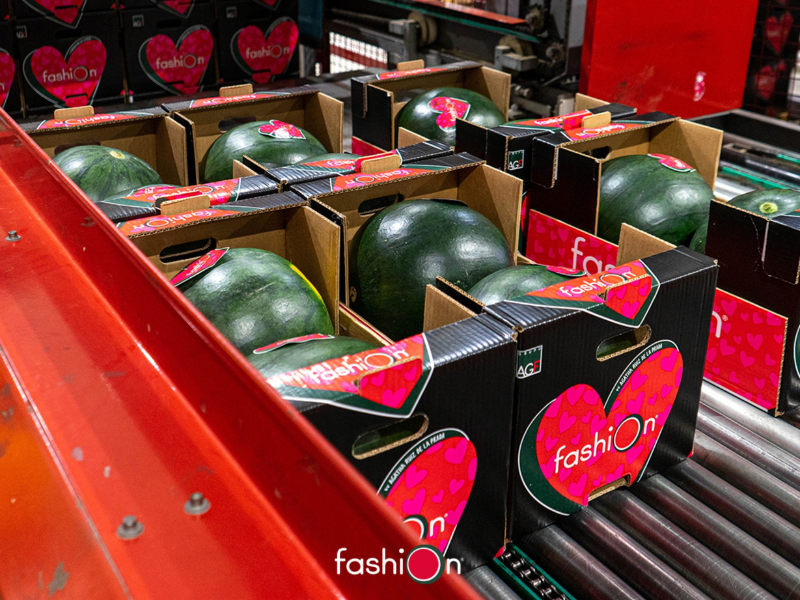
The first Fashion watermelons, produced in Senegal, reached the market on 10 March, one month later than in previous years. “There was not enough quality to pack under the brand, so we preferred to wait”.
The “Wall Street of watermelon”
The Fashion brand will celebrate its 25th anniversary in 2027. It was a pioneer in introducing the ‘club fruit’ model to watermelon and operates as the price benchmark for this fruit in the European market.
“If we lower our price, we drag the entire value chain down,” Hidalgo acknowledges. For this reason, the team—comprising eight people based in El Ejido—manages pricing decisions with particular responsibility.
Climate change and varieties
The long-term trend favours watermelon. “We are capable of producing high-quality watermelon throughout the entire campaign, something that is not always possible with melon,” Hidalgo explains.
RELATED NEWS: The Fashion® Producers Club is born
However, quality is under threat from climate change, which is forcing adjustments to calendars and growing areas. “Where you previously produced with certainty until 31 July, now you may need to finish production by the 10th. The real challenge is to avoid tropical nights, which damage fruit quality”.
The varietal issue is addressed thanks to the alliance with BASF Nunhems, which allows for the annual testing of new varieties that are more resilient to climate change.