








The forecast, which includes peaches, nectarines and cling peaches, points to a season without major climate incidents across Europe. Although some isolated frosts have been recorded in certain production areas, Europe’s overall production potential is not expected to have been significantly affected.
Recovery after an uneven 2025 season
European production in 2025 stood at around 3.14 million tonnes, 9% below the 2024 crop. That season was affected by frosts in Greece and Turkey, which had a significant impact on summer fruit. In Italy, France and Spain, there were no major frosts, although frequent rainfall during flowering slightly reduced production potential.
Several weeks after flowering, violent hailstorms also hit Spanish production areas, including Catalonia, Aragon and the Region of Murcia. For 2026, however, the outlook is more favourable, with a general recovery in production potential across the main European producing countries.
Spain to exceed 1.5 million tonnes
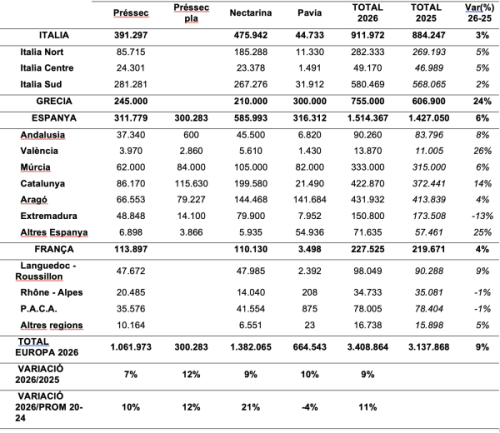
Spain remains Europe’s leading producer of peaches, nectarines, flat peaches and cling peaches. The 2026 forecast stands at 1,514,367 tonnes, up 6% on 2025 and 14% above the recent average. Specifically, almost 1.2 million tonnes of peaches, nectarines and flat peaches are expected, together with around 316,000 tonnes of cling peaches.
The Spanish season is starting under generally favourable conditions, with good chilling hours and improved water reserves following the end of the drought that had particularly affected the Ebro Valley. However, some uncertainties remain in areas such as Catalonia and Aragon, while declines are expected in Extremadura due to fruit set problems.
RELATED NEWS: Peach and nectarine group to ask the CE to speed up approval of plant protection products
Structurally, the Spanish sector continues to move towards lower acreage but greater technical development, varietal change, adaptation to climate change and an increasing focus on quality and market requirements.
Greece leads Europe’s recovery
Greece is expected to post the strongest recovery compared with 2025, a year in which the country suffered a severe production shortfall due to frosts in March and April. For 2026, around 455,000 tonnes of peaches and nectarines are forecast, up 35% year-on-year, along with approximately 300,000 tonnes of cling peaches, up 12%.
The improvement is due to much more favourable weather conditions, with a normal winter and spring and no significant damage. In terms of trends, the Greek sector is showing improved yields and quality, although the area planted with peaches and cling peaches is gradually declining, partly as some growers shift towards kiwifruit. In the north of the country, however, interest is growing in nectarines and very late peach varieties.
Italy remains close to its potential
In Italy, 2026 production is expected to remain close to potential levels. Around 867,000 tonnes of peaches and nectarines are forecast, up 3% on 2025, while cling peach production is expected to reach around 45,000 tonnes, down slightly by 2%.
Italy’s 2025 season was slightly below 2024 levels, although there were no major climate events. The reduction in volumes was mainly due to a decline in planted area, particularly in peaches and cling peaches. Even so, the market performed well, with solid domestic and export demand, prices above previous years and less competition from Spain and Greece.
France stabilises production
France expects a crop of around 224,000 tonnes of peaches and nectarines, up 4% on 2025 and 10% above the 2020-2024 average. Cling peach production is expected to remain practically stable at around 3,500 tonnes.
Last year was irregular for the French sector. At the start of the season, there was a shortage of fruit on the European market, but supply later became too abundant, especially for small-calibre nectarines. For 2026, growers will therefore need to pay particular attention to thinning in order to obtain larger and better-valued fruit sizes.
Structurally, French production appears to have stabilised thanks to plantation renewal. Nectarines continue to dominate, accounting for around 65% of volumes, while peaches represent approximately 35%. Flat fruit is also growing, especially flat nectarines.
Catalonia to grow by 13.5% compared with 2025
In Catalonia, forecasts point to a significant recovery after a moderate 2025 season. The Catalan peach and nectarine crop could reach 422,870 tonnes, representing a 13.5% increase compared with 2025 and 24% above the 2021-2025 average.
Last season closed with final production of 372,441 tonnes, slightly below 2024, which had already been under Catalonia’s usual production potential. For 2026, prospects are positive, although still conditioned by the final development of fruit sizes and the definitive assessment of hail damage.
Several hailstorms were recorded during spring, particularly on 19 April, 4 May and 12 May. The first two had limited impact, while the last was more intense and its real effect on fruit is still being evaluated. Some isolated frosts have also occurred.
Lleida drives Catalonia’s growth
By area, Lleida clearly accounts for the bulk of Catalan production and explains practically all the forecast growth. Production could reach 403,970 tonnes, up 14% on 2025. Particularly notable increases are expected in nectarines, up 15.4%, flat nectarines, up 17.7%, and flat peaches, up 14.8%.
In Tarragona, the situation is much more stable, with a forecast of 15,340 tonnes, just 0.8% higher than in 2025. Growth in flat peaches and flat nectarines would partially offset the expected decline in round nectarines.
Structurally, Catalonia continues to strengthen the role of nectarines —especially flat nectarines— and flat peaches, segments with more dynamic growth and rising demand. The region is also consolidating its focus on higher-quality, higher-value production in a context shaped by climate risks and the need for varietal and technological adaptation.