






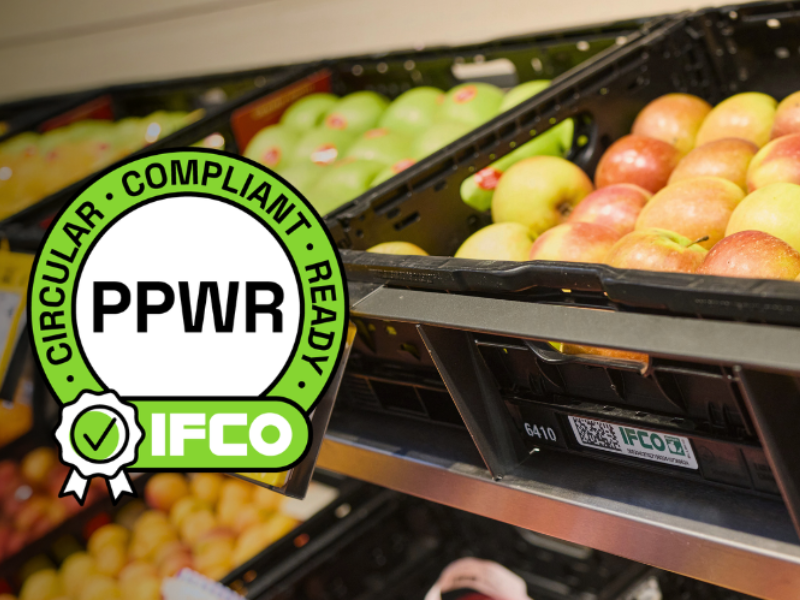
IFCO, a global provider of reusable packaging containers (RPCs) and reusable packaging solutions, supports retailers, producers, and growers in fulfilling the requirements of the EU Packaging and Packaging Waste Regulation (PPWR), as well as its key food safety and chemical safety standards.
From 12 August 2026, manufacturers must hold a formal written Declaration of Conformity for every packaging type placed on the EU market. IFCO’s Declaration of Conformity provides the necessary technical data and statements to help customers and pooling partners demonstrate compliance with PPWR.
Proven circular infrastructure operating at scale
IFCO has operated its share, reuse, and recycle business model since 1992. In Europe alone, IFCO achieved over 1.9 billion cycles in 2025, measured by RPC scans at IFCO service centers. This showcases that large-scale, high-volume circular reuse is an everyday operational reality, not an aspirational future goal.
“PPWR introduces mandatory targets to reduce packaging waste across Europe and marks an important step towards a more circular packaging system. For many companies, regulation brings new complexity. For IFCO customers, it confirms the direction we have been working towards for decades: replacing single-use packaging with reusable solutions.
We have already built and scaled the reusable packaging infrastructure the fresh grocery supply chain needs”, said Mike Pooley, Chief Executive Officer of IFCO.
Using IFCO’s reusable packaging containers ensures:
- Recycled-content targets: PPWR mandates that plastic packaging include at least 25% Post-Consumer Recycled (PCR) content by 2040. In 2025, IFCO crates already contained an average of 39% recycled material. All regrind material originates from a verified, closed-loop IFCO stream and is processed in authorized facilities using a mass-balance approach. Under the IFCO SmartCycle, RPCs are designed for maximum durability with up to 120 uses. When an RPC is removed from circulation, it is fully remanufactured back into new, high-quality IFCO crates, with no packaging waste sent to landfill.
- Chemical and substance safety: IFCO RPCs comply with the EU Registration, Evaluation, Authorisation and Restriction of Chemicals Regulation (REACH), and they are not manufactured or formulated with per- and polyfluoroalkyl substances (PFAS). IFCO European Lift Lock RPCs also hold 2026 recertification as Cradle to Cradle Certified® Full Scope Silver, confirming performance across key sustainability categories including material health, circularity, clean air and climate protection, water and soil stewardship, and social fairness.
- Hygienic washing and food safety: To comply with strict sanitation rules, IFCO RPCs undergo a state-of-the-art industrial washing and disinfection process after every trip. The process is supported by established quality controls and verified by independent auditors, guaranteeing effective removal of microbiological contamination and preventing the transfer of pesticide residues or toxic substances to fresh products.
IFCO’s value goes beyond a PPWR-compliant and proven reuse system, with environmental validation and advanced digital capabilities.
Peer-reviewed LCAs confirm environmental performance
Third-party, peer-reviewed Life Cycle Assessment (LCA) studies and separate food waste studies have scientifically quantified the environmental benefits of the IFCO SmartCycle. Compared to single-use cardboard packaging, IFCO RPCs generate up to 62% less CO₂e, use up to 80% less water, consume up to 64% less energy, and reduce the generation of waste by up to 96%.
RELATED NEWS: IFCO launches TRLLN, a pioneering Tracking-as-a-Service solution for global asset visibility
A 2025 study by Fraunhofer IML found that switching from single-use packaging to reusable packaging containers can reduce damage to fresh produce by up to 98%, creating significant cost-saving and food waste reduction potential for the fruit and vegetable supply chain.
Digital traceability built into circular reuse
PPWR requires reusable packaging to operate within a formal, traceable reuse system to verify usage and rotation counts. IFCO’s pooling model already meets this requirement by documenting reuse cycles and asset flows across the fresh grocery supply chain.
Beyond compliance, IFCO’s digital capabilities provide additional visibility and operational value. Through its Tracking-as-a-Service (TaaS) model, IFCO embeds unique, permanent digital identities, such as BLE (Bluetooth Low Energy) tags, RFID (Radio-Frequency Identification), and GRAIs (Global Returnable Asset Identifiers), directly into its assets. This digital layer gives partners visibility across the supply chain, helping them monitor temperatures, track transit times, identify bottlenecks and streamline order workflows, without requiring expensive scanners, gates or complex fixed infrastructure on their side.
“The EU PPWR targets should not be viewed as a hurdle, but as a catalyst for positive supply chain transformation,” said Íñigo Canalejo, Chief Sustainability Officer at IFCO. “What makes the IFCO SmartCycle model so powerful is its simplicity: it combines reusable packaging, circular infrastructure, traceability, and operational scale in one proven system. By partnering with IFCO, businesses can secure regulatory readiness, advance on their sustainability goals, and drive down supply chain costs, without the operational disruption or complex infrastructure changes that many fear.”