









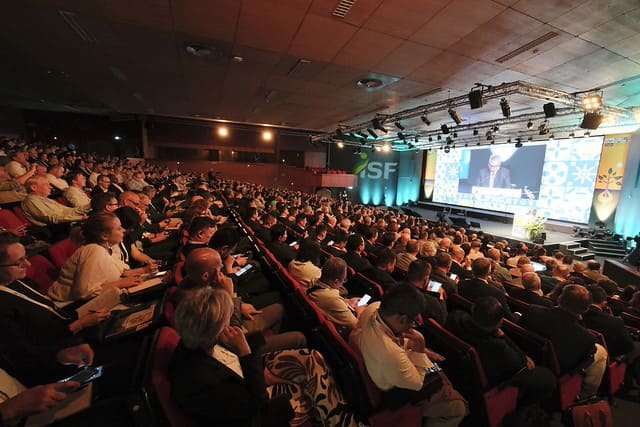
The World Seed Congress 2026 closed in Lisbon with record participation and a historic milestone for the global seed sector: the election of Lorena Basso, from Argentina, as the first female president of the International Seed Federation (ISF) in its 102-year history.
Hosted by the ISF, the congress brought together more than 1,800 delegates and guests from 78 countries, representing over 900 companies and organisations. Under the theme “Joint Actions, Resilient Futures”, the event placed seed at the heart of discussions on food security, innovation, international trade, genetic resources and the resilience of agri-food systems.
Seed, at the centre of resilient food systems
The congress took place against a global backdrop marked by climate shocks, geopolitical instability and trade disruptions, all of which continue to put pressure on agri-food systems.
Michael Keller, Secretary General of the ISF, stressed that the Lisbon event demonstrated the sector’s willingness to continue working together across regions, crops, business models and generations. He also underlined that ISF members represent 96% of global seed trade, reflecting the federation’s strategic role in ensuring farmers have access to quality seed.
The shared objective, according to Keller, is to support food and nutrition security and help build more resilient food systems for the future.
Lorena Basso becomes the first female ISF President
One of the key moments of the congress took place during the ISF General Assembly, with the election of Lorena Basso as the federation’s new president. Basso, President of Basso Semillas, a family-owned seed company in Argentina, brings more than two decades of experience in the seed industry and has been actively involved in ISF’s strategic work as a member of its Board of Directors.
In her address to ISF members, Basso highlighted the significance of the appointment not only for herself, but also for women across the seed sector and for Latin America. She paid tribute to women working in the field, in laboratories, in companies, in associations and in leadership roles, as well as to those who often work “behind the scenes”.
Basso also welcomed the election of Ellen Sparry, General Manager of C&M Seeds, as ISF Vice-President. Sparry is expected to succeed Basso as president in 2028, reinforcing a significant shift in female representation within the organisation.
A presidency focused on purpose, innovation and the future
During her speech, Basso recalled her family’s long history in the seed sector, including the work of her father and grandfather. She described that legacy as one built on work, respect, commitment, honesty and love for seeds.
Looking ahead, the new president called on ISF to remain focused not only on efficiency and action, but also on purpose. She stressed that the work of the seed sector has an impact far beyond the industry itself, influencing farmers, food systems, innovation, climate resilience and future generations.
A practical guide on social rights and ethical practices
The Lisbon congress also saw the launch of ISF’s new practical guidance document, “A Practical Guide for Seed Production: Navigating Social Rights and Ethical Practices in the Seed Sector”.
This voluntary framework is designed to help seed companies, suppliers, growers and associations strengthen responsible labour practices across the seed value chain. The initiative reflects a sector agenda increasingly focused not only on genetic innovation and trade, but also on social responsibility and sustainable operations.
Open trade, clear rules and plant breeding innovation
Throughout the congress sessions, representatives from international organisations such as the World Bank, the World Trade Organization (WTO) and the International Plant Protection Convention (IPPC), alongside industry representatives, highlighted the need to build inclusive, open and resilient seed systems.
The development of a new commercial variety often involves breeding, testing, production, quality assurance and distribution across several countries. For this reason, the sector stressed the importance of open, predictable and science-based seed trade as a key condition for ensuring farmer access to innovation and strengthening global food security.
The debate also focused on regulatory coherence for plant breeding innovation, including new genomic techniques in Europe and beyond. The ISF called for policies that allow innovation to reach farmers without unnecessary or non-science-based barriers.
Genetic resources and public-private collaboration
Another central topic was the importance of plant genetic resources. Discussions underlined the need for continued international cooperation on conservation, access and benefit-sharing, recognising that genetic diversity is the foundation of plant breeding, biodiversity, climate adaptation and long-term food security.
RELATED NEWS: ISF World Seed Congress debates the future of agriculture in Lisbon
The congress also issued a clear call for sustained investment in gene banks and stronger public-private collaboration to conserve, characterise and make plant genetic resources available for breeding, research and farmer resilience.
Portugal as a meeting point for the global seed sector
The World Seed Congress 2026 was hosted in cooperation with ANSEME, the Portuguese Seed Association, whose members represent almost 90% of the Portuguese seed market.
Lisbon provided a fitting setting to highlight Portugal’s role as a bridge between Europe and the Lusophone world, at a time when the sector is seeking to strengthen farmer access to quality seed, accelerate innovation and respond to climate and trade challenges.
The congress closed with a clear message: the future resilience of food systems will depend on joint action, suitable regulatory frameworks, investment in innovation and closer collaboration between companies, institutions, researchers and the next generation of seed sector leaders.