







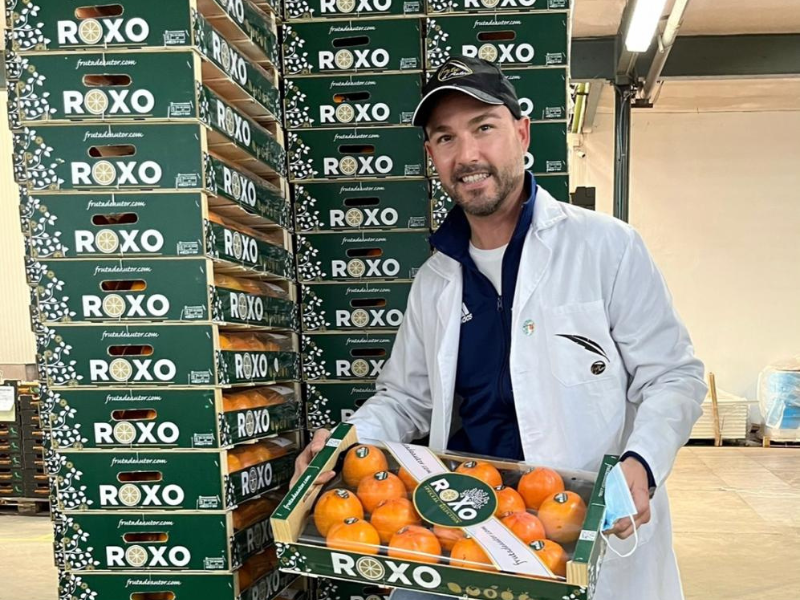
The company maintains a clearly defined strategy: limited volumes, maximum quality and a strong export focus, with Europe and overseas markets each accounting for roughly half of its sales.
For Autor Fresh, persimmon is first and foremost an export product. The company has built its positioning around a very specific strategy: rather than competing on volume, it competes on quality, targeting markets that value large sizes, attractive presentation and particularly careful packing.
“Our focus is on the premium product,” says Manuel Baides, the company’s Commercial Director. His words sum up much of the company’s business model: producing controlled volumes, maintaining high quality and directing the product towards markets where this differentiation is most highly valued.
And those markets are mainly outside Spain. Approximately half of its persimmons are shipped to Europe, with France, the Netherlands and Germany as the main destinations. The other 50% goes to overseas markets, with Arab countries accounting for a particularly significant share, although the company also supplies destinations such as Brazil and Canada.
The domestic market plays a much smaller role. Autor Fresh maintains some customers in locations such as Bilbao and Mercabarna, but the concentration of supply in Spain and commercial pressure from major operators make it more difficult to develop the same premium positioning that the company achieves abroad.
Roxo, the flagship of premium persimmon
Roxo has become the company’s flagship brand. Baides describes it as its strongest brand in both Europe and overseas markets, with particularly strong recognition in Eastern European markets as well.
The philosophy behind the product is clear: “to produce limited volumes, but volumes of very high quality.” The company handles around half a million kilos of premium persimmons and is even considering increasing this figure depending on how the season develops.
An almost normal season
The new season comes against a challenging backdrop for Spanish persimmons, but Autor Fresh has remained relatively unaffected by some of the main weather-related problems. In the production areas managed by the company around Xàtiva and Llanera, hail has caused very little damage, apart from isolated incidents on some plots.
A lower fruit load on the trees does not necessarily have to translate into an equivalent reduction in kilos. Baides estimates that the trees are carrying approximately 80% of their usual crop load, but the lower number of fruits allows the trees to nourish the remaining persimmons more effectively, favouring larger sizes.
Autor Fresh therefore expects a fairly normal season in terms of volume. The company also uses techniques designed to bring production forward and expects to begin its first shipments to Europe at around 20–25 September.
Less hail, but more sun damage
While hail has largely spared its orchards, the heat has left its mark. One of the problems this season is sunburn, damage to the fruit skin caused by intense exposure to high temperatures.
Baides acknowledges that the percentage of affected persimmons can be significant on certain plots. It does not necessarily compromise the internal development of the fruit, but it does affect its external appearance, a particularly critical factor for a premium product where presentation is an essential part of its commercial value.
Interestingly, the heat also appears to have coincided this year with lower pressure from certain pests. Problems such as mealybug and whitefly, which were particularly challenging during the previous season, have had a lower incidence on the company’s farms.
From Dubai to Jeddah: geopolitics changes the route
The most distinctive feature of this season, however, will probably not be in the field, but rather in the route the persimmons take to reach their customers.
The geopolitical situation is forcing Autor Fresh to modify its logistics to Arab countries. Dubai has traditionally served as a major hub for the entry and redistribution of produce throughout the region, but changes to maritime routes are extending transit times.
The company’s response will be to change its point of entry. Instead of shipping the produce directly to Dubai, consignments will be sent to the port of Jeddah in Saudi Arabia, with an approximate transit time of seven or eight days. From there, the produce will continue by road to different Gulf markets, including the United Arab Emirates, Qatar, Oman and Bahrain.
Jeddah will therefore take over part of the logistics role previously performed by Dubai as a regional redistribution point. The change represents a significant adjustment for a company that sends around half of its production to overseas markets. This comes on top of rising logistics costs. Baides notes that road transport to Europe could become around 30% more expensive than last year, while sea freight rates have also increased.