







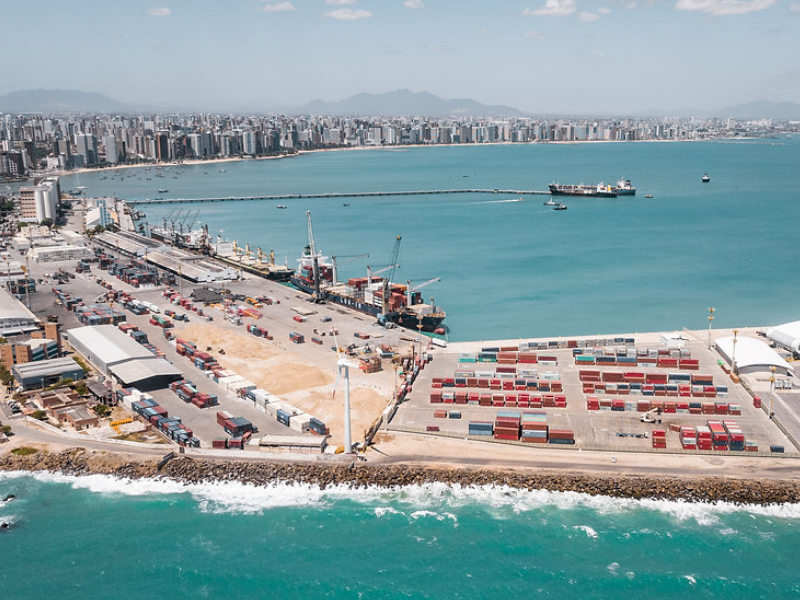
Under the initial project, MUC04 will feature at least 1,226 reefer plugs, together with three cranes and six heavy-duty forklifts.
Refrigerated agricultural commodities already play a central role in the port’s container activity. In 2025, they accounted for around 95% of container movements, with fresh fruit among the main export cargoes.
Container operations to be consolidated
Container handling at the Port of Fortaleza is currently spread across different areas totalling approximately 88,000 square metres.
The MUC04 project would consolidate these operations within a continuous area of around 148,000 square metres, providing greater capacity and a more integrated logistics platform.
The terminal is expected to have a static capacity of 9,080 TEUs and, once fully developed, an annual operational capacity of 360,000 TEUs.
Cold-chain capacity for fruit exports
The expansion comes at a time when fruit logistics in Ceará are also growing.
The Port of Pecém recorded a 14% increase in fruit handling in 2025, while volumes of fresh melons, watermelons and papayas rose by 27%.
Ceará’s melon exports also continued to gain momentum in 2026. By May, exports had reached US$90.94 million, already exceeding the total value recorded for the whole of 2025.
The state ranked as Brazil’s second-largest melon exporter, behind Rio Grande do Norte.
A wider production hinterland
The potential hinterland for MUC04 extends beyond Ceará to other states in north-eastern Brazil and parts of the country’s Center-West region.
This would allow the terminal to handle export cargo from a broader production area and reinforce Fortaleza’s role as a logistics gateway for agricultural products.
RELATED NEWS: Typhoons put China’s main ports under pressure
For fruit exporters, the planned reefer infrastructure would provide additional cold-chain capacity to maintain the temperatures required throughout transport, an essential factor for preserving product quality and shelf life.
Phytosanitary conditions also improve
Ceará also expanded its pest-free area for Anastrepha grandis in 2026, a development with implications for the phytosanitary conditions governing melon and watermelon exports.
The combination of new port infrastructure, additional reefer capacity and improved phytosanitary conditions could further strengthen the state’s position in Brazil’s fresh fruit export chain.