










The global apple industry is experiencing a period of significant contrasts, marked by major changes in production volumes, varietal development and commercial dynamics. According to the latest global analysis presented by Chris Gerlach, Vice President of Insights & Analytics at the U.S. Apple Association (USApple), the sector is undergoing a major adjustment phase as producers face climate challenges and increasing pressure on margins.
China maintains global leadership
At international level, China remains by far the world’s largest apple producer. For the 2026/27 season, production is estimated at around 1.8 billion bushels (approximately 38 million tonnes), representing a modest 1% increase compared with the previous campaign.
The United States remains the second-largest global producer, although its 2026/27 crop is forecast at 263 million bushels, down 7% year-on-year and 3% below the five-year average.
The decline in the US crop is mainly linked to adverse weather conditions, particularly severe spring frosts in key producing areas on the East Coast. Production in Pennsylvania is expected to fall by 58%, to around 5 million bushels, while Virginia could see a 48% decline, reaching 1.8 million bushels.
In contrast, Washington State continues to lead US production with 176 million bushels, despite a slight 2% decrease. It is followed by New York, with 32 million bushels (-10%), and Michigan, with 25 million bushels (-1%).
Europe faces one of the sharpest declines
Europe is experiencing one of the most significant production adjustments worldwide. Forecasts point to a crop of around 508 million bushels, representing a 16% reduction compared with the previous season.
The decline is attributed to adverse weather conditions during critical stages of crop development, adding further pressure to a sector already dealing with rising production costs.
Meanwhile, South America is showing a more positive trend, with production expected to reach 127 million bushels, up 5% year-on-year.
Among North American partners, Mexico is forecast to produce 47 million bushels, slightly down by 1%, while Canada is expected to reach around 19 million bushels, representing a 2% decrease.
Strong demand supports international trade
Despite production fluctuations, international apple trade continues to show solid demand across traditional markets.
In the United States, fresh apple exports reached almost 45 million bushels, increasing by 2%, while imports declined by 12% to around 4 million bushels.
As a result, the US fresh apple trade surplus approached 41 million bushels, with a value exceeding 1 billion dollars.
Mexico and Canada remain the main destinations for US apples, jointly accounting for 58% of purchases. Shipments to Mexico increased by 12%, reaching 17.5 million bushels, representing 39% of total exports, while exports to Canada grew by 20%, reaching 8.3 million bushels.
According to Gerlach, these figures highlight the strategic importance of maintaining stable cross-border trade relationships while also developing higher-value opportunities in other markets.
Varietal transformation reshapes US orchards
The US apple sector is also undergoing a significant varietal transition.
While Gala remains the leading variety by volume, with almost 42 million bushels (16% of US production), it is followed by Red Delicious and Granny Smith, each with around 30 million bushels (12% and 11% respectively). Other important varieties include Honeycrisp, with approximately 27 million bushels (10%), and Fuji, with around 23 million bushels (9%).
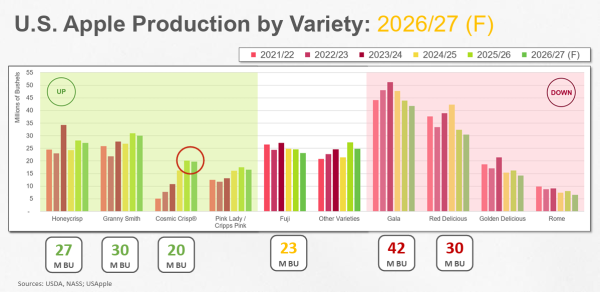
However, long-term trends show a gradual replacement of traditional varieties by those more aligned with current consumer preferences.
Varieties such as Red Delicious, Gala and Fuji are experiencing a decline in planted area, while alternatives including Honeycrisp, Granny Smith, Cosmic Crisp and Pink Lady/Cripps Pink continue to gain ground.
Profitability remains the sector’s main challenge
Beyond production and market trends, profitability remains one of the biggest challenges facing apple growers worldwide.
In the United States, labour currently represents around 60% of total orchard production costs, while agricultural inputs and freight expenses have also increased significantly.
RELATED NEWS: Apples: EU harvest set to fall below 10 million tonnes
In several commercial windows, farm-gate prices have approached or even fallen below production costs for some major varieties.
For Gerlach, the long-term sustainability of the apple industry will depend on producers’ ability to balance operating costs through improvements in labour availability, technological innovation and higher productivity per hectare, while securing returns that guarantee the future viability of the sector.