








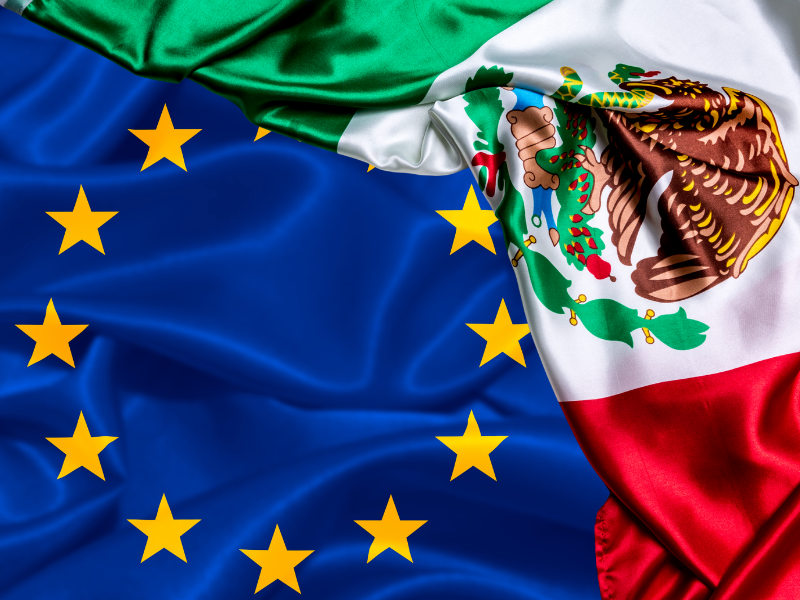
The agreement was sealed during the 8th Mexico-EU Summit, held in Mexico City, with the participation of Mexican President Claudia Sheinbaum, European Commission President Ursula von der Leyen, and European Council President António Costa.
The new framework includes a Modernised Global Agreement, an interim trade agreement and political coordination mechanisms on international issues. With this update, both parties aim to adapt their relationship to a global context marked by trade uncertainty, tariff pressure and the reorganisation of supply chains.
An agreement to strengthen trade diversification
The modernisation of the agreement comes at a time when Mexico and the European Union are seeking to expand their economic alliances and reduce their exposure to international trade tensions. In recent years, the rise of protectionist measures and the imposition of tariffs by the United States on various trading partners have accelerated the search for alternatives by numerous economic blocs.
In this context, the relaunch of the alliance between Mexico and Brussels is seen as a diversification strategy. For Mexico, it represents an opportunity to strengthen its presence in the European market, while for the European Union it offers a way to consolidate its position in Latin America and reinforce ties with a strategic partner.
New opportunities for agri-food trade
One of the main objectives of the agreement is the elimination of tariffs on a wide range of products, with particular relevance for the agri-food sector. This measure could open up new opportunities for Mexican exports to the European market and encourage greater trade between the two parties.
The new framework also includes chapters on public procurement, digital trade, innovation and technological cooperation, areas that were not covered by the original agreement signed more than two decades ago. Through these provisions, Mexico and the EU aim to adapt their trade relations to new economic dynamics and to the changes brought about by digitalisation.
European investment in strategic sectors
The European Union has also announced investments of up to €5 billion through the Global Gateway strategy, aimed at clean energy, digitalisation and pharmaceutical industry projects.
With this initiative, Brussels seeks to strengthen its economic presence in Latin America and take part in the development of strategic value chains. Investment in sectors linked to the energy transition and technology forms part of a broader European strategy to diversify partners, reduce dependencies and gain room for manoeuvre in key regions.
The relationship with the United States remains decisive
Despite the scope of the agreement, Mexico’s trade dependence on the United States remains a central factor in its economic strategy. More than 80% of Mexican exports are destined for the US market, limiting the possibility of significantly redirecting trade flows towards other destinations.
RELATED NEWS: Mexico to eliminate almost all tariffs on EU imports
For this reason, the new rapprochement with Europe is not seen as a replacement for the North American economic relationship, but rather as a way to broaden Mexico’s room for manoeuvre and reduce risks in an increasingly fragmented trade environment.
The relationship with the United States and the North American regional agreement remain the main axis of Mexican trade policy. However, the modernisation of the pact with the European Union allows the country to advance a diversification strategy without altering the balance of its main economic ties.
Pending institutional ratification
Before fully entering into force, the agreement must go through the corresponding institutional ratification processes within the European Union and other competent bodies. However, some of its provisions could begin to apply provisionally while the legislative procedures move forward.
Trade between Mexico and the European Union currently exceeds €100 billion per year, a figure that both parties aim to increase under the new cooperation framework.
With this update, Mexico and Brussels seek to strengthen a relationship built over more than 25 years and adapt it to an international scenario in which trade diversification, supply chain security and strategic cooperation have become increasingly important.