For the past eight years,
Semillas Fitó and
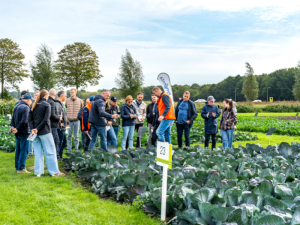
La Cocina de Ideas, Huercasa’s food innovation centre, have been working together on projects linked to various agro-industrial crops. During a press trip organised by the company, a group of agri-food journalists travelled to Segovia to see first-hand how this alliance works, focusing on the Veg Industry channel and two products with great potential: Lamuyo pepper and sweetcorn.
The model
“The aim of this meeting is to explain how a seed company can collaborate with the different links in the chain to generate sustainable value for everyone,” says Xavier Fitó, director of the company’s Vegetable Business Unit.Semillas Fitó follows a clear strategy in vegetables: to work with a limited number of species (only 10) in order to be an expert partner in each one. With these crops, the company develops 165 genetic improvement programmes. Their approach is also regional, as they are not present worldwide. “We do not operate in China, Japan, Korea or the USA. We do work across Latin America, the Mediterranean region of Europe and Southeast Asia,” Fitó notes.
The seed company focuses its work on three channels: Veg Production, in which it collaborates with growers to develop more productive, valuable and resistant varieties; Veg Industry, in which it works with the food industry to develop fruits that are easy to harvest and suitable for processing while maintaining quality; and Veg Value Chain, where it collaborates with retail and the rest of the chain to create unique fruits and consumer concepts adapted to new needs and trends.Examples include tomatoes (Monterosa and Wabi-Sabi), melons (Little Planet and Waikiki) and courgettes (Crü).One example of a collaborative project is ‘Plant varieties to reduce agriculture’s ecological footprint’, jointly developed with Institut Cerdà. The goal is to accurately measure the impact of a variety on water and energy footprint, land use and fertiliser and crop-protection consumption. “We created this protocol to measure environmental sustainability. We will present it next year and the European Commission has already requested it for use in the registration of active substances,” Fitó says enthusiastically.
Veg’s Industry channel
The products Fitó works with in this area include sweetcorn, red and green peppers, broad beans, green beans, courgettes and aubergines. The company operates in Spain, Portugal, Italy, Turkey and Morocco, and is also working with Poland and Hungary.David García, Global Coordinator of Large Seeds, explains: “At Semillas Fitó we work on tailor-made projects with food companies to address their specific needs and improve their products.”An example of this is Seednergic technology, a seed coating that provides biostimulants, plant nutrients and beneficial bacteria to promote optimal growth and vigour, and which is also suitable for organic agriculture.Another solution is Harbest®, which offers growers an answer to one of the most demanding stages in production: harvesting. Harbest® provides compact plants, peduncles that detach easily and GG-size fruits, among other features. This genetic profile is currently used in pepper varieties for industry and helps address one of agriculture’s major challenges: the shortage of labour.
La Cocina de Ideas
Cristina Rueda, innovation director at La Cocina de Ideas, stresses that “innovation is essential for us to remain competitive. And this innovation is not only in the product, but also in the process.”La Cocina de Ideas is made up of seven specialists (agronomists, biologists, technologists, nutritionists…) divided into two areas: a supply-chain area that conducts agricultural trials and investigates new industrial materials; and another dedicated to industrial processes, product development and new processing methods. There is also an auxiliary marketing team in charge of commercial launches.Their main activities include varietal characterisation, assessing processing suitability (studying the performance of different varieties in different industrial processes), post-harvest studies (evaluating how varieties behave over time and through processing), nutritional quality (monitoring nutrient evolution in fresh and processed products) and studies of different culinary uses.With Semillas Fitó they have two flagship projects: sweetcorn kernels and Lamuyo pepper.
Lamuyo pepper project
This project began in 2018 with the aim of characterising different short Lamuyo pepper varieties based on quality indicators and industrial yield.To begin the work, 80 kg of peppers are harvested at optimum maturity and 20 units are selected, taking into account characteristics such as weight, length, width, peduncle cavity depth, core depth, seed distribution, flesh thickness, Brix degrees, firmness and dry matter.Their performance is then assessed in three processes: roasted preserves, frozen, and frozen plus searing. “We calculate the percentage of loss and yield in each process,” explains Carlos Serrano, R&D technical manager at La Cocina de Ideas.A nutritional analysis is also carried out to measure vitamin A and C content both fresh and after each industrial process, and “we have had pleasant surprises,” Serrano says, “as these levels remain stable from start to finish, with no deterioration due to processing.”
The final tasting
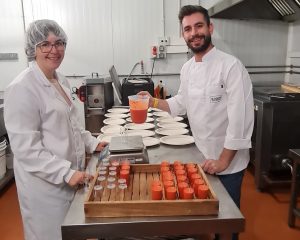
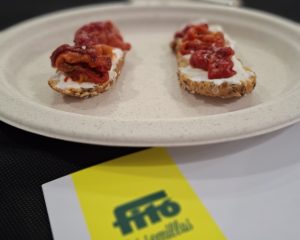
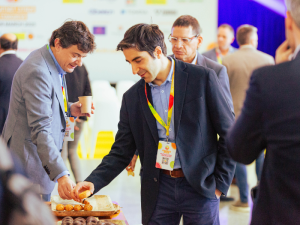
To conclude the visit, attendees were able to enjoy a blind tasting of two preparations made with Semillas Fitó short Lamuyo peppers. The first was a gazpacho and the second a toast. Aspects evaluated were colour, texture and flavour. The varieties used were Ramonete and Lobezno.