










However, the wholesale sector warns that this administrative step, although positive, must be accompanied by a deep regulatory and operational update of the market to ensure its future.
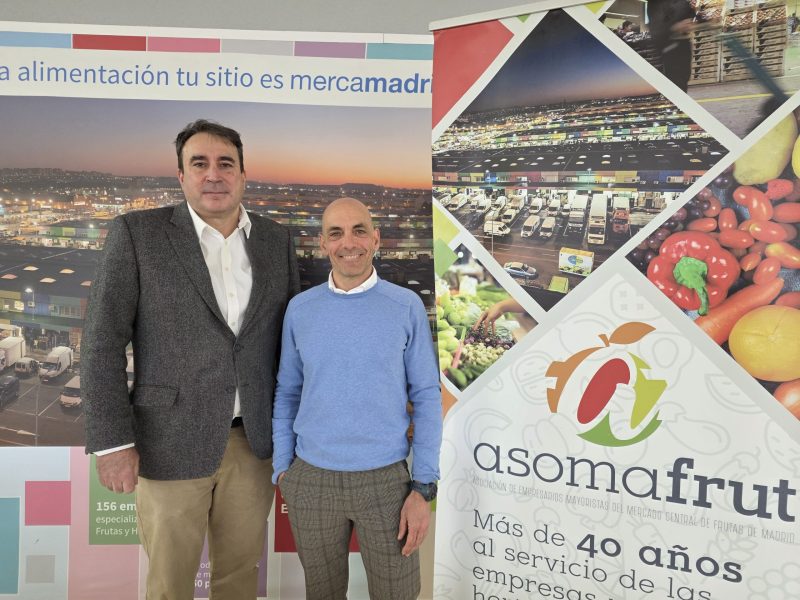
This is explained by Santiago Blázquez, manager of Asomafrut, and Sergio Fernández, member of the association’s Management Committee, who stress that Mercamadrid’s institutional continuity is only the first step in a much broader process.
“What has happened is that the provision of the public service has moved to a direct management system. Mercamadrid no longer has an end date; the company, now part of the public sector, has an indefinite lifespan,” explains Blázquez. “In practice, the market leaves behind the previous model and consolidates itself as a stable public instrument of Madrid City Council.”
This change opens the door to a key administrative process: the allocation of new legal titles for the use of commercial spaces through a competitive procedure that must be launched before 31 December 2028. The sector had long been calling for a change that would guarantee continuity and security for businesses.
A framework to ensure business continuity
Blázquez emphasises that one of the main objectives for wholesalers was to secure a stable framework that would allow them to plan the future of their businesses.
“Continuity was possible before, but now it is definitive. Mercamadrid has an indefinite lifespan and the market will continue beyond 2032,” he notes.
However, the process is still far from complete. The modification of the regulations governing the market has already been approved by Madrid City Council.
Rules from 1982 for a 21st-century market
Beyond institutional continuity, wholesalers consider it essential to undertake a deep update of the regulations governing Mercamadrid, which date back to 1982.
Sergio Fernández sums it up clearly: “We are working with regulations established in 1982, reflecting the needs of that time. Clearly, society and distribution have changed completely.”
For the Asomafrut representative, renewing concessions will make little sense if it is not accompanied by an evolution of the market’s operating model.
“If the City Council limits itself to renewing concessions without updating the rules of the game, the market will continue to face the same problems,” he warns.
Among the most urgent issues are the revision of the activity calendar and working hours—two aspects that, according to wholesalers, respond to a distribution model that no longer reflects current realities.
The debate over night-time operations
Currently, wholesale activity in Mercamadrid mainly takes place overnight, between midnight and 11 a.m., from Tuesday to Saturday. For the sector, this model has become one of the main obstacles to the market’s future.
“Night-time hours may have made sense 40 or 50 years ago, but today they no longer do,” says Fernández. In his view, this system is creating structural problems for both companies and workers.
NOTICIA RELACIONADA: Asomafrut analyzes the wholesale channel to address future challenges
One of the most evident is the lack of generational renewal. “A greengrocer who starts work at three in the morning and finishes late in the day is unlikely to want that lifestyle for their children,” he explains.
The situation also affects the functioning of wholesale companies, which are finding it increasingly difficult to recruit qualified staff.
“We have a huge labour shortage problem. Working at night and under these conditions is not attractive to many people,” he adds.
Work-life balance, mobility and labour shortages
Night-time schedules also generate practical challenges such as work-life balance and worker mobility.
“At night there is no public transport, and many of the profiles working in the market do not have their own vehicle,” explains Fernández. This is compounded by changing attitudes among younger generations, who increasingly prioritise work-life balance.
Adapting to changes in consumption
Asomafrut representatives stress that the transformation of the market must also take into account the changes that have occurred in the food distribution system in recent decades.
“Consumption and distribution have evolved enormously. Supermarkets have completely changed the dynamics of the sector, and wholesale markets are not always prepared to adapt to this reality,” says Fernández.
Even so, he insists that Mercamadrid remains a key logistics hub for fruit and vegetable supply, although it needs to adapt to new market demands and changes in the supply chain.