








The biennial report “The Circular Economy for Plastics: A European Analysis”, published by Plastics Europe, concludes that annual growth in circular plastics production in Europe is declining amid increasing global competition.
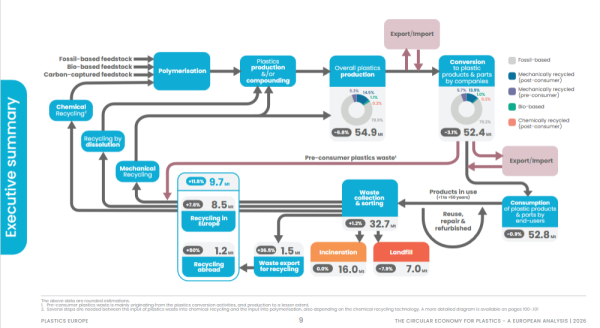
Europe’s transition pace has slowed considerably. Annual growth in circular plastics production across Europe (EU27 plus Norway, the United Kingdom and Switzerland) dropped sharply from 13.6% in 2022 to only 1.2% in 2024, reaching 8.7 million tonnes of circular production, equivalent to 15.8% of total European plastics production. By contrast, global annual growth in circular plastics production accelerated from 5% to 7.7%.
At the same time, European demand for circular plastics also declined significantly, from 16.2% growth in 2022 to just 4% in 2024.
Data for Spain reveal a slowdown in circular plastics production growth, falling from an annual increase of 12.8% between 2018 and 2022 to just 7.2% between 2022 and 2024. The use of circular plastics has virtually stalled, moving from annual growth of 35% between 2018 and 2022 to no growth at all between 2022 and 2024. This situation is further aggravated by the increase, reported throughout the sector, of imports containing declared recycled content that cannot be verified in the final product.
External dependency
Foreign trade figures highlight Europe’s dependence on external value chains for its circular transition: 19% of demand for circular plastics was met through imports, while 12.4% of European waste is recycled in other parts of the world.
Europe’s external dependency is even greater for fossil-based plastics, with 25% of processors’ demand supplied through imports from outside the European Union.
Rob Ingram, President of Plastics Europe and CEO of Ineos Olefins & Polymers Europe, stated: “It is deeply concerning that, at a time when Europe should be accelerating its transition towards a circular economy, we are witnessing a sharp slowdown. As a result of high energy and raw material prices, emissions costs and the lack of fair trade conditions, European plastics producers are operating in survival mode. Our value chain cannot make the investments required for circularity; instead, we are witnessing the decarbonisation of Europe through deindustrialisation.”
RELATED NEWS: Pro Food turns to sport to spread the message on the benefits of plastic packaging
Europe still maintains the highest share of circular plastics production (15.8%) relative to its overall production mix. However, this leadership is increasingly linked to a significant decline in fossil-based plastics production, which fell by 8.3% to 43.3 million tonnes between 2022 and 2024.
According to Virginia Janssens, Managing Director of Plastics Europe: “If we continue exporting waste and importing recycled materials, we undermine both our industrial base and our climate ambitions. The Gulf crisis has once again highlighted Europe’s high exposure to shocks linked to fossil resources.”
Spain, a recycling leader
Regarding waste management, the report confirms Spain’s leadership in recycling performance, with a recycling rate of 42.5% for all plastic waste.
Spain tops the European ranking, ahead of Belgium, the Netherlands and Germany, and well above the EU27+3 average of 29.6%.
However, this positive figure contrasts with Spain’s long-standing weakness, which continues to limit real progress towards circularity: landfill disposal. Despite the landfill tax that came into force on 1 January 2023, figures reveal that more than 35% of plastic waste still ends up in landfill.
Across Europe, although the recycling rate improved to 29.6%, more than 70% of collected plastic waste — a valuable circular raw material capable of reducing dependence on fossil resources — continued to be sent to incineration (16.0 million tonnes, 48.9%) and landfill (7.0 million tonnes, 21.5%) in 2024.
Without competitiveness, circularity will not take off
“The transition towards a circular plastics economy must become a top priority for Europe. The Circular Economy Act must genuinely drive change and make circularity an attractive business opportunity in Europe. Without urgent action, we risk losing the benefits of our own circular transition while other regions capture its industrial and economic value. Circularity is not only an environmental objective; it is also an industrial objective,” said Janssens.
“Europe is home to some of the world’s most innovative and visionary plastic raw material producers. With the right support, we can create a thriving circular system that supports the next generation of industry in Europe and guarantees its resilience and economic security,” she added.