








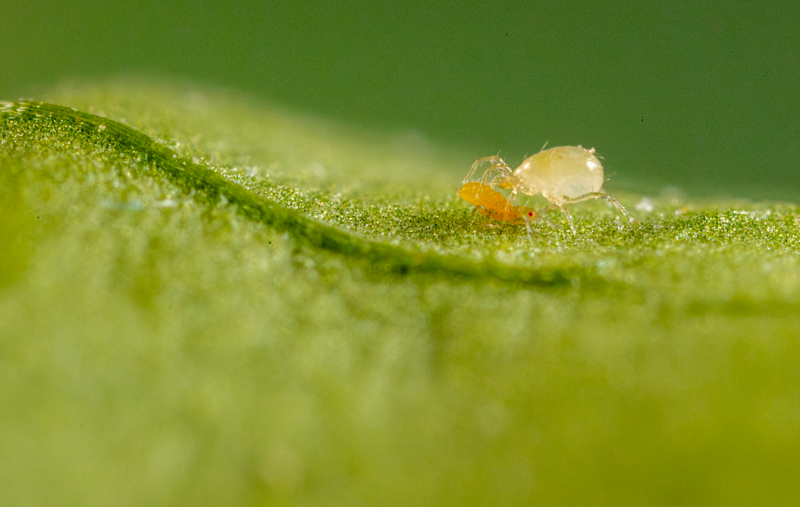
Once again, Koppert’s strong innovation capacity is changing the rules of the game in the biological control of key pests such as thrips and whitefly. Following the outstanding commercial success achieved with Limonica in bottle format, Koppert Spain is now finalising preparations for the imminent launch of the predatory mite Amblydromalus limonicus in the revolutionary Ulti-Mite sachet format.
Limonica Ulti-Mite is a patented innovation by Koppert that combines state-of-the-art slow-release technology with the most effective predatory mite against Thrips parvispinus. The result is an exclusive biological control solution that delivers maximum reliability thanks to the sachet’s technical specifications, which are unique on the market. Made with a 100% industrially compostable outer film, it creates an optimal microclimate for mite reproduction and release, even under challenging conditions. Unlike paper sachets, Limonica Ulti-Mite retains internal humidity and withstands adverse weather conditions, ensuring uninterrupted development of predatory mites inside the sachet.
RELATED NEWS: Fresón de Palos strengthens biological control in partnership with Koppert
The favourable conditions inside the sachet turn the Ulti-Mite format into a true biofactory, from which predatory mites emerge over a period of up to six weeks. The result is a sustained and reliable release of predators, perfectly synchronised to adapt to pest pressure in the crop. In addition, the slow-release system allows the initial mite content of the sachet to multiply by up to four times, making the Ulti-Mite format the most cost-effective solution on the market.
Performance at lower temperatures
Many crops begin their growth cycles during the colder months. Temperature tolerance is often a limiting factor in the use of biological control. A. limonicus maintains its effectiveness at relatively low temperatures compared with other predators. Comparative studies have shown that, below 14°C, Limonica outperforms other predatory mites in egg-laying capacity and predation rates. It will be commercially available in Spain in spring.