








Two of these solutions, Plenexos™ and the Preceon™ Smart Corn System, have already entered commercialisation. In soybeans, Bayer expects Vyconic™ to reach the United States and Canada next year, while Intacta 5+™ is scheduled for introduction in Brazil in the 2027/28 season, subject in both cases to the relevant regulatory approvals.
“We are delivering on our commitments and making a new generation of solutions available to farmers. Integrating innovation in seeds and crop protection allows us to offer more comprehensive solutions that help manage risks, unlock yield potential and improve farm profitability,” said Rodrigo Santos, Member of the Board of Management of Bayer AG and Head of the Crop Science division.
Preceon is already present in Spain
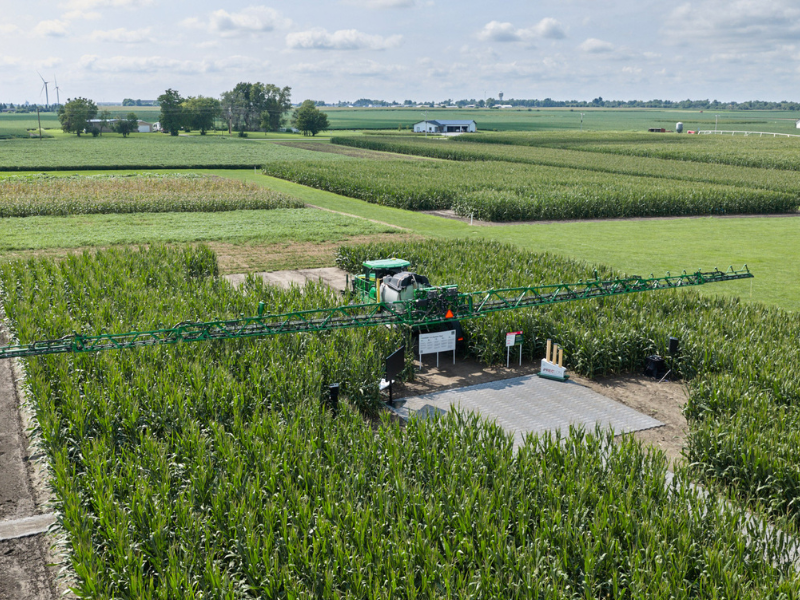
The Preceon™ Smart Corn System, which combines digital tools with short-stature corn, is already being used in Mexico, Italy, Spain and the United States.
Among its agronomic benefits, Bayer highlights greater protection against adverse weather conditions, flexibility to increase planting density, improved access to the crop with conventional farm machinery during the season and a larger root system.
The company aims to expand the technology to 10.5 million hectares by 2035.
Preceon also incorporates the digital capabilities of FieldView™, designed as a collaborative tool for farmers and agronomic advisers to optimise the agronomic and economic potential of the crop.
Plenexos aims to reduce active ingredient use
In crop protection, Plenexos™ has begun commercialisation in Colombia and is expected to subsequently reach Mexico, Brazil and the United States.
The new insecticide is designed to control a broad spectrum of sucking insects, with key target crops including soybeans, cotton, fruit and vegetables.
According to Bayer, based on more than 600 internal and external trials conducted in Brazil between 2021 and 2025, the solution can use up to 75% less active ingredient to control certain pests compared with the reference treatment used in those trials.
Bayer estimates that Plenexos could reach peak sales of €500 million by the mid-2030s.
New technologies for soybean production
Soybeans are another major focus of Bayer’s innovation pipeline.
Vyconic™ is intended to become the industry’s first technology to combine tolerance to five herbicides, giving farmers greater flexibility in weed control and helping them manage increasing resistance pressure.
Intacta 5+™, meanwhile, is being developed for the Brazilian market and will combine tolerance to five herbicides with new insect-protection traits specifically designed for local requirements.
Bayer estimates that these technologies, together with subsequent generations of herbicide-tolerance and insect-protection solutions for soybeans, could collectively exceed €3 billion in peak sales potential.
Other major innovations planned before the end of the decade include a fourth generation of corn rootworm protection and Icafolin, a new herbicide with an innovative mode of action and estimated peak sales potential of €750 million by the mid-2030s.
Genome editing to develop soybeans with greater lodging resistance
Alongside its upcoming launches, Bayer continues to develop its Crop Science R&D pipeline, introducing between 400 and 500 new hybrids and varieties every year.
Part of this work is supported by an AI-powered precision breeding platform. According to the company, the technology can double the rate of yield improvement achieved with each new generation compared with historical breeding methods and accelerate the development of new varieties by up to three times.
Bayer is also introducing genome editing from the early stages of its breeding programmes.
One project focuses on developing soybean varieties with an improved plant architecture to reduce the risk of lodging, when plants bend or fall as their height and yield increase.
New product concepts resulting from this research could reach the market in the early 2030s.
More than 15 new modes of action under research
In crop protection, Bayer is using its AI-powered CropKey platform to identify new modes of action and design molecules in a more targeted way.
The system evaluates efficacy, safety and sustainability from the earliest stages of research and has helped build a pipeline containing more than 15 new modes of action currently under investigation.
RELATED NEWS: Bayer Seminis backs Calidus and Galdius to gain share in cucumber
These include a new broad-spectrum fungicide for soybeans, developed through CropKey and already advanced to Phase II.
The company is also working on its sixth generation of herbicide tolerance, which is expected to include tolerance to Icafolin. For the first time, Bayer is simultaneously developing a new herbicide molecule and a specific tolerance trait in the plant, with the aim of creating an integrated weed-control system combining both technologies.
Hybrid wheat and crops for biofuels
Bayer’s R&D pipeline also extends into new growth areas. The company is developing crops for biofuel production, including camelina, winter canola and CoverCress™, to respond to the expected increase in demand for biodiesel, renewable diesel and sustainable aviation fuel.
Bayer is also progressing with plans to commercialise hybrid wheat in Europe and North America in the early 2030s.
The technology aims to bring the benefits of hybridisation to a crop grown on more than 200 million hectares worldwide.
A growth strategy driven by innovation
Bayer is developing these technologies as part of the five-year strategy announced in 2025, designed to drive growth, strengthen business resilience and improve profitability.
Its main growth drivers include the annual launch of new high-yielding hybrids, faster adoption of new technologies and the expansion of established solutions into markets across Asia and EMEA.
“Our innovation strategy and our five-year plan are built on execution,” Santos concluded. “We are progressing on the commitments we have made and want to continue delivering value to our customers and shareholders through differentiated solutions that address the needs of farmers around the world.”