






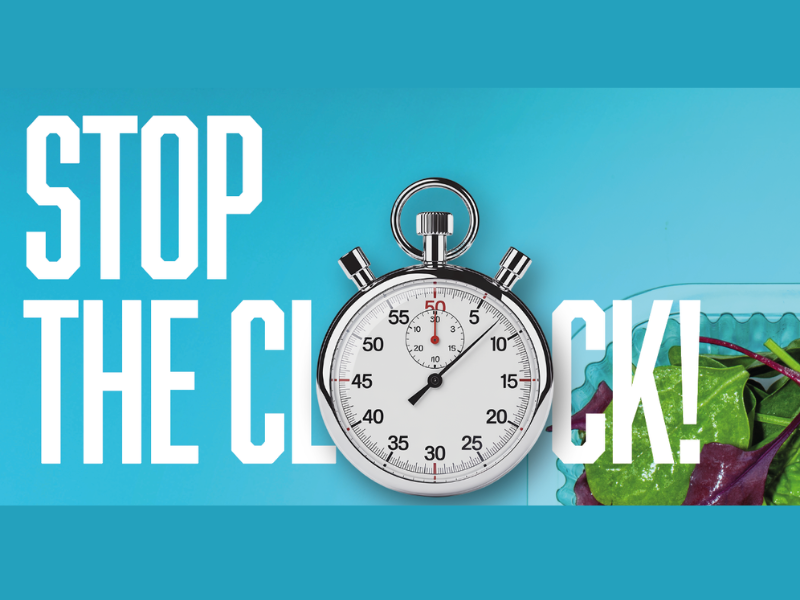
Pro Food, Unionplast and their member companies have joined the “Stop the Clock” campaign, which calls on the European Union to postpone the general application date of the Packaging and Packaging Waste Regulation (PPWR) by at least 24 months.
The Regulation is currently scheduled to apply from 12 August 2026, but more than 500 European companies and associations argue that the framework required for its implementation remains incomplete.
According to Pro Food, businesses are being asked to adapt processes, prepare compliance documentation and plan investments without having access to all the technical criteria, harmonised methodologies, implementing measures and operational guidance they need.
Businesses seek certainty, not weaker environmental targets
The organisations backing the campaign stress that they are not questioning the environmental objectives of the PPWR.
Pro Food supports measures aimed at increasing recycling, expanding the use of secondary raw materials and reducing the environmental impact of packaging throughout its life cycle. However, it believes that applying the Regulation before the full technical framework is available could lead to regulatory uncertainty, unnecessary costs and results that conflict with the goals of the green transition.
Among the issues still unresolved are testing methodologies, criteria for assessing recyclability and the allocation of responsibilities among supply chain operators.
RELATED NEWS: The sector warns of the impact of the PPWR and calls for clear rules
Significant parts of the framework are expected to be defined later through delegated acts, technical standards and interpretative guidance, even though companies will soon be required to certify that their products comply with the Regulation.
“Businesses are not asking for the transition to be halted, but to be able to carry it out on the basis of complete, verifiable rules,” said Mauro Salini, president of Pro Food.
He argued that companies should not be required to issue declarations of conformity, change production processes and commit investment before essential technical elements have been finalised.
Concerns over restrictions on fresh produce packaging
Pro Food also wants the postponement to provide more time to assess the restrictions included in Article 25 and Annex V of the PPWR.
From 1 January 2030, these provisions will affect, among other formats, single-use plastic packaging for fresh, unprocessed fruit and vegetables sold in quantities below 1.5 kilograms, as well as certain packaging used in the HORECA sector.
The association argues that these restrictions were not preceded by a sufficiently detailed comparative impact assessment covering the entire life cycle of the available alternatives.
It maintains that replacing one material with another does not necessarily produce an environmental improvement. Factors such as recyclability, recycled content, transport efficiency, food protection, shelf life and the prevention of food waste should also be considered.
Packaging plays a key role in fresh produce
For the fresh fruit and vegetable industry, packaging performs an essential function throughout post-harvest handling, transport, distribution and storage.
Pro Food points out that some of the plastic formats that could be prohibited already contain levels of post-consumer recycled material above the targets set by the PPWR for 2040.
In its view, banning these solutions solely because of the material used could penalise packaging already aligned with circular economy principles, without proof that the alternatives offer better environmental performance.
Risk of shifting production outside Europe
The organisation also refers to the experience of the Single-Use Plastics Directive, which has prohibited certain disposable plastic products since 2019.
Value of EU imports from China, Turkey and India of substitute products, including paper or cellulose-pulp cups and plates and wooden cutlery, rose from approximately €290 million in 2018 to around €730 million in 2025. The combined value of these imports approached €5 billion over the period.
Pro Food acknowledges that these figures do not constitute a complete impact assessment, but considers them evidence of a potential risk: European-made products may be replaced by imports manufactured under different economic and environmental conditions.
“Before banning a solution, careful consideration needs to be given to what will replace it and under what conditions,” Salini said.
He warned that poorly designed restrictions could shift production, employment and part of the environmental impact outside the European Union, without ensuring that the legislation achieves its intended objectives.
Call for complete and harmonised rules
Pro Food is asking the EU to use the proposed delay to complete the outstanding delegated acts, testing methodologies and technical standards, while clarifying the obligations of each operator in the packaging value chain.
It also wants implementation and enforcement to be harmonised across all Member States, avoiding different interpretations that could fragment the single market.
The association is additionally calling for comparative, performance-based impact assessments before specific packaging formats are banned, as well as equivalent conditions and controls for imported products.
For Pro Food, the objective is not to reduce regulation, but to ensure that the rules are clear, consistent and capable of delivering measurable environmental benefits without undermining the competitiveness of European industry.