







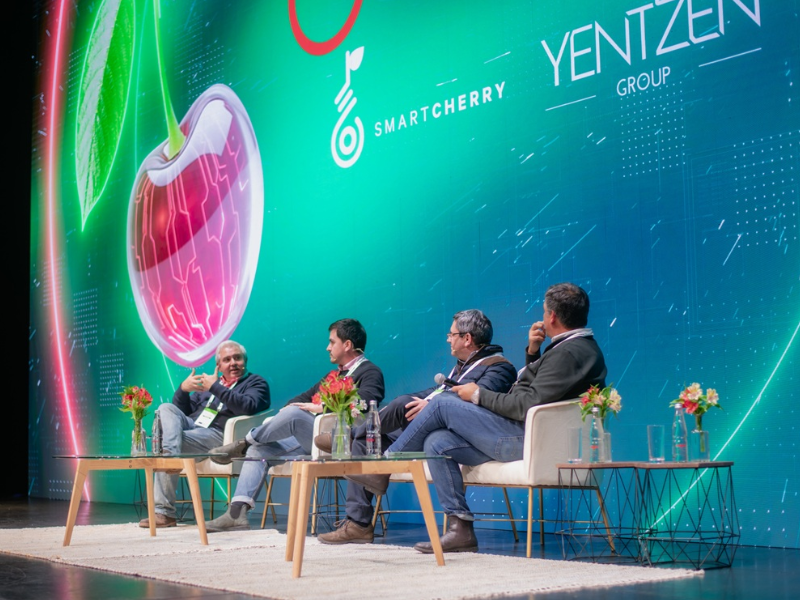
That was one of the central messages delivered at CherryTech 2026, held on 17 June in San Francisco de Mostazal, Chile, where Carlos Tapia, founder and technical director of Avium SpA, analysed the productive, varietal and climatic challenges facing the country’s cherry sector.
According to Tapia, the industry’s next competitive step will depend increasingly on what happens inside the orchard: how growers manage crop load, water, rootstock-variety combinations, fruit size, growth regulators and the early physiological stages that determine final commercial performance.
From export leadership to productive discipline
Chile has consolidated a position of global relevance in fresh cherries. The country accounts for around 71% of world cherry exports and dominates Southern Hemisphere shipments, representing close to 97.3% of the region’s export volume in the 2025/26 season.
This leadership gives Chile a clear commercial advantage, but it also increases pressure on the industry. Any problem in Chile — whether climatic, logistical, productive or commercial — can have an immediate effect on a significant part of global supply.
At the same time, the international cherry calendar is becoming less concentrated. New production areas, warmer regions, low-chill varieties and protected cultivation systems are helping to extend the availability window. This means Chile will have to compete for longer periods and with consumers who may have more alternatives than in the past.
A large planted base, but not all in full production
One of the key figures discussed at CherryTech 2026 was Chile’s planted area. Avium’s technical estimates place the country at around 82,000 hectares of cherry trees, although no more than 70,000 hectares are currently considered to be in full production.
This means that a relevant share of the surface is still entering its productive stage. Tapia estimated that around 13,000 hectares could increase volumes progressively in the coming seasons.
At the same time, part of the least efficient area is expected to leave the system. Around 4,000 to 5,000 hectares could be removed this year, mainly low-yielding orchards, with a possible additional removal of up to 10,000 hectares next season.
However, this does not necessarily imply a proportional reduction in export supply. Many of the orchards likely to be removed are producing below seven or eight tonnes per hectare, while newer orchards entering production may achieve higher yields.
The real issue, therefore, is not only how much land remains planted, but how productive and commercially efficient that land can become.
The industry is still below its productivity target
Chile has improved its average cherry productivity in recent years. Before 2020, average yields were around 6.4 tonnes per hectare. Between 2020 and 2026, that figure rose to approximately 9.5 tonnes per hectare, reaching close to 9.7 tonnes per hectare in the most recent season.
The improvement reflects better technical management, new planting systems, higher-density orchards, more suitable rootstocks and varieties with stronger productive potential.
Even so, Tapia warned that the industry remains below the reference level he considers necessary to compete sustainably: 12 tonnes per hectare.
This gap matters because Chile is operating in a context of rising costs, more demanding markets and tighter returns. Increasing productivity without sacrificing quality will be essential for the sector’s next stage.
The new equation: 12 tonnes, 70% 2J (Doueble Jumbo) + and 85% pack-out
At CherryTech 2026, Tapia proposed a clear technical benchmark for the future of the industry: 12 tonnes per hectare, at least 70% of fruit sized 2J and above, and 85% pack-out.
This equation reflects the need to move beyond yield alone. Producing more fruit is not enough if that fruit does not reach the right size, condition or commercial value.
Based on a large database built by Avium with information from producers, the industry is close to achieving some of these indicators, but still struggles to meet all three at the same time.
In the analysed sample for the 2025/26 season, orchards reached around 10.5 tonnes per hectare, with 69% of fruit sized 2J and above and pack-out close to 85%. In other words, fruit size and pack-out were close to the target, but productivity remained below the desired threshold.
For Tapia, reaching a higher share of 2J+ fruit does not mean eliminating smaller sizes completely, but reducing their weight in the final crop to increase the value generated by each hectare.
Variety and rootstock decisions become more decisive
The presentation also highlighted major differences between the main varieties. Lapins, Santina and Regina remain central to Chile’s cherry production and are expected to continue shaping the industry in the coming years.
Lapins showed strong productive performance in the data analysed, with around 13 tonnes per hectare, 86% pack-out and 75% of fruit sized 2J and above. In combinations with Colt, results were even stronger, with yields close to 14 tonnes per hectare.
Tapia’s analysis suggests that Lapins should not be dismissed because of specific commercial or condition issues in some seasons. The variety still offers productive strength and room for technical improvement.
Santina, on the other hand, continues to be valuable because of its early window, but requires much more precise management. Its shorter cycle means that decisions on crop load, vigour, size and condition must be taken with very little margin for error.
Regina faced a more complex season. Although some orchards reached around 12 tonnes per hectare, the percentage of fruit sized 2J and above was lower than expected. Tapia linked part of this result to the rapid accumulation of heat during spring, which shortened the chronological time available for fruit growth.
Warmer springs may reshape production strategies
One of the most relevant technical discussions at CherryTech 2026 concerned the accumulation of degree-days. The last two seasons have shown values above historical averages at different stages of spring.
When heat accumulates too quickly, varieties reach their thermal requirements in fewer days. The fruit may mature, but the tree has less chronological time to complete key processes such as cell division and cell elongation, both essential for final size.
This is particularly important for late varieties such as Regina, which normally require a longer period between full bloom and harvest.
Tapia was cautious about presenting this as a permanent trend, but he stressed that two consecutive warmer seasons are enough to make growers review their strategies, especially in orchards using rootstocks that bring maturity forward.
Fruit size is built very early
Another key message was that much of the final fruit size is determined shortly after full bloom. Cherry development is divided into three main stages: cell division, stone hardening and cell elongation.
In varieties such as Santina, the first stage is especially short, and the most intense phase of cell division occurs during the first nine to ten days after full bloom.
RELATED NEWS: The role of cherries in Chile’s future challenges
This means that an orchard entering this period with nutritional imbalances, excess crop load, low vigour or water stress may lose part of its size potential very early in the season.
Later interventions can help, but they cannot fully compensate for poor early management.
Water management must move from hours to real volumes
Water was another critical topic. Tapia called for a shift from irrigation programmes based simply on hours to systems managed according to the actual cubic metres of water delivered to the orchard.
Irrigating for a certain number of hours does not guarantee that the crop has received the right amount of water. Pressure changes, emitter performance, pump efficiency and soil conditions can all alter the final volume applied.
More precise irrigation management is especially important in periods when evapotranspiration rises sharply. If growers use last week’s conditions as a reference, the orchard may quickly fall below its real water requirement, affecting both fruit growth and vegetative development.
Growth regulators require technical precision
The use of growth regulators was also discussed as a tool that can support size and condition, but only when used with clear technical objectives.
Tapia differentiated between natural cytokinin promoters and synthetic molecules such as TDZ and CPPU, which should be reserved for specific situations such as high crop load, lower vigour or combinations with a history of size problems.
Timing is critical. In short-cycle varieties, applications need to be concentrated very early after full bloom. Applying products too late or increasing concentrations does not necessarily improve results and can create additional risks.
The same applies to gibberellic acid, commonly used in cherry production. According to Avium’s trials, the most effective timing is at the start of the third growth stage, when cell elongation begins. Excessive concentrations may delay colour development and affect return bloom in the following season.
Chile’s leadership will depend on consistency
The message from CherryTech 2026 was clear: Chile has already demonstrated its ability to lead the world cherry market, but the next stage will be more technical, more demanding and more focused on consistency.
The industry’s future will depend on its capacity to produce fruit that is not only abundant, but also large, firm, well packed and commercially valuable.
Achieving this will require better-balanced orchards, more accurate irrigation, stronger technical monitoring, correct rootstock-variety combinations, early decisions on crop load and responsible use of growth regulators.
For Chilean cherries, the next competitive advantage will not come only from more hectares or more kilos. It will come from the precision with which every orchard is managed.