









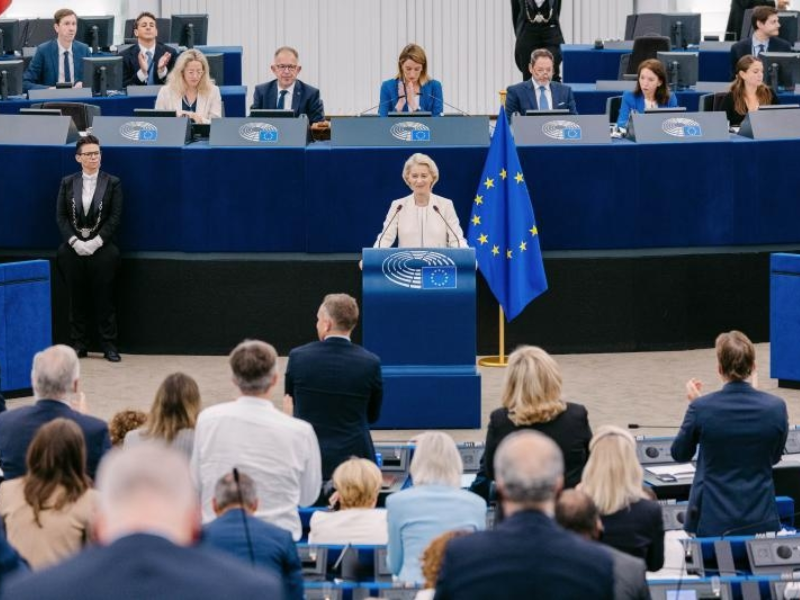
The President of the European Commission, Ursula von der Leyen, highlighted artificial intelligence as one of the main strategic challenges for the European economy during her State of the Union address delivered on 16 September before the European Parliament.
According to Von der Leyen, Europe’s opportunity does not only lie in competing to develop the most advanced AI models, but also in applying this technology to sectors where the EU already has a strong industrial base and access to large volumes of data.
The Commission President specifically referred to precision agriculture and identified five high-value areas where industrial AI could have the greatest impact: healthcare, transport, agri-food, advanced manufacturing, and defence and space.
From the screen to the field
Brussels’ approach is focused on accelerating the integration of artificial intelligence into productive activities and turning it into a tool capable of improving decision-making processes and productivity.
In the agri-food sector, this strategy opens the door to further development of applications linked, among other areas, to precision farming and the use of sector-specific data.
Von der Leyen argued that Europe can capture significant value from this technology by applying it to the economy, even if it does not necessarily lead the development of every frontier AI model.
“The key is to create the value that AI has not yet delivered: bringing AI from the screen into the real economy and society,” she stated during her speech.
New initiatives expected in November
The European Commission is preparing a package of initiatives for November 2026 specifically aimed at these five strategic sectors.
Von der Leyen did not provide details of the measures yet, but announced that the Commission intends to involve Member States, Members of the European Parliament, companies and entrepreneurs in the process.
Brussels also plans to strengthen Europe’s computing capacity and develop new mechanisms to mobilise public and private funding towards European AI-related start-ups and companies.
The initiative comes at a time of rapid growth in business adoption of artificial intelligence technologies.
RELATED NEWS: Artificial Intelligence transforms the retail sector
According to Eurostat, 20% of EU companies with at least ten employees used some form of artificial intelligence technology in 2025, compared with 13.5% one year earlier.
Adoption levels vary significantly depending on company size. In 2025, AI was used by 55% of large companies, 30.4% of medium-sized companies and 17% of small companies.
The challenge for the European Commission will now be extending this adoption to productive sectors where digitalisation can have a direct impact on efficiency, competitiveness and decision-making capacity.
More AI, with safeguards
The expansion of the technology will also be accompanied, according to the Commission President, by measures aimed at managing associated risks.
Von der Leyen highlighted potential challenges linked to the most advanced AI models, particularly regarding cybersecurity, and referred to the EU Artificial Intelligence Act as one of the instruments designed to establish safeguards for the development and use of these technologies.
The strategy promoted by Brussels therefore seeks to combine broader AI adoption across the economy with a framework of security and oversight.
For the agri-food sector, November will be the next key milestone, when the Commission is expected to specify the measures it will introduce to accelerate the use of artificial intelligence in one of the areas it has identified as a priority.