









Maintaining table grape quality from harvest to retail remains one of the main post-harvest challenges for the industry. Long-distance transportation, cold storage, refrigerated logistics and distribution can extend the time between harvest and consumption to several weeks, increasing the risk of quality deterioration.
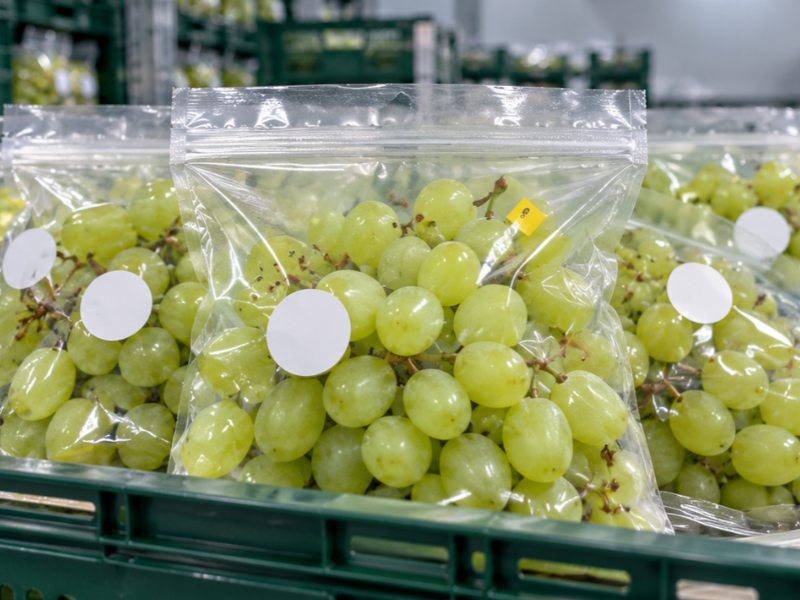
Against this backdrop, Fresh Inset has published a new analysis of its Vidre+® freshness protection technology, reporting that Vidre+ stickers extended the marketable life of table grapes by an average of 4.95 days, equivalent to approximately 35% longer marketable life compared with untreated control samples.
The results are based on nine post-harvest trials conducted in Italy, Greece, Spain and the United Kingdom, involving 38 Vidre+ sticker variants and 354 paired quality comparisons.
Improved rachis and berry preservation
The analysis assessed some of the key quality parameters that determine the commercial value of table grapes, including rachis browning, berry shatter and damage, and decay-related deterioration.
For rachis browning, Vidre+ delayed the development of an equivalent level of deterioration by an average of 5.6 days (+35%) compared with control samples. Maintaining a green, fresh-looking rachis for longer is particularly relevant from a commercial perspective, as stem appearance is one of the main visual indicators of freshness for consumers.
The strongest calculated improvement was recorded for berry shatter and damage. According to the analysis, grapes treated with Vidre+ stickers took an average of 10.5 additional days (+65%) to reach an equivalent level of deterioration.
Berry shatter can occur during handling and transportation and can affect the overall appearance of bunches at retail. Greater berry integrity could therefore be particularly relevant for operators managing long and complex supply chains.
Regarding decay-related deterioration, the trials showed an average extension of 4.8 days (+28%) before reaching an equivalent level of deterioration to the control samples. The parameters assessed included deterioration associated with Botrytis cinerea and Mucor species.
A 1-MCP-based freshness technology
Vidre+ is a freshness protection technology that expands the possibilities for applying 1-MCP, a compound used in post-harvest management to control the effects of ethylene.
According to Fresh Inset, one of its main features is that it can be incorporated directly into different packaging formats as a sticker, label or imprint, compared with other 1-MCP application systems that may require dedicated infrastructure or controlled treatment environments.
The technology is designed to be integrated at different stages of the fresh produce supply chain, from grower operations and packinghouses to retail packaging.
Trials covering different varieties and packaging formats
The trial programme included several commercially important table grape varieties, including Italia, Soultanina, Aledo, Dominga and Sweet Celebration.
The tests were conducted under different post-harvest conditions, with variations in storage periods and temperatures as well as packaging formats. Grapes were assessed in standard boxes, with intact and perforated films, and in retail flow-wrapped punnets.
This range of conditions is relevant because post-harvest quality is influenced by more than variety alone. Packaging, storage duration, temperature management and distribution conditions can all affect the rate at which fruit deteriorates.
Although the trials were conducted in Europe, Fresh Inset considers the findings potentially relevant to other major table grape-producing and exporting countries, including Peru, Chile, South Africa and India, where supply chains to international markets can also involve long transportation and distribution periods.
Five additional days of commercial flexibility
Ideal for growers and exporters, a longer marketable window could provide greater flexibility when managing harvesting schedules, cold storage and international shipments, particularly when delays occur or deliveries need to be coordinated across different markets.
For packinghouses, improved berry integrity and delayed rachis browning could help maintain commercial quality during handling, storage and distribution.
RELATED NEWS: LUV Fiera: the future of table grapes takes shape with the debut of IVC 235
For retailers, preserving external appearance for longer is particularly important in a category where consumers assess freshness visually through rachis colour, berry condition and the overall appearance of the bunch.
A longer marketable life could also create opportunities to reduce rejections and markdowns, although extending marketable life does not automatically translate into lower food waste.
An average 35% extension in marketable life
Fresh Inset reports an overall relative improvement of approximately 35%, although it notes that different calculation methods produced figures ranging from 33% to 40%.
Overall, the analysis indicates that Vidre+ treated table grapes maintained comparable marketable quality for approximately five additional days compared with control samples.
For an industry facing increasingly long supply chains and demanding quality requirements at destination, this additional time could provide greater flexibility across post-harvest operations and international table grape marketing.