




Packaging for fresh fruit and vegetables is undergoing a profound transformation. New sustainability requirements, increased focus on reducing food waste and the growing complexity of international supply chains are reshaping its role. Packaging can no longer be seen simply as a container, but as a strategic tool to protect the product, extend shelf life and enhance its value at the point of sale.
For ILIP, this evolution is structured around three pillars: sustainability, innovation and adaptability to customer needs. “Each package must be ‘fit for purpose’: designed to effectively meet the specific application for which it is intended, without excess, but without compromising performance.”
One of the key challenges is resource optimisation. Reducing raw material usage is a priority, but in the fruit and vegetable sector this must always be balanced with requirements for protection, hygiene, strength and product preservation.
For this reason, ILIP has been working for years on downgauging and eco-design. As early as 2010, with the EcoDesign-Reduce project, the company achieved an average reduction in packaging weight of 18.5%, while maintaining performance.
Circularity and recycled materials
Another fundamental pillar is circularity. Thanks to its integration within the ILPA Group, ILIP is part of a recycled PET chain that enables the development of the T2T R-PET® model, transforming post-consumer trays and punnets into new food-contact packaging.
This approach reduces the use of virgin raw materials and achieves a certified recycled content of 81%, while ensuring quality, safety and traceability.
Protection and waste reduction
In fresh produce, the protective function of packaging is essential. This is particularly evident in small fruits, where impacts, moisture and handling can significantly affect quality.
To address this, ILIP has developed AirWave, a range of R-PET punnets for berries and delicate fruit, featuring a specially designed convex base that absorbs impacts and eliminates the need for absorbent pads or bubble pads.
The packaging is mono-material, facilitating optimal end-of-life management, while contributing to product protection and waste reduction.
Alternative materials and hybrid solutions
Alongside R-PET solutions, ILIP is expanding its portfolio with alternative materials and hybrid solutions.
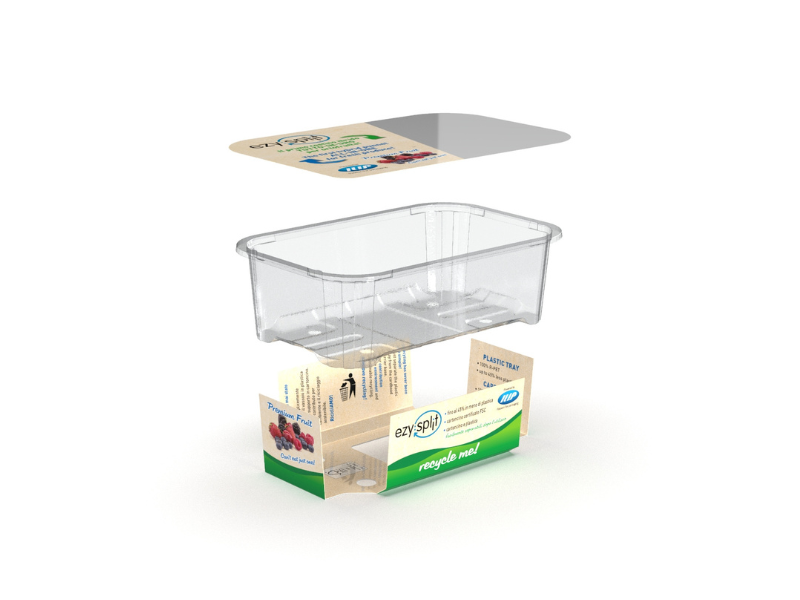
Ezy:Split combines a lightweight R-PET punnet—reduced by up to approximately 45%—with a cardboard support, while maintaining the possibility of easily separating both materials at the end of their life cycle.
Customisation and customer adaptation
Another increasingly important requirement is customisation. Producers, packers and retailers are looking for solutions capable of adapting to different formats, automated lines, markets and branding strategies.
RELATED NEWS: ILIP showcases integrated solutions at Macfrut
For this reason, ILIP has invested in the SPRINT project, focused on developing tailor-made products that support customers from initial needs assessment through to the implementation of the most suitable solution.
Regulatory framework and future challenges
The European PPWR will push the sector towards more recyclable, lighter packaging with a growing proportion of recycled content. The challenge will be to translate these requirements into concrete, industrially viable and truly effective solutions across the entire value chain.
For ILIP, the packaging of the future must be sustainable, circular and intelligently designed: not “less packaging”, but better packaging—capable of reducing environmental impact, protecting the product and creating value.